


Extensions for Damaged Hair: Safe Choices That Work
Extensions can be safe for damaged or fragile hair — but only when you choose the right method and start with an honest assessment of your hair’s current condition. For most people with some degree of damage, low-tension options like the Top~Lock V-Part Topper, clip-ins, or U-part pieces are the safest first step. When hair passes a basic strength assessment, carefully fitted nano bead or micro bead systems can also work well. Fusion or keratin bond methods on genuinely fragile hair carry real risk and should wait until your natural hair has rebuilt some strength.
Before you do anything else:
- Do a quick strand test at home (see Section 3 below) and note how many red flags you find.
- If two or more severe signs are present, book an in-salon consultation before purchasing anything.
- Do NOT apply semi-permanent bonded extensions to hair that is actively breaking or shedding.
- Do choose a topper or clip-in option as a low-risk bridge while you treat and strengthen.
- Do ask your stylist specifically about weight distribution and attachment tension, not just color match.
- Do not skip maintenance appointments — missed visits are one of the top causes of extension-related damage.
Table of Contents
- Do hair extensions damage hair?
- Can you get extensions with damaged hair?
- Which extension types work best for damaged or fine hair?
- What should a professional stylist do for fragile hair?
- How do you care for extensions when your natural hair is fragile?
- What treatments help damaged hair recover, and how long does it take?
- What are the best short-term alternatives while your hair heals?
- Key Takeaways
- Why gentle solutions always come first
- Ready to find the right solution for your hair?
- Useful sources and further reading
- FAQ
Do hair extensions damage hair?
Extensions don’t automatically damage hair. The real question is whether your hair, in its current state, can handle the method you’re considering. Professional guidance consistently warns that applying semi-permanent adhesive or heat-bond methods to already weakened hair compounds existing damage rather than concealing it.
The primary causes of extension-related harm fall into a few clear categories. Pre-existing fragility is the biggest factor — hair that is already thinning, over-processed, or breaking has less tensile strength to absorb the added weight and attachment pressure. Traction from heavy wefts or tight bonds pulls on the follicle over time, which can cause traction alopecia if left unchecked. Chemical and heat stress from fusion or keratin bond application adds another layer of risk on top of whatever damage is already present. Poor installation technique, such as placing bonds too close to the root or using too much hair per attachment point, concentrates load in a small area. Skipped maintenance appointments allow bonds to migrate and tangle, creating matting that tears natural hair on removal.
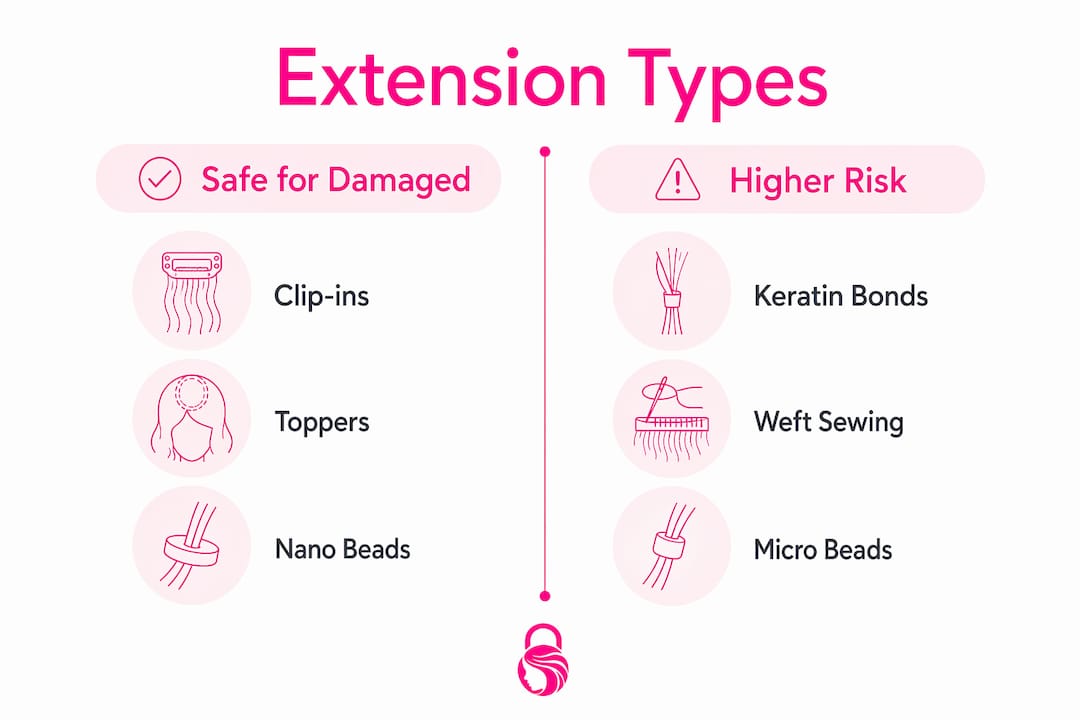
Clip-ins and halo-style extensions sit at the opposite end of the risk spectrum. They are removable daily, require no adhesive or heat, and let you check your scalp regularly. Nano bead and micro bead systems distribute load across many small attachment points and, when installed conservatively, can be a lower-tension semi-permanent option. Weft extensions sewn onto a braid base avoid chemical bonds but do create some scalp tension depending on how tightly the base is constructed. Keratin bond and fusion methods use heat during application and removal, making them the highest-risk category for fragile hair.
Pro Tip: The single biggest predictor of extension-related harm is the starting strength of your natural hair, not the brand of extension you choose. A premium product applied to severely compromised hair will still cause damage.
Can you get extensions with damaged hair?
Yes — but the answer depends on the severity of your damage, not just your desire for length or volume. Use this checklist to assess where you stand before booking an appointment.
Home assessment: four steps to check your hair’s readiness
- Strand test. Pull a single strand from the middle of your head and stretch it gently. Healthy hair stretches slightly before snapping. Hair that breaks with almost no tension, or that stretches and doesn’t spring back, is in a weakened state.
- Pull test. Run your fingers through a small section from root to tip. Losing more than a few strands with light pressure suggests active shedding or breakage that needs to be addressed first.
- Visual inspection. Look at your ends and mid-lengths in natural light. Significant split ends, visible thinning at the crown, or patches of breakage are moderate-to-severe signs.
- Chemical and heat history. Note any bleaching, relaxing, perming, or heavy heat styling in the past three months. Recent chemical processing weakens the hair shaft and raises the risk of bond-related damage.
Severity scale
- Mild: Some split ends, minor dryness, no active breakage. Most extension types are suitable with proper installation.
- Moderate: Noticeable breakage, some thinning, recent chemical treatment. Stick to toppers, clip-ins, or conservatively fitted nano bead systems. Delay fusion or keratin bonds.
- Severe: Active shedding, scalp sensitivity, significant thinning patches, or hair that snaps easily. Delay all semi-permanent extensions. Focus on treatment and use toppers or clip-ins only.
Semi-permanent adhesive or heat-bond methods should not be applied to weakened hair without strengthening treatments first. When in doubt, bring these four questions to your consultation: What is my scalp condition right now? Have I had any chemical treatments recently? How long do I want these extensions to last? Am I able to commit to regular maintenance visits?
Which extension types work best for damaged or fine hair?
Toppers and temporary clip or U-part solutions come first. Low-tension nano bead or micro bead fits are the next step when hair passes the assessment above. Fusion and thermal bonds should wait until hair has rebuilt meaningful strength.
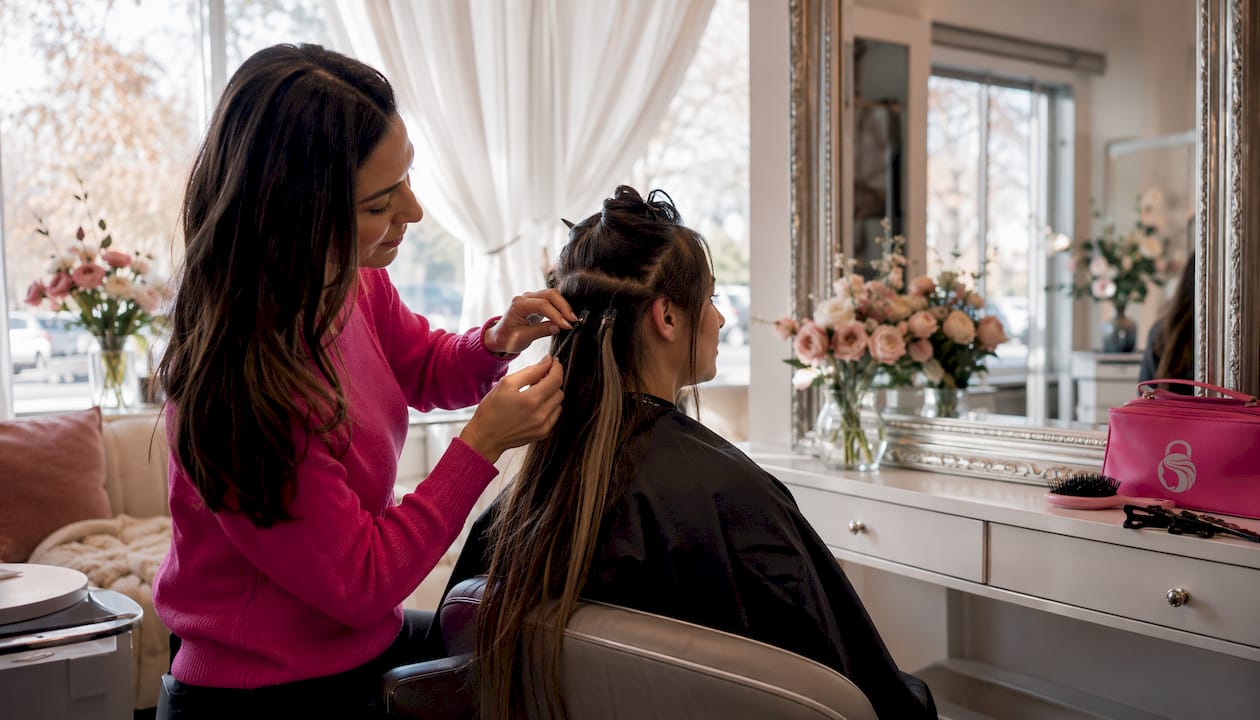
Your options, matched to hair condition
Top~Lock V-Part Topper shifts weight away from weakened roots and creates coverage without full-head attachment. Because it clips onto a small section at the crown rather than bonding along the entire scalp, it avoids the high root tension that causes traction damage. Hairlockshairextensions’s exclusive Top~Lock V-Part Topper is made from 100% human hair and is particularly well suited to diffuse thinning or fragile hair at the crown.
Clip-ins and U-part pieces are the least damaging option for fine or thinning hair because they are removed daily and require no adhesive or heat. They are ideal for event use or as a holding strategy while you treat and strengthen your natural hair. Hairlockshairextensions carries a range of U-part clip-in extensions in 100% human hair.
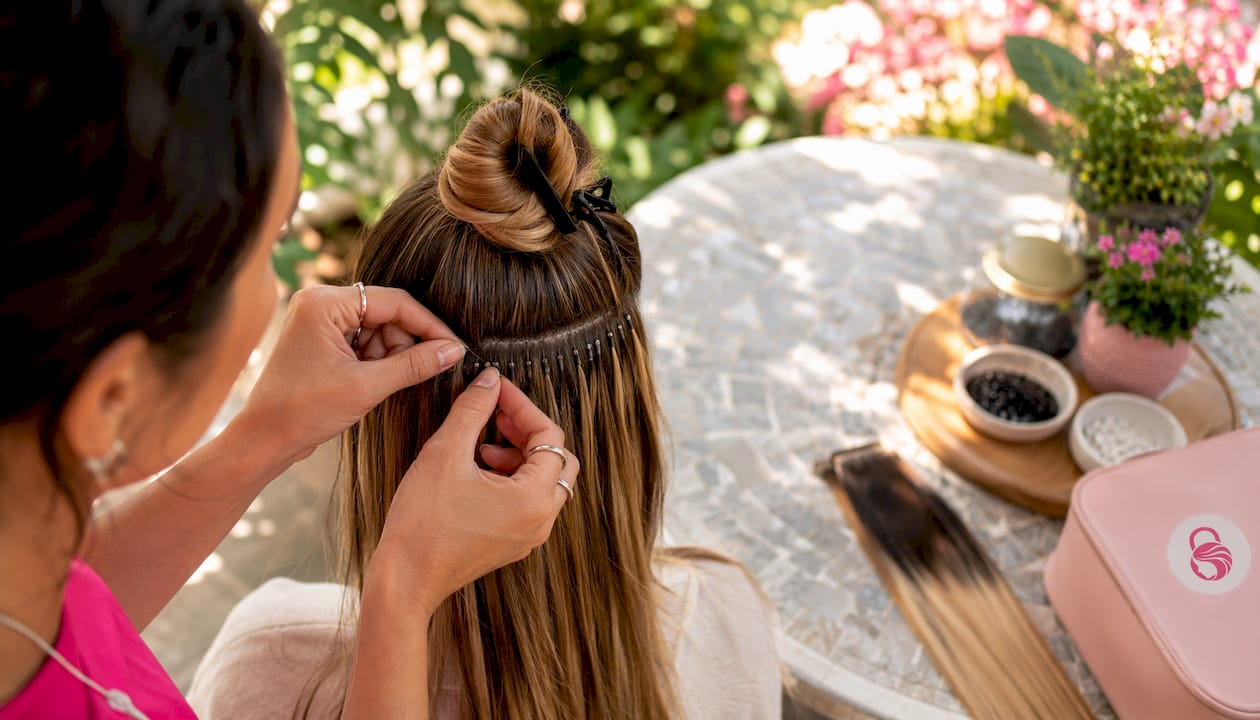
Nano bead extensions distribute hair load across many micro attachment points. When installed conservatively with low hair-per-bead ratios, they can be a viable semi-permanent option for hair that has passed the assessment above. Regular moves and adjustments are non-negotiable for fragile scalps.
Micro bead extensions work on a similar principle to nano beads but use a slightly larger bead. They suit hair that is fine but not severely compromised, and they avoid heat and adhesive entirely. Hairlockshairextensions offers micro bead extensions as part of its application range.
Weft extensions are sewn onto a braid base, which avoids chemical bonds but does create some scalp tension. They work best when hair is at least in the mild-to-moderate range and when the braid base is not pulled too tightly.
Keratin bond extensions use a heat tool to melt a soft keratin bond close to the root. On healthy hair, this is a durable and natural-looking method. On fragile hair, the heat application and removal process adds stress that most weakened strands cannot absorb well.
| Extension type | Suitability for fragile hair | Damage risk | Maintenance frequency | Lifespan | Cost shape |
|---|---|---|---|---|---|
| V-Part Topper | Excellent — no root tension | Very low | Daily removal; clip check monthly | Months to years with care | Mid-to-high purchase; low ongoing |
| Clip-ins / U-part | Excellent — fully removable | Very low | Daily removal; weekly condition | Months if not worn daily | Low-to-mid purchase |
| Nano bead | Good when hair passes assessment | Low-medium | Salon move every 6–8 weeks | 3–4 months per set | Mid-to-high installation |
| Micro bead | Good for fine but not severe damage | Low-medium | Salon move every 6–8 weeks | 3–4 months per set | Mid installation |
| Weft (sewn) | Moderate — depends on braid tension | Medium | Salon check every 4–6 weeks | 2–3 months | Mid installation |
| Keratin bond | Low for fragile hair; better for healthy | Medium-high | Salon removal/reapplication | 3–6 months | Higher installation |
What should a professional stylist do for fragile hair?
A responsible stylist tailors the attachment method to your hair’s current condition, minimizes tension at the root, and preserves your natural hair throughout the installation process. If a stylist skips the assessment phase and moves straight to application, that is a red flag.
What a careful installation looks like
- Scalp and strand examination before any product is opened — checking for sensitivity, active breakage, or scalp conditions that contraindicate certain methods.
- Small test area or patch test to confirm the attachment method suits your hair before committing to a full head.
- Weight distribution planning — spreading attachment points evenly so no single section carries disproportionate load.
- Avoiding adhesive or heat bonds on visibly weakened roots — a skilled stylist will redirect to a bead or clip method if roots look fragile.
- Topper placement assessment for clients with crown thinning, confirming the clip base sits on hair dense enough to support it.
Red flags to watch for
- Tight installs that cause immediate scalp tension or pain.
- Adhesive applied directly to roots that are visibly breaking.
- No patch test or trial section offered before full application.
- A stylist who dismisses your concerns about hair condition without examining your scalp.
Typical service timeline
- Consultation: Scalp and strand assessment, method selection, color matching.
- Patch/test area: 24–48 hours before full installation for new clients.
- Installation: Full application session, length varies by method.
- First maintenance visit: 4–6 weeks post-installation for bead systems; 6–8 weeks for wefts; ongoing daily removal for toppers and clip-ins.
Hairlockshairextensions’s professional installation guidance reflects this careful, step-by-step approach, with founder Michele’s 30 years of experience informing every assessment protocol.
How do you care for extensions when your natural hair is fragile?
Lower tension, gentle grooming, and regular salon checks keep fragile hair safe with extensions in place. Skipping any one of these three habits is where most extension-related damage begins.
Daily routine
- Brush from ends to roots using a soft-bristle or loop brush. Never start at the root and drag downward — this tears natural hair against the attachment points.
- Apply a light leave-in detangler to dry hair before brushing, especially at the nape and behind the ears where tangling concentrates.
- Avoid heavy oils or conditioners on bond or tape areas. Product buildup on bonds causes slippage and, on removal, pulls natural hair. Keep moisturizing products on mid-lengths and ends only.
- Sleep with hair in a loose braid or satin-lined scrunchie. Friction against a cotton pillowcase accelerates tangling and stresses attachment points overnight.
- Never go to bed with wet extensions. Wet hair is weaker and more prone to matting, especially around bead or bond areas.
Weekly and monthly maintenance
- Wash with a sulfate-free shampoo, working in a downward motion rather than scrubbing at the roots.
- Apply a lightweight conditioning mask to mid-lengths and ends once a week; avoid the bond zone.
- Book a salon check every 4–8 weeks depending on your method (see the timeline in the previous section) to have bonds moved, beads re-clamped, or wefts checked for loosening.
- If you notice slippage, pain, or unusual shedding between appointments, contact your stylist immediately rather than waiting for the scheduled visit.
Pro Tip: For repairing the extensions themselves, the LOC method (Liquid, Oil, Cream applied in sequence) can restore moisture to human hair wefts and reduce tangling — but keep oil away from any bonded or taped attachment areas.
What treatments help damaged hair recover, and how long does it take?
Many damaged hair issues improve meaningfully with targeted treatments, and most clients with mild-to-moderate damage can reconsider semi-permanent extensions within two to four months of consistent care.
Treatment options
- Deep conditioning masks (used weekly) restore moisture and flexibility to dry, brittle strands. Look for ingredients like hydrolyzed keratin, panthenol, or shea butter.
- Protein treatments rebuild the hair shaft’s structural integrity. Use monthly rather than weekly — over-proteining can make hair stiff and more prone to snapping.
- Bond builders (such as Olaplex or similar in-salon systems) work at a molecular level to reconnect broken disulfide bonds caused by bleach or chemical processing.
- Scalp treatments address the root environment, improving circulation and reducing inflammation that can slow regrowth.
- Hot oil treatments penetrate the cuticle and are particularly effective for restoring moisture to wefts and extensions themselves, as well as natural hair.
Recovery timeline
| Treatment | Visible improvement window | Recommended wait before semi-permanent extensions |
|---|---|---|
| Deep conditioning (weekly) | 3–4 weeks | 6–8 weeks of consistent use |
| Protein treatment (monthly) | 4–6 weeks | 2–3 months |
| Bond builder (in-salon) | 2–4 weeks | 4–6 weeks post-treatment |
| Scalp treatment course | 6 weeks | Reassess at 3 months |
If you are experiencing sudden, diffuse shedding, patches of hair loss, or scalp tenderness that does not resolve with standard care, consult a trichologist or dermatologist before pursuing any extension method. These can be signs of conditions such as scarring alopecia that require medical attention first.
What are the best short-term alternatives while your hair heals?
Use toppers, volumizing hairpieces, clip-in fringe, lightweight ponytails, or professional styling to conceal damage while you rebuild strength. None of these options require adhesive or heat, and all can be removed daily.
- V-Part Topper: Best for diffuse thinning at the crown. Clips onto a small section, adds volume and length without touching the perimeter, and can be color-matched to your natural hair. Hairlockshairextensions’s Top~Lock is a strong choice here.
- Clip-in extensions: Ideal for event use or days when you want more volume. Apply only to sections with adequate density to hold the clip, and remove before sleeping.
- Lightweight wraparound ponytail: A wraparound ponytail extension wraps around your natural ponytail with no clips or glue, adding length and thickness without causing any root tension. Hairlockshairextensions carries these in 100% human hair.
- U-part piece: Covers the top section of the head and blends with your natural hair pulled through the opening. Good for moderate thinning across the crown and mid-section.
- Instaglam 3/4 piece: A partial hairpiece that adds volume to the back and sides without covering the front hairline, useful when damage is concentrated at the ends rather than the roots.
When choosing any non-permanent option, prioritize weight. A lighter piece with fewer grams of hair puts less stress on fragile roots than a heavy, full-length set. Place clips on the densest sections of your natural hair, and always remove the piece before bed.
Key Takeaways
For damaged or fragile hair, the safest path to extensions starts with an honest assessment, a low-tension method, and a professional who examines your scalp before touching a single bond.
| Point | Details |
|---|---|
| Assess before you apply | Use the strand test, pull test, and chemical history check — delay semi-permanent extensions if two or more severe signs are present. |
| Start with toppers or clip-ins | V-Part toppers and clip-in or U-part pieces carry the lowest damage risk and can be removed daily for scalp checks. |
| Choose bead systems carefully | Nano bead and micro bead extensions can work for fine but not severely damaged hair when installed conservatively with regular salon moves. |
| Maintain gently and consistently | Brush ends-to-roots, keep products off bond areas, sleep with hair protected, and never skip scheduled maintenance visits. |
| Hairlockshairextensions for fragile hair | Hairlockshairextensions offers the Top~Lock V-Part Topper, nano bead, micro bead, and weft options alongside personalized consultations for damaged or fragile hair in Australia. |
Why gentle solutions always come first
The instinct to reach for the longest, fullest extension set is understandable. But after years of working with clients whose hair has been compromised by bleach, heat, or previous extensions, the pattern is consistent: the clients who get the best long-term results are the ones who started with a topper or clip-in, gave their natural hair time to recover, and then graduated to a semi-permanent method when their hair was genuinely ready.
What most articles don’t say clearly enough is that a beautiful result and a safe result are not in tension with each other. A well-fitted Top~Lock V-Part Topper on someone with crown thinning looks every bit as natural as a full set of nano beads, and it carries a fraction of the risk. The clients who skip the assessment phase and go straight to fusion bonds on fragile hair are the ones who end up needing six months of recovery before they can wear extensions again.
Regular check-ins matter more than most clients expect. A bond that feels fine at week four can be causing traction by week eight if it has migrated toward the root. Catching that early, at a scheduled maintenance visit, is the difference between a minor adjustment and a genuine setback. The aftercare plan is not optional — it is the other half of the service.
Ready to find the right solution for your hair?
Hairlockshairextensions specializes in exactly this situation: clients with fragile, fine, or damaged hair who want real results without compromising what they have left. Rather than a one-size-fits-all approach, every consultation with founder Michele begins with a thorough scalp and strand assessment, so the method chosen is matched to your hair’s actual condition right now.
Whether you need the Top~Lock V-Part Topper for crown coverage, a low-tension nano or micro bead fit, or simply a professional opinion on where your hair stands, Hairlockshairextensions has the full range of application methods to match your needs. Browse the before and after gallery to see real client outcomes, including transformations for thinning and damaged hair. When you’re ready, visit hairlockshairextensions.com.au to book your consultation or explore pricing and availability.
Useful sources and further reading
- How to Fix Damaged Hair From Extensions — Wella Professional Australia’s guide to identifying and addressing extension-related damage, including practical repair steps and professional treatment options.
- Before and After: Extensions for Hair Damage Repair — An Australian salon perspective on using extensions as part of a damage repair strategy, with before and after examples.
- 6 Best Hair Extensions 2025 — Allure — Editorial roundup covering the least damaging extension types and typical lifespan windows for each method.
- 3 Simple Ways to Repair Hair Extensions — wikiHow — Step-by-step at-home repair methods including hot oil treatments, the LOC method, and cautions for bonded areas.
- How to Repair Damaged Hair Extensions — Practical guide to the LOC method and hot-water reconditioning for human hair wefts.
- Care Sheet: Permanent Hair Extensions — Hairlockshairextensions — Hairlockshairextensions’s own in-salon care guide covering maintenance schedules, product recommendations, and aftercare for bonded and wefted extensions.
- Before and After Gallery — Hairlockshairextensions — Client transformation gallery showing outcomes for thinning and damaged hair, including topper and low-tension extension results.
- Top~Lock V-Part Topper — Hairlockshairextensions — Product and application guide for the Top~Lock V-Part Topper, the recommended first step for crown thinning and fragile hair.
- Application Hair Extensions — Hairlockshairextensions — Overview of all application methods available at Hairlockshairextensions, including nano bead, micro bead, weft, keratin bond, and topper options.
FAQ
What hair extensions are best for damaged hair?
Toppers, clip-ins, and U-part pieces are the safest starting point because they require no adhesive or heat and can be removed daily. For hair that passes a basic strength assessment, nano bead or micro bead systems installed conservatively are a good low-tension semi-permanent option.
Can I get hair extensions with damaged hair?
Yes, in many cases, but the method matters. Clip-ins, toppers, and halo-style pieces are suitable for most damage levels; semi-permanent bonded methods should be delayed until hair has been strengthened with targeted treatments.
What are the best extensions for fine, damaged hair?
Lightweight clip-ins, V-Part toppers, and conservatively fitted nano bead extensions are consistently recommended for fine or thinning hair because they distribute weight across many small points and avoid concentrated root tension.
What is the best treatment for extremely damaged hair before extensions?
A combination of weekly deep conditioning masks, monthly protein treatments, and in-salon bond-building treatments typically produces visible improvement within four to six weeks. Most stylists recommend two to three months of consistent treatment before applying any semi-permanent extension method.
Recommended
- Professional Hair Extensions Gold Coast: The Ultimate Guide to Luxury – HairLocks Hair Extensions
- Before and After Hair Extensions Gallery - HairLocks – HairLocks Hair Extensions
- How to Make Hair Extensions Look Natural: The Professional Blending Gu – HairLocks Hair Extensions
- CARE SHEET – HairLocks Hair Extensions