

Hair Extensions for Alopecia: Safe Solutions That Work
For women in Australia dealing with alopecia or thinning hair, the right extensions or topper can restore natural-looking volume without putting fragile strands at further risk. The most effective options include lightweight clip-in and halo extensions for minimal scalp stress, micro bead and nano bead extensions for semi-permanent volume, weft and keratin bond extensions for fuller coverage, and the Top~Lock V-Part Topper for targeted crown coverage. Hairlockshairextensions offers all of these, backed by founder Michele’s 30 years of professional experience and personalized consultations tailored to each client’s hair loss pattern.
Here is what each solution does:
- Clip-in and halo extensions add temporary volume and length with zero chemical bonding, making them the gentlest starting point for sensitive scalps.
- Micro bead and nano bead extensions attach strand by strand without heat or adhesive, distributing weight evenly across the scalp.
- Weft extensions are sewn or bonded in rows, offering fuller coverage suited to moderate thinning.
- Keratin bond extensions fuse individual strands for a seamless, long-lasting result.
- Top~Lock V-Part Topper sits directly over the crown, blending with your natural hair to cover thinning patches discreetly.
Professional consultation is non-negotiable here. The wrong method on compromised hair can accelerate loss rather than conceal it.
Table of Contents
- What does hair thinning from alopecia actually look like?
- What are the pros and cons of extensions for thinning hair?
- How do crown hair toppers work, and which type suits you?
- What does hair topper and extension pricing look like in Australia?
- How do hair toppers help women with thinning hair day to day?
- How do you care for extensions and toppers to make them last?
- What do real client results look like with Hairlockshairextensions?
- Which extension type suits your specific alopecia pattern?
- What happens during a hair extension consultation?
- Human hair vs. synthetic: which is better for alopecia?
- What are the long-term effects of extensions on a fragile scalp?
- Hairlockshairextensions: expert care for women with thinning hair
- Key Takeaways
- FAQ
What does hair thinning from alopecia actually look like?
Alopecia is not one condition. Alopecia areata causes patchy, often circular bald spots that can appear suddenly anywhere on the scalp. Androgenetic alopecia, the most common type in women, produces a gradual widening part and diffuse thinning concentrated at the crown. Traction alopecia results from years of tight hairstyles pulling at the hairline and temples.
Each pattern affects extension suitability differently. Crown-focused thinning calls for a topper rather than length extensions. Patchy loss requires precise placement to avoid attaching extensions to areas with insufficient anchor hair. Diffuse thinning across the entire scalp demands the lightest possible attachment method to avoid stressing already-weakened follicles.
Scalp sensitivity often accompanies active alopecia, so any adhesive, heat, or mechanical pressure needs careful assessment before application.
What are the pros and cons of extensions for thinning hair?
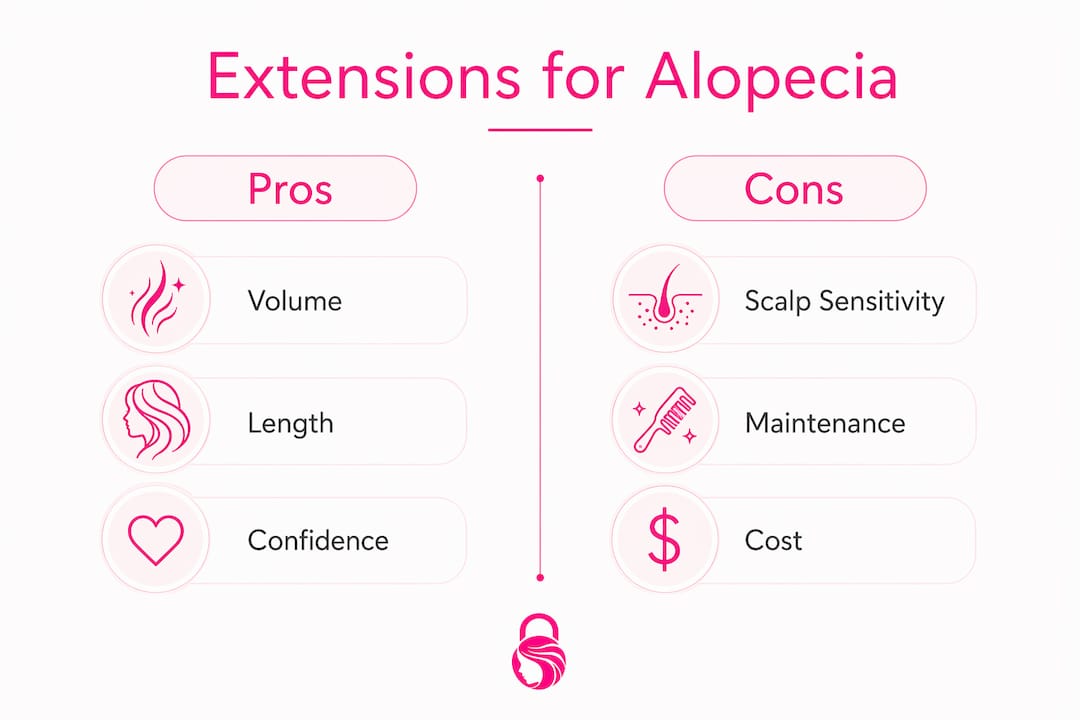
The benefits are real and well-documented. Lightweight extensions restore volume and length almost instantly, and the psychological lift that comes with a full head of hair is significant for women managing the emotional weight of hair loss. Clip-ins and halo styles require no commitment and cause no scalp contact stress. Micro bead and nano bead methods distribute attachment points widely, reducing pressure on any single follicle.
The risks are equally real. Heavy extensions applied without professional guidance can cause traction alopecia on top of existing loss. Adhesive-based methods may irritate a sensitive scalp. Improper weight distribution pulls at weakened roots and can worsen thinning over time.
The safest path through these trade-offs:
- Choose the lightest method your hair density can support.
- Always have a professional assess your scalp before committing to semi-permanent attachment.
- Avoid clip-ins placed directly over active bald patches where there is no hair to anchor them.
- Schedule regular check-ins to monitor scalp health and adjust placement as your hair changes.
How do crown hair toppers work, and which type suits you?
A hair topper is not an extension. It sits on top of the crown, covering thinning areas while blending with the hair around it. Extensions add length and volume along the hair shaft; toppers add density at the root zone where alopecia most visibly strikes.
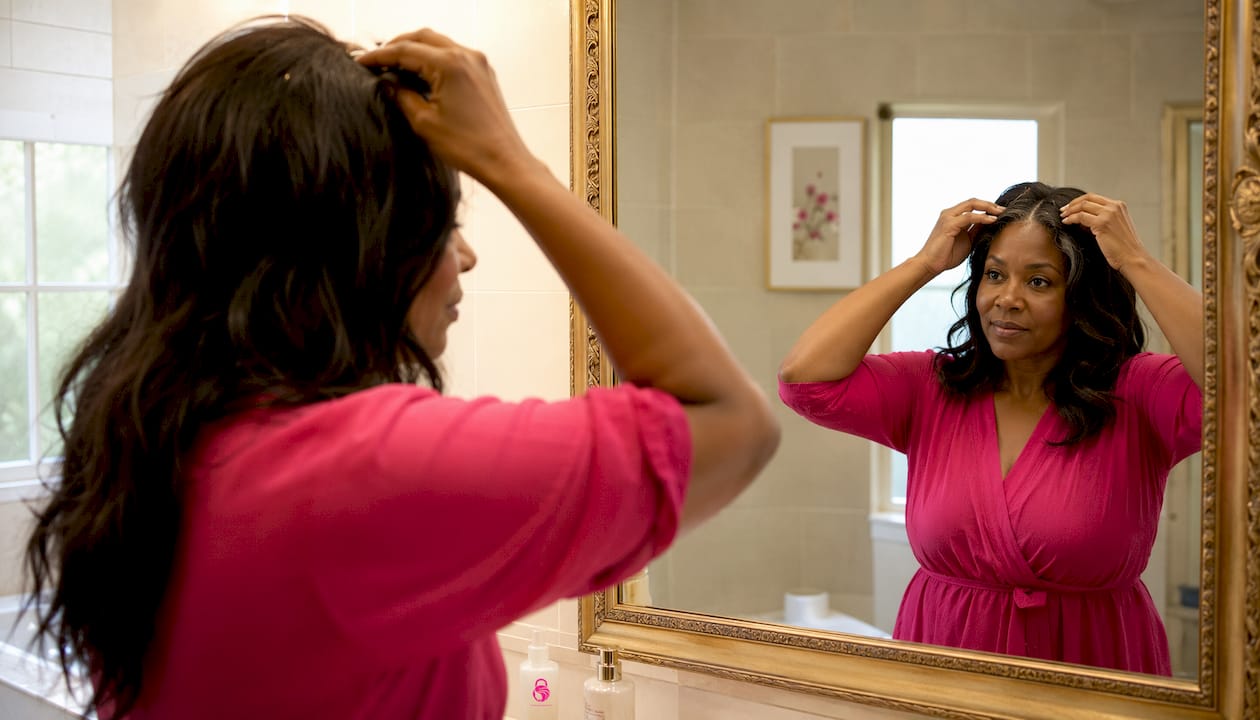
Toppers vary by base material, and that choice affects comfort, appearance, and durability.
| Base Type | Coverage | Weight | Breathability | Best For |
|---|---|---|---|---|
| Lace front | Moderate | Light | High | Natural hairline, mild thinning |
| Monofilament | Moderate–high | Light | High | Realistic parting, sensitive scalps |
| Silk base | High | Medium | Moderate | Maximum concealment of knots |
| Machine-made | Moderate | Medium | Lower | Budget-conscious, less sensitive scalps |
| Injected silk (V-Part) | High | Light | High | Crown thinning, seamless parting |
Attachment methods include pressure-sensitive clips, double-sided tape, and adhesive. Choosing a base size roughly one inch larger than your thinning area gives clips enough anchor hair to grip securely without slipping. The Top~Lock V-Part Topper from Hairlockshairextensions uses an injected silk base for a knotless, natural-looking part that works in any direction.
What does hair topper and extension pricing look like in Australia?
Permanent hair extensions in Australia typically cost $700–$3,000+ depending on the method and maintenance. Nano bead and micro bead methods sit toward the mid-to-upper end of that range because of the precision labor involved. Weft extensions vary widely based on the number of rows and whether hand-tied or machine weft is used. Keratin bond extensions are among the more time-intensive to apply, which is reflected in their pricing.
Hair toppers carry their own cost structure. Synthetic toppers are the most affordable entry point, though they offer less styling flexibility. Human hair toppers cost more upfront but last significantly longer and can be colored, heat-styled, and trimmed to match your natural hair exactly.
Additional costs to factor in:
- Initial professional consultation and color matching.
- Maintenance appointments every 6–8 weeks for semi-permanent methods.
- Extension-safe shampoos, conditioners, and styling products.
- Periodic color refreshes to keep extensions matching your natural hair as it grows or changes.
Investing in quality human hair from the start usually costs less over time than replacing lower-quality synthetic pieces repeatedly.
How do hair toppers help women with thinning hair day to day?
The practical difference a well-fitted topper makes is immediate. It covers the crown without requiring the rest of your hair to carry extra weight, which matters when your natural strands are already fragile. Because toppers integrate with your existing hair rather than replacing it, they allow for natural parting variation, so you are not locked into a single style.
Volume returns at the root zone, which is where thinning is most visible and most aging. A topper that matches your color and texture precisely looks indistinguishable from your own hair in motion. For women managing androgenetic alopecia or post-partum thinning, this kind of non-permanent solution also adapts as hair loss patterns shift over time.
Pro Tip: If your thinning is progressing, choose a topper with a slightly larger base than your current thinning area. It gives you room to grow into the coverage without needing a replacement piece too soon.
How do you care for extensions and toppers to make them last?
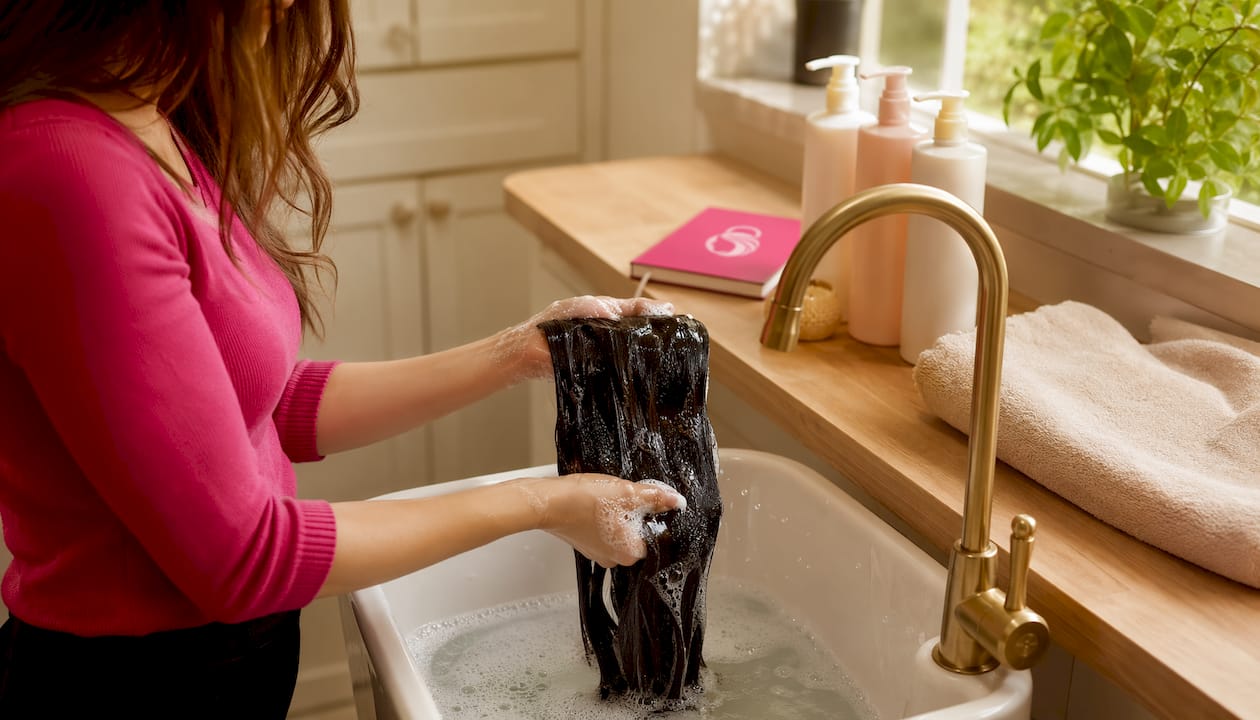
Proper maintenance extends the life of both extensions and toppers while protecting your natural hair underneath, using treatments like the Voraly Clinical Hair Growth System designed to support hair health for alopecia patients. Wash semi-permanent extensions every 7–10 days using sulfate-free, extension-safe shampoo, working from mid-length to ends rather than scrubbing at the roots. Condition from the mid-shaft down, keeping product away from attachment points to prevent slippage or buildup.
Heat styling is fine on 100% human hair extensions, but keep temperatures moderate and always use a heat protectant. Excessive heat accelerates dryness and shortens the lifespan of the hair. For toppers, store them on a wig stand when not in use to maintain their shape.
Professional upkeep every 6–8 weeks is standard for micro bead, nano bead, and keratin bond methods. At those appointments, a stylist moves attachments up as your natural hair grows, checks scalp health, and removes any buildup. The full care guide from Hairlockshairextensions covers product recommendations and daily handling in detail.
What do real client results look like with Hairlockshairextensions?
Client results with Hairlockshairextensions consistently show natural blending, restored crown density, and a finish that holds through daily styling without requiring constant adjustment. The before and after gallery documents transformations across a range of alopecia stages, from early diffuse thinning to more significant crown loss. What stands out across these results is how precisely the extensions and toppers are color-matched to each client’s natural hair.
Clients report increased confidence and a natural look that integrates with their own hair. Michele’s 30 years of experience means color matching, density selection, and placement are handled with a level of detail that makes the difference between extensions that look added and extensions that look grown. Personalized consultations are central to every result shown.
Which extension type suits your specific alopecia pattern?
Matching the extension method to your hair loss pattern is where professional guidance becomes critical. Here is how the main methods align with common alopecia presentations:
- Micro bead extensions work well for diffuse thinning because individual strand attachment distributes weight without concentrating stress. The 2.8mm bead size used by Hairlockshairextensions is particularly gentle.
- Nano bead extensions use an even smaller bead, making them the best semi-permanent option for very fine or fragile hair.
- Weft extensions suit women with moderate thinning who have enough density to anchor rows securely. They add significant volume efficiently.
- Keratin bond extensions are suited to women with stable, non-progressive hair loss who want a long-lasting, seamless result.
- Top~Lock V-Part Topper is the go-to for crown-specific thinning, particularly androgenetic alopecia, where the rest of the hair retains reasonable density.
Clip-in extensions remain the safest option for women with active, unpredictable alopecia areata, since they can be removed entirely on difficult days without any scalp contact.
What happens during a hair extension consultation?
A thorough consultation covers more than color matching. It assesses your current hair density, scalp sensitivity, the pattern and progression of your hair loss, and your lifestyle. From that picture, a stylist recommends the attachment method that adds the volume you want without stressing the hair you have.
At Hairlockshairextensions, Michele’s consultations include a free personal color matching service to ensure extensions blend precisely with your natural tone. Density selection, length, and placement are all customized. For topper clients, the base size and attachment method are chosen to suit both the thinning area and the surrounding hair’s ability to anchor clips securely.
Human hair vs. synthetic: which is better for alopecia?
Human hair extensions outperform synthetic in almost every category that matters for alopecia. They move, reflect light, and respond to heat styling exactly like your own hair, which is what makes blending seamless. They can be colored to match your natural shade precisely and last significantly longer with proper care.
Synthetic extensions cost less upfront but cannot be heat-styled without damage, tend to tangle more readily, and have a shorter lifespan. For women already managing the emotional and financial demands of hair loss, replacing synthetic pieces frequently often negates the initial savings.
The one scenario where synthetic makes sense is as a temporary, low-commitment option while you assess which permanent method suits your hair loss pattern. All extensions and toppers at Hairlockshairextensions are 100% human hair, which is why the results hold up to daily styling and close inspection.
What are the long-term effects of extensions on a fragile scalp?
The long-term picture depends almost entirely on method selection and professional oversight. Extensions applied correctly to hair with sufficient density cause no measurable long-term damage. The risk to fragile scalps comes from traction: attachment points that are too heavy, too tight, or left in place too long without adjustment.
Nano bead and micro bead methods are the most scalp-friendly for long-term wear because they use no heat or adhesive and can be adjusted as your natural hair grows. Keratin bond extensions, when applied by an experienced stylist, also have a strong long-term safety record. The methods to approach with caution on very fragile hair are heavy weft rows and any adhesive-based system applied directly to an irritated or inflamed scalp.
Regular maintenance appointments are not optional for long-term wearers. They are the mechanism that keeps attachment points safe, catches early signs of scalp stress, and adjusts placement as your hair loss pattern evolves.
Hairlockshairextensions: expert care for women with thinning hair
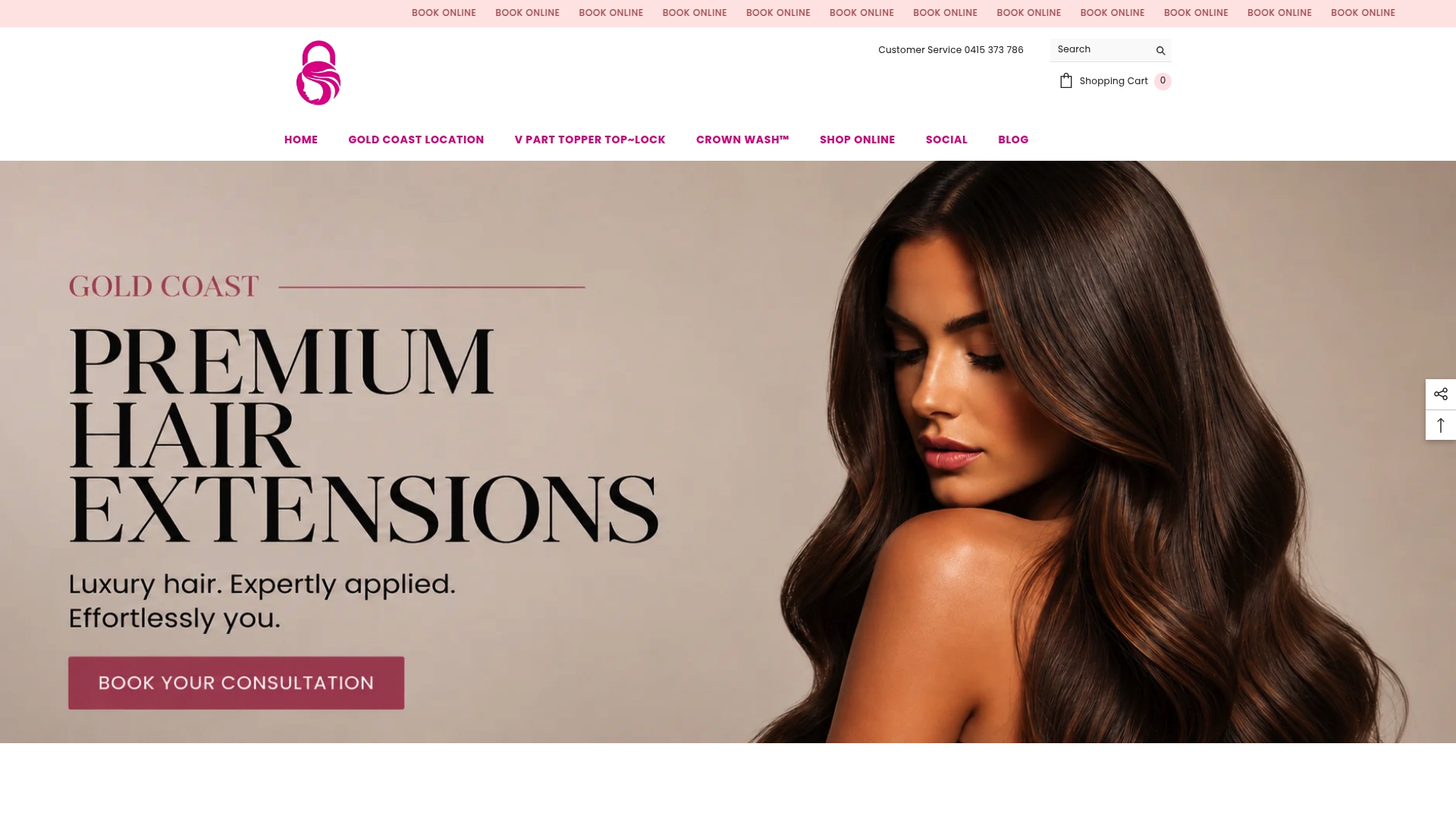
Hairlockshairextensions offers something most online extension retailers cannot: 30 years of hands-on expertise applied to every single client, not just a product range. For women managing alopecia, that distinction matters. Michele’s personalized consultations assess your specific hair loss pattern, scalp condition, and styling goals before recommending any method, so you leave with extensions or a topper that genuinely works for your hair, not a generic solution.
The full range covers weft, nano bead, micro bead, and keratin bond extensions, plus the exclusive Top~Lock V-Part Topper for crown thinning. Every product is 100% human hair. Color matching is included as a free service. If you want to see what is possible before booking, the client gallery shows real results across a range of alopecia stages. When you are ready to take the next step, book your consultation and get a solution built specifically for you.
Key Takeaways
For women with alopecia, the safest and most natural-looking results come from matching the extension method precisely to the hair loss pattern, with professional guidance at every stage.
| Point | Details |
|---|---|
| Match method to pattern | Crown thinning suits a topper; diffuse thinning suits nano or micro bead extensions. |
| Human hair outperforms synthetic | Human hair blends naturally, accepts heat styling, and lasts longer for alopecia clients. |
| Australian pricing range | Permanent extensions in Australia typically cost $700–$3,000+ depending on method and maintenance. |
| Maintenance protects your scalp | Semi-permanent methods need professional upkeep every 6–8 weeks to prevent traction damage. |
| Hairlockshairextensions | Offers weft, nano bead, micro bead, keratin bond, and the Top~Lock V-Part Topper with personalized consultations. |
FAQ
Can you get hair extensions with alopecia?
Yes, though the method must match your hair loss pattern and density. Lightweight options like micro bead or nano bead extensions are generally the safest for fragile hair, and a professional consultation is the right first step.
How can you hide alopecia without a wig?
A hair topper for crown thinning, such as the Top~Lock V-Part Topper from Hairlockshairextensions, covers thinning patches while blending with your natural hair, giving a full look without the coverage of a full wig.
Can extensions be applied to a nearly bald area?
Extensions require existing hair to anchor to, so they cannot attach to fully bald patches. A topper or hairpiece is the appropriate solution for areas with little to no remaining hair.
Do alopecia patients get free wigs in Australia?
Some state health programs and private health funds in Australia provide partial subsidies for hairpieces for medical hair loss, but coverage varies by fund and policy. Checking directly with your health insurer or a GP is the most reliable way to confirm eligibility.
Are nano bead extensions safe for very fine, thinning hair?
Nano bead extensions use a very small attachment point and no heat or adhesive, making them one of the gentlest semi-permanent methods available for fine or fragile hair when applied by an experienced stylist.
Recommended
- Professional Hair Extensions Gold Coast: The Ultimate Guide to Luxury – HairLocks Hair Extensions
- The Ultimate Guide to Hair Toppers: Restoring Volume and Confidence in – HairLocks Hair Extensions
- Before and After Hair Extensions Gallery - HairLocks – HairLocks Hair Extensions
- Application Hair Extensions – HairLocks Hair Extensions