


V Part vs U Part Wigs: Which One Is Right for You?
If you have fine or thinning hair and want a fast, protective install, a V-part wig is your best match. If you have thicker hair and want maximum parting freedom, a U-part delivers a fuller, more flexible blend. For Australian women ready to shop now, the Top~Lock V-Part Topper from Hairlockshairextensions is a purpose-built option worth looking at first.
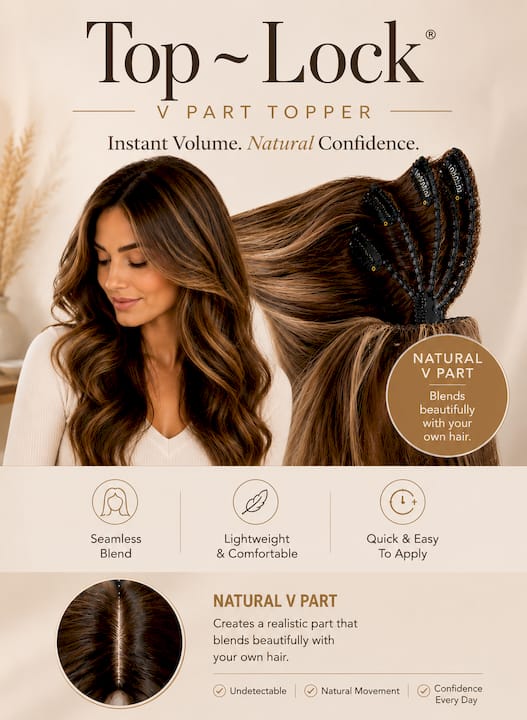
The practical difference between these two styles comes down to one thing: how much of your own hair you need to leave out. According to measured specs from APOHAIR, a U-part opening sits at roughly 4×2 inches and requires a substantial leave-out, while a V-part opening measures just 2–3 inches long by 0.5–1 inch wide and needs only a small amount of leave-out. That gap in leave-out percentage shapes everything else, from how long installation takes to how much heat your natural hair absorbs daily.
Key Takeaways
The single most important factor when choosing between a V-part and U-part wig is how much natural hair you have available to leave out and blend.
| Point | Details |
|---|---|
| Leave-out is the deciding factor | V-part needs only a small proportion of leave-out; U-part needs 25–40%, so match the style to your hair density. |
| V-part installs faster | A V-part takes roughly 3–5 minutes versus 10–15 minutes for a U-part, making it better for daily wear. |
| U-part offers more parting freedom | The wider 4×2-inch opening lets you shift between center, side, and off-center parts throughout the day. |
| V-part is more protective | Less leave-out means less daily heat on your natural hair, which matters most for fine or thinning strands. |
| Hairlockshairextensions Top~Lock V-Part Topper | A 100% Russian human hair option available in Australia, with fittings and color matching from founder Michele. |
Table of Contents
- What exactly is a V-part wig, and who does it suit?
- V-part vs U-part at a glance: how do the two designs compare?
- How to install and blend a V-part or U-part at home
- Styling options: what works for each part type
- How to choose between V and U: a practical buying checklist for Australian shoppers
- Our expert pick: the HairLocks Top~Lock V-Part Topper
- A note on fit and protection from Michele
- Ready to find your fit? Shop and book with Hairlockshairextensions in Australia
- Sources
- FAQ
What exactly is a V-part wig, and who does it suit?
A V-part wig has a narrow, V-shaped opening at the crown of the cap. Because the opening is small, only a thin strip of your natural hair needs to be pulled through and blended with the wig. That minimal leave-out is what makes V-parts particularly well suited to women with fine, delicate, or thinning hair.

How the opening works: The V-shaped gap sits at the top center of the cap, typically measuring 2–3 inches long and 0.5–1 inch wide. You pull a small section of your own hair through, blend it with the wig’s hairline, and secure the cap with clips. No glue, no lace, no lengthy prep.
Primary benefits:
- Requires only a small proportion of leave-out, so less of your natural hair is exposed to heat or manipulation
- Installs in roughly 3–5 minutes, making it practical for busy mornings
- Creates a natural-looking center part without a visible lace edge
- Protective by design: the cap covers most of your hair, reducing daily styling stress on fragile strands
- Glueless construction means no adhesive damage to your scalp or hairline
Common trade-offs:
- Parting flexibility is limited; a strict center part is the default look
- The small leave-out strip must closely match the wig’s color and texture, which can require a precise color match
- Precision cap construction tends to push the price slightly higher than basic clip-in alternatives
As Govihair notes, V-parts offer a quicker, more protective option for women who want coverage without committing to a full wig. ToAllMyBlackGirls reinforces that V-parts are easier for beginners precisely because there is so little hair to blend.
Pro Tip: When your leave-out is minimal, a tinted dry shampoo or root shadow powder in your natural hair color can help the blend look seamless, especially at the part line.
V-part vs U-part at a glance: how do the two designs compare?
The table below covers the dimensions that actually affect your daily experience with either style.
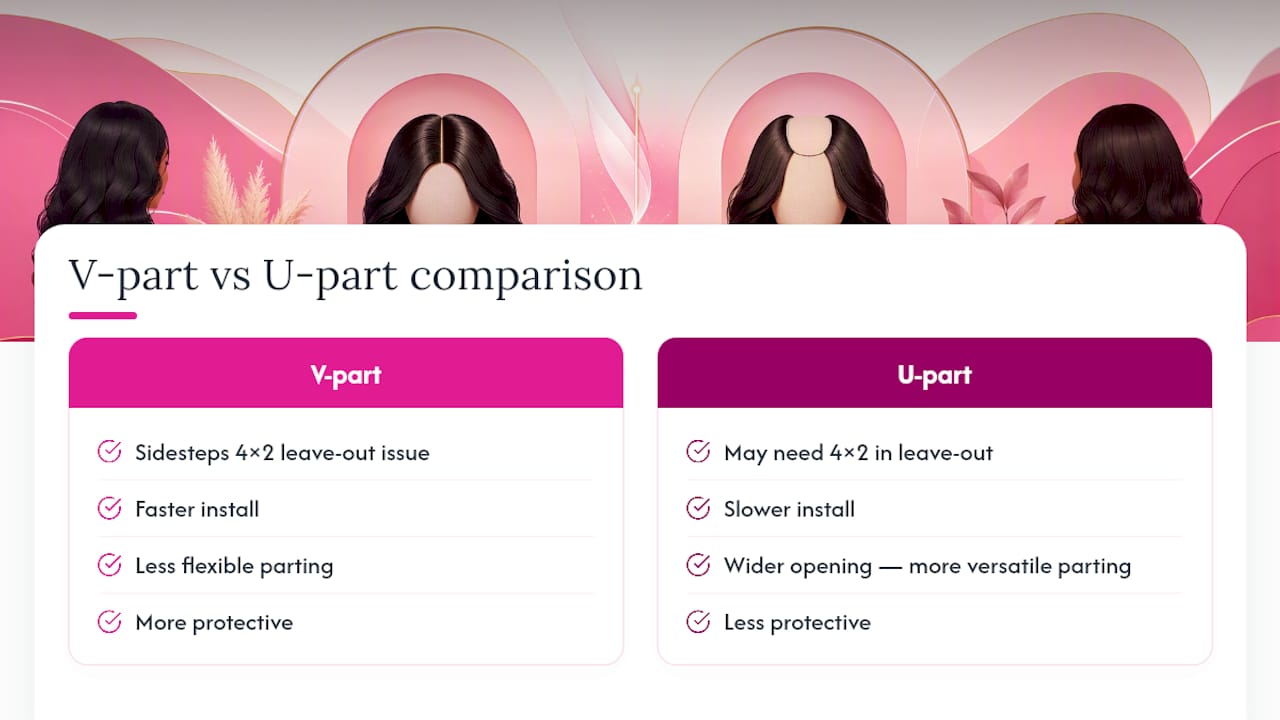
The single most important column for most readers is leave-out percentage. Community users on r/BlackHair consistently identify this as the practical dividing line: if you do not have enough natural hair to cover a 4×2-inch opening convincingly, a U-part will look patchy at the part line. A V-part sidesteps that problem entirely.
For women prioritizing speed and protection, the V-part wins on both counts. For women with thicker hair who want to change their part throughout the day, the U-part’s wider opening is genuinely more versatile.
How to install and blend a V-part or U-part at home
Tools to have ready
- Rat-tail comb and wide-tooth comb
- Sectioning clips
- Edge control or light-hold gel
- Heat protectant spray
- Bobby pins or additional snap clips
Installing a V-part wig
- Prep your hair. Braid or flatten your natural hair close to the scalp. A flat cornrow or two-strand twist at the crown keeps the cap sitting flush.
- Section the leave-out. Using a rat-tail comb, pull a thin strip of hair through the V-shaped opening. Keep it narrow — only what the opening allows.
- Position the cap. Align the V opening with your natural part line and press the cap flat against your head.
- Secure the clips. Attach the built-in clips to your braided base, starting at the nape and working forward. Check that the cap sits evenly on both sides.
- Blend the leave-out. Smooth your leave-out hair over the V opening using a fine-tooth comb. Apply a small amount of edge control to lay the hairline flat.
- Final check. Run your fingers along the part line. If you see a gap, use a bobby pin to anchor the leave-out hair closer to the wig’s part.
Application instructions for the Top~Lock V-Part Topper walk through these steps with product-specific guidance.
Installing a U-part wig
- Prep your hair. Braid the bulk of your hair flat. Leave out the section that will cover the U-shaped opening — this is a wider section than a V-part requires.
- Section the leave-out. Pull the leave-out section through the U opening. This will be a larger portion of hair, so take your time parting it cleanly.
- Position and clip. Place the cap on your head, align the U opening where you want your part, and secure all clips firmly.
- Blend with heat if needed. Because the leave-out is larger, you may need a flat iron or curling wand to match the wig’s texture. Always apply heat protectant first.
- Style the part. Use a rat-tail comb to define your chosen part — center, side, or off-center. The wider opening gives you room to shift the part line.
- Smooth the edges. Apply edge control along the hairline and use a soft brush to lay baby hairs flat.
Pro Tip: For a U-part, clip the wig slightly further back than feels natural at first. This gives you more leave-out to work with at the front and prevents the cap edge from peeking through.
Common mistakes to avoid:
- Leaving out too much hair for a V-part (it creates bulk under the cap and lifts the wig)
- Skipping heat protectant on U-part leave-out, which leads to breakage over time
- Clipping the cap too loosely — a wig that shifts even slightly will expose the cap edge
- Choosing a wig texture that does not match your natural hair’s curl pattern, making the blend line obvious
Styling options: what works for each part type
V-part styling
The V-part’s default look is a clean center part, and it does that exceptionally well. The narrow opening creates a natural-looking part line without any lace to cut or glue to apply. For everyday wear, this is the style that requires the least effort.
Side parts are possible on a V-part, though they require a bit more work.
shows that an experienced stylist can achieve a deep side part on a V-part wig by adjusting the leave-out placement and using edge control to redirect the part. It is a technique rather than a built-in feature, so treat side-part flexibility as a bonus rather than a guarantee.
V-part styling dos and don’ts:
- Do use a low-heat flat iron (below 180°C / 356°F) on the leave-out strip to match the wig’s texture
- Do apply heat protectant every time you use any heat tool on your leave-out
- Don’t attempt high updos that pull the cap away from the crown — the V opening is small and the cap can shift
- Don’t use heavy oils directly on the part line; they weigh down the leave-out and make blending harder
U-part styling
The U-part’s wider opening is where its styling advantage shows. You can part the hair at center, far left, far right, or anywhere in between, and the leave-out covers the opening convincingly in each position. Loose updos, half-up styles, and ponytails are all achievable because the leave-out blends naturally with the wig hair across a wider surface area.
The trade-off is heat exposure. Because the leave-out section is larger, you will use heat tools on your natural hair more often to keep the blend looking consistent. Consumer blogs note that V-parts provide more protective coverage and reduce day-to-day heat styling on natural hair, while U-parts require regular blending and occasional heat on the exposed leave-out area.
Face shape and parting guidance:
- Oval faces: most part positions work well with either style
- Round faces: a side part (easier with U-part) adds length and definition
- Heart-shaped faces: a center part (V-part’s strength) balances a wider forehead
- Square faces: a soft side part or curtain-bang style suits U-part flexibility
How to choose between V and U: a practical buying checklist for Australian shoppers
Work through these questions before you buy.
Your hair profile:
- Do you have fine, thin, or thinning hair? A V-part protects more of your natural hair and requires far less leave-out.
- Do you have medium to thick hair with enough density to cover a 4×2-inch opening? A U-part will blend more naturally.
- Does your natural hair texture closely match the wig you are considering? Texture mismatch is more visible with a U-part because the leave-out section is larger.
Your lifestyle:
- Do you need to be ready in under 10 minutes? V-part installs in roughly 3–5 minutes versus 10–15 minutes for a U-part.
- Do you change your part position regularly? U-part gives you that flexibility; V-part does not.
Budget and quality signals:
Price drivers for both styles include hair origin and grade, cap construction, clip count, and any custom color matching. APOHAIR’s retail guidance places typical entry-level human hair options in the $80–$180 range, though premium Russian or European hair and custom color work push prices higher. In Australia, factor in import duties and shipping when comparing overseas prices to local retail.
Red flags when shopping online:
- No stated opening dimensions (a reputable seller lists exact measurements)
- Vague descriptions of hair origin (“premium quality” with no country or grade specified)
- No local return or fitting policy — important for Australian buyers who cannot easily return international orders
- Missing clip count or clip placement details, which affects how securely the wig sits
For Australian shoppers, look for sellers who offer in-person or virtual color matching and a clear return window. The Hairlockshairextensions U-part clip-in range includes Afterpay at checkout, which is a practical option for managing cost.
Our expert pick: the HairLocks Top~Lock V-Part Topper
For Australian women with thinning hair or fine strands who want a protective, natural-looking solution, the Top~Lock V-Part Topper from Hairlockshairextensions stands out as a purpose-built option.
Product features:
- 100% Russian human hair — one of the finest grades available for natural movement and longevity
- V-shaped base opening designed for minimal leave-out and maximum coverage at the crown
- Multiple secure clips for a firm, all-day hold without glue or tape
- Available in 22-inch length with color options to match a range of natural tones
- Glueless construction — no adhesive damage to your scalp or hairline
Why it suits thinning hair specifically: The narrow V opening means only a small strip of your natural hair is exposed, which reduces daily heat and manipulation on already-fragile strands. Retailers and suppliers consistently position the V-part design as the protective choice for women experiencing thinning, because it preserves more natural hair and requires less daily styling effort.
Trust signals:
- Founder Michele brings 30 years of industry experience to every fitting and consultation
- Before-and-after gallery available at Hairlockshairextensions showing real client results
- In-person and virtual consultations available for Australian customers, including color matching and clip placement guidance
- Local availability means no international shipping delays or return complications
For women exploring thinning hair solutions more broadly, the thinning hair toppers guide on the Hairlockshairextensions blog covers additional options and suitability criteria for the Australian market.
A note on fit and protection from Michele
After 30 years working with women’s hair, the question I hear most often is not “which wig looks better?” It is “which one will protect my hair.” For most of my clients with fine or thinning hair, the V-part wins that conversation every time. The smaller opening means less leave-out, less daily heat, and less manipulation on the strands that need the most care. For women with thicker hair who love to switch up their part, the U-part gives them that freedom — but it asks more of your natural hair in return. If you are unsure which suits your density and texture, book a consultation with us. We offer in-person fittings and virtual color matching for Australian clients, and we will not recommend a product that does not genuinely fit your hair.
Ready to find your fit? Shop and book with Hairlockshairextensions in Australia
The Top~Lock V-Part Topper is available now for Australian women who want a protective, natural-looking crown solution without glue, lace, or lengthy installs. Every purchase comes with access to Hairlockshairextensions’ fitting expertise — founder Michele and the team offer color matching and clip placement guidance so your topper sits perfectly from day one.
Browse the Top~Lock V-Part Topper on the Hairlockshairextensions website, or explore the full European and Russian human hair collection to compare grades and lengths. To book a fitting or virtual color match, visit Hairlockshairextensions and use the booking form. A return and exchange policy is in place for Australian orders — check the product page for current terms before purchasing.
Sources
- U Part vs V Part Wig: Which Glueless Wig Is Right For Your Hair Type?
- U Part vs V Part Wig: Which One Is Better for You?
- u part vs v part wigs and how to achieve style : r/BlackHair
FAQ
Is a V-part or U-part wig better for thin hair?
A V-part is better for thin or fine hair. Its narrow opening requires only a small proportion of leave-out, which means less of your natural hair is exposed to heat and daily styling stress.
Can you do a side part with a V-part wig?
Yes, though it takes more effort than a center part. Experienced stylists can achieve a deep side part on a V-part by adjusting the leave-out placement and using edge control, but side-part flexibility is a built-in strength of the U-part design.
Are U-part wigs heavy to wear?
U-part wigs are not inherently heavy, but the wider leave-out section means more hair to blend and style, which can feel more involved than a V-part. Cap weight depends primarily on hair density and length rather than the opening shape.
Is a half wig or U-part wig better for everyday wear?
A U-part wig generally offers a more natural blend than a traditional half wig because the opening integrates your own hair rather than sitting on top of it. For everyday protective wear with minimal effort, a V-part topper is often the most practical choice.
How do I match my natural hair to a V-part or U-part wig?
Match both color and texture as closely as possible. For a V-part, the leave-out strip is small, so even a slight mismatch is visible at the part line. For a U-part, the larger leave-out area makes texture matching equally important. A professional color consultation, like those offered by Hairlockshairextensions, helps get this right before you buy.