


Protect the Base First: Australian Salon Rules for Dyeing Hair Toppers
Human-hair toppers take permanent, demi, or semi-permanent color the same way natural hair does, provided you protect the base and run a strand test first. Synthetic toppers almost never accept standard hair dye; you’re better off with temporary sprays, diluted alcohol inks, or a pre-colored piece. If your topper cost real money or the base is delicate lace or silk, a professional color match beats a DIY gamble every time.
TL;DR:
- DIY dyeing human-hair toppers is safe when you run a strand test and protect the base from dye penetration, especially on lace or silk bases.
- Synthetic toppers cannot be reliably dyed with standard hair dye and respond best to surface-level methods like sprays or alcohol-based inks.
- A thorough workspace setup includes gloves, a proper applicator, developer, barrier cream, and a test strand to avoid costly mistakes.
- Overprocessing, uneven color, and base staining are common risks, with professional color matching recommended for expensive or delicate toppers.
- Proper maintenance, including gentler washing and storage, extends the vibrancy and lifespan of dyed toppers.
Table of Contents
- Dyeing Hair Toppers: Human vs. Synthetic Fibers
- Prepping Your Workspace and Protecting the Base
- How to Dye a Human-Hair Topper Step by Step
- Coloring Synthetic Toppers: What Actually Works
- Keeping Color Fresh: Washing, Styling, and Storage
- Troubleshooting Common Topper Dye Problems
- HairLocks’ Rules for Coloring a Topper Without Ruining It
- Why Base Protection Deserves More Respect Than It Gets
- Get a Professional Color Match Instead of Guessing
- Sources
- FAQ
Dyeing Hair Toppers: Human vs. Synthetic Fibers
Before you buy a single box of dye, figure out exactly what your topper is made of. Getting this wrong is the single most common reason DIY color jobs on toppers go sideways.
Most manufacturer labels or original packaging state fiber content outright, but if you’ve lost that paperwork, a burn test tells you fast. Snip a few strands from an inconspicuous spot near the base and hold them near (not in) a flame. Human hair singes, smells like burning protein, and turns to fine ash. Synthetic fiber melts, curls into a hard bead, and smells like burning plastic. You can also run hot water over a hidden section: synthetic fibers that go limp or lose their set are heat-friendly (and possibly dyeable with the right method), while fibers that hold their shape under hot water are usually heat-resistant Kanekalon or a similar plastic blend.
Why does this matter so much for dyeing hair toppers? Human hair is built from keratin, a protein structure full of tiny gaps and bonds that dye molecules can penetrate and lock into. Permanent and demi-permanent dyes rely on that structure. Synthetic fiber is essentially colored plastic with a sealed surface. Regular oxidative dye has nothing to grab onto, which is why most permanent and demi-permanent formulas are built for keratin hair and simply won’t bond with synthetic plastic fibers. Apply box dye to a synthetic topper and you’ll typically get patchy, uneven color, or none at all, plus a fiber that feels drier and more brittle afterward.
A few practical takeaways once you’ve identified the fiber:
- Human-hair toppers can be lightened, darkened, toned, or fully re-colored using standard salon or at-home dye, following the same rules as your natural hair.
- Synthetic toppers can generally only be darkened using surface-level methods, never reliably lightened, since there’s no bleach process that works safely on plastic fiber.
- Always check the manufacturer’s care label or product page first. Some synthetic blends are explicitly marked heat-resistant and dye-tolerant; others say do not color anywhere in the fine print.
- Blended toppers (part human, part synthetic) will color unevenly unless you treat each fiber type separately, which is rarely worth the risk for a DIY project.
If you’re still not sure which category your piece falls into, it’s worth reading up on dyeing extensions before you commit, since the same fiber logic applies across toppers and extensions alike.
Prepping Your Workspace and Protecting the Base
Rushing this stage is how bases get ruined.
Protect the base first. Lace and silk bases are porous, which means liquid dye can wick into the knots and stain them permanently, even if you never intended to color that area. Colorists generally apply a thin layer of petroleum jelly or a clear barrier cream along the base perimeter before starting, and maintain a small buffer, roughly 1 to 2 millimeters, between the dye and the base edge to stop capillary transfer. Many experienced colorists will decline to color anywhere near a base they consider too fragile, and that instinct is worth copying at home.
Gather your supplies before you open a single bottle:
- Nitrile gloves, a tinting bowl, and a color brush or applicator bottle.
- Your chosen developer, mixed according to the dye manufacturer’s ratio, never eyeballed.
- Sectioning clips and a wide-tooth comb.
- A canvas block or mannequin head, or a clean flat towel-covered surface if you don’t own one.
- Petroleum jelly or barrier cream for the base edge.
- Old towels, a timer, and a well-ventilated room, especially if you’re using alcohol-based inks or fabric dyes for a synthetic piece, since those products carry stronger fumes than typical salon color.
Pro Tip: Snip a small, hidden strand from the topper’s underside, ideally near the base seam, and run your entire planned process on it first, including developer strength and processing time. If the color and texture look right after that test strand dries, you’re clear to move to the full piece. This single step catches most disasters before they happen.
A strand test isn’t optional busywork. It’s the only reliable way to see how a specific fiber, dye, and developer combination behaves before you commit an entire topper to it.
How to Dye a Human-Hair Topper Step by Step
Once your strand test confirms the color and texture hold up, you’re ready to color the full piece. Work in a well-lit space and don’t rush the timing windows.
1. Wash first, but skip the conditioner. Shampoo the topper a day or two before dyeing, but avoid heavy conditioners or oil treatments in that window, since residue can create a barrier that blocks even color absorption. Let it air-dry fully before you start.
2. Mount and section. Secure the topper on a canvas block or mannequin head using T-pins, or lay it flat on a towel if you don’t have a stand. Divide it into two to four sections with clips, just as you would section your own hair, so you can track exactly where you’ve applied color.
3. Protect the base. Apply your barrier cream or petroleum jelly along every base edge before mixing a single drop of dye. This is your last chance to do it, so don’t skip it even if you’re in a hurry.
4. Mix your color. Follow the developer ratio on your dye’s packaging exactly. Toppers are typically porous and process faster than you’d expect, so err toward the gentler end of the developer strength range if you have a choice.
5. Apply mid-lengths and ends first. Start about an inch away from the base and work toward the tips. This area needs the most processing time and the least risk of base contact.
6. Bring color toward the roots last, staying off the base entirely. Work dye up toward the base line but stop within your buffer zone. Never saturate the last few millimeters of hair closest to the knots.
7. Set a timer and check progress at intervals. Most demi-permanent formulas process in a moderate amount of time; permanent color often needs less. Check a small section every 5 to 10 minutes by gently wiping it with a damp cloth to see how the color is developing, rather than guessing.
8. Rinse with cool to lukewarm water, working from ends toward the base. Never scrub or rub dye across the base while rinsing, since that motion is exactly how pigment gets forced into the lace or silk fibers.
9. Condition lightly and detangle. Use a leave-in or lightweight conditioner made for color-treated hair, applied only from mid-length to ends.
10. Air-dry completely before styling. Air-drying protects the cuticle and keeps the base from warping under heat, so resist the urge to blow-dry a freshly colored piece.
Watch for these stop signs during the process:
- The hair starts to feel gummy, stringy, or unusually soft partway through processing.
- You see any discoloration bleeding into the base material.
- The color is developing visibly unevenly between sections.
If any of those happen, rinse immediately and stop. A topper that’s overprocessed or base-stained is far harder to fix than one that simply needs a second, gentler color session. When in doubt, a professional colorist can usually correct or finish the job; a home dye disaster on a $500 human-hair piece is not the place to improvise.
Coloring Synthetic Toppers: What Actually Works
Synthetic fiber changes the entire game, and pretending otherwise is how most synthetic dye jobs fail. Standard oxidative dye simply has no chemical mechanism to bond with plastic-based fiber, so the realistic options are narrower and more surface-level.
Three methods have a track record of working on the right synthetic fibers:
- Temporary color sprays made for hair or costume wigs, which sit on the fiber surface and wash out over a few wears.
- Diluted alcohol-based inks, often called the FW Ink method, which can tint heat-resistant synthetic fibers when applied carefully, though the result stays surface-level and can fade with handling.
- Disperse fabric dyes, which work on some heat-safe synthetics but require a heat-set step the fiber must be rated to tolerate.
Standard box dye and bleach are off the table for synthetic fiber. Bleach in particular tends to melt or gum up plastic strands rather than lift any pigment, since there’s no natural pigment in synthetic fiber to lift in the first place.
If you’re using the alcohol-ink approach, a common starting point is roughly one part ink to three parts 70% isopropyl alcohol, applied in thin layers with full drying time between each pass. Building color slowly in light coats gives you far more control than saturating the fiber in one go, and it’s much easier to add more color than to strip out too much.
Pro Tip: Work in a ventilated room or outdoors when using alcohol inks, and wear gloves and an old shirt. These products are more chemically potent than typical hair color, and they’re not ideal for repeated contact if the topper sits close to your scalp, so reserve them for occasional-wear pieces rather than a topper you wear daily.
Even on heat-tolerant synthetics, gentler heat settings than you’d use on human hair are essential unless the manufacturer explicitly confirms the fiber and base can handle higher temperatures. Skip any method that calls for boiling water unless you’ve verified that tolerance directly with the maker.
Realistically, if you need a specific, predictable shade on a synthetic topper, your best move is often to skip DIY dyeing altogether and choose a piece that’s already made in your target color, or switch to a human-hair topper you can color with confidence later.
Keeping Color Fresh: Washing, Styling, and Storage
Freshly dyed color, whether on human hair or a tinted synthetic, needs gentler handling than color on a topper you never touched.
Wash less often than you think you need to, and when you do, reach for a sulfate-free, color-safe shampoo paired with a lightweight conditioner. Sulfates strip pigment fast, cutting the life of your color job short regardless of how careful your application was.
Let the topper air-dry whenever possible, and detangle gently starting from the ends before working up. If you must use heat, keep it low, especially on synthetic fiber, since even heat-tolerant synthetics need less heat than natural hair to avoid damage.
A few habits protect your investment long after the dye has set:
- Store the topper on a stand or in a loose braid to prevent tangling and reduce fiber-on-fiber rubbing that can dull color over time.
- Avoid letting a newly colored, especially newly dyed synthetic, piece rub against light-colored clothing or pillowcases, since surface pigment on synthetic fiber can transfer, particularly when the piece is new or still slightly damp.
- Keep the topper away from direct sun and chlorinated water, both of which accelerate fading on any dyed fiber.
- If you wear hats or head coverings often, look for features that reduce friction and hat hair, since constant rubbing against fabric wears down color faster than most people expect.
Handled this way, a well-colored human-hair topper can hold vibrant tone for weeks between touch-ups, and a tinted synthetic piece stays wearable far longer than one left to fend for itself.
Troubleshooting Common Topper Dye Problems
Even a careful process sometimes goes slightly wrong. Knowing how to read the problem saves you from making it worse.
Base staining vs. surface pigment. If discoloration sits on top of the lace or silk and wipes away with a damp cloth, it’s surface pigment; a gentle rewash with clarifying shampoo usually lifts it. If the color has soaked into the base material itself, it’s likely permanent, and applying petroleum jelly earlier next time is the fix going forward.
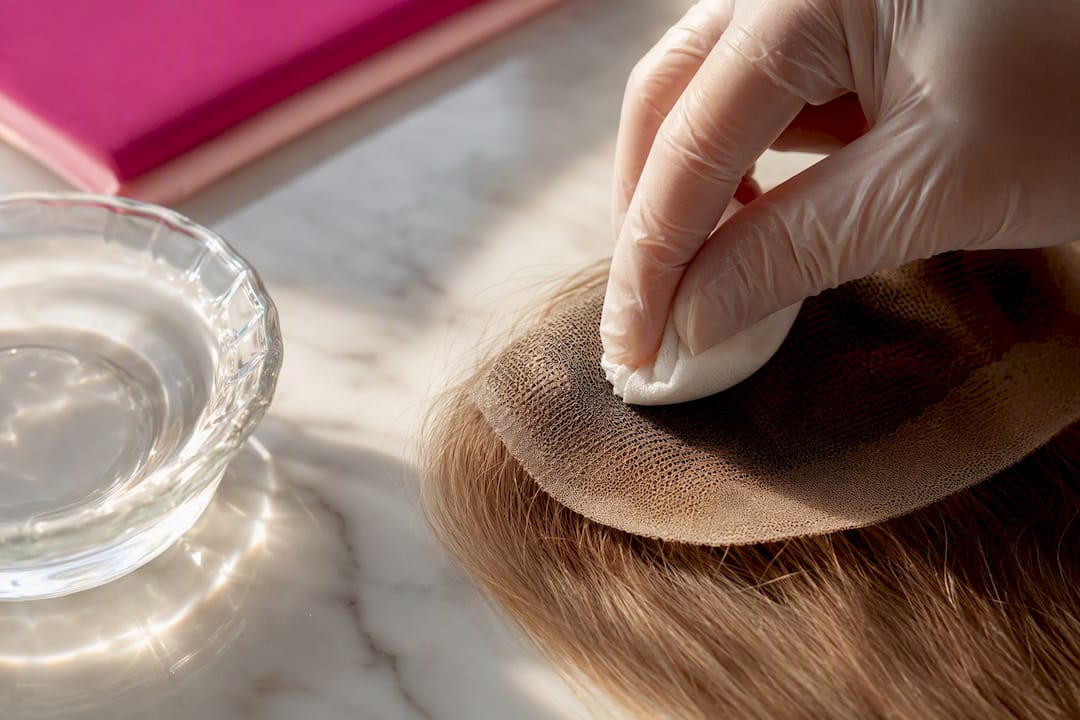
Uneven color or brassy tones. Patchy sections usually mean uneven dye saturation during application. A toning shampoo or gloss can sometimes even things out on human hair; for anything more stubborn, a professional re-tone is safer than layering more dye on top and risking overprocessing.
When to retire the piece. If fibers have melted, turned stiff and straw-like, or tangled into mats that won’t comb out, no amount of conditioning treatment will bring that topper back. At that point, replacing it is cheaper and less frustrating than chasing a fix that doesn’t exist. Before giving up entirely, it’s worth checking what actually makes a topper look natural, since sometimes a styling adjustment solves what looks like a color problem.
HairLocks’ Rules for Coloring a Topper Without Ruining It
After decades of fitting and customizing hair pieces, a few rules hold up consistently: always strand test, always protect the base, and always favor human hair when permanent color is the goal. Synthetic fiber should be colored conservatively, if at all, and pre-colored synthetic pieces remain the more predictable choice for anyone who isn’t ready to gamble on alcohol inks and dilution ratios.
Founder Michele has spent 30 years matching color and texture for clients, and that experience points to a consistent pattern: the toppers that end up damaged are almost always the ones where someone skipped the base protection step or skipped the strand test to save ten minutes. An in-person color match on a piece like the Top-Lock V Part Topper often costs less in the long run than replacing a topper ruined by a rushed home dye job, particularly for anyone new to coloring hairpieces.
A short list worth pinning above your workspace:
- Strand test every single time, even if you’ve dyed the same topper before.
- Protect base edges with petroleum jelly before you touch a bottle of dye.
- Choose human hair when you want reliable, repeatable permanent color.
- Choose pre-colored synthetic pieces when predictability matters more than saving money on dye.
Why Base Protection Deserves More Respect Than It Gets
Most home dyeing advice treats the strand test and base protection steps as optional extras, footnotes buried after the “fun part” of picking a color. That ordering is backwards. The base is the one component of a topper you cannot repair once it’s stained or warped, while color, even a bad batch, can usually be corrected, toned, or grown out.
The conventional advice also underplays how differently synthetic and human-hair fibers behave, often lumping them into one generic “how to dye your topper” guide. That’s misleading. A synthetic topper isn’t a cheaper version of the same project; it’s a fundamentally different material with a much narrower set of safe options.
If you take one thing from this guide, let it be sequencing: protect the base first, test the strand second, and only then reach for the dye. Readers chasing a specific, complicated color change on an expensive human-hair piece are usually better served booking a professional consultation than troubleshooting mid-process. DIY color works best on straightforward, low-risk changes, not ambitious transformations on your only topper.
— HairLocks
Get a Professional Color Match Instead of Guessing
If your topper is expensive, has a lace or silk base you’re nervous about, or needs a specific shade you can’t confidently mix at home, professional color matching removes the guesswork entirely. In-person consultations are offered by some providers to assist with decisions like matching color to your natural hair and skin tone before dyeing a piece.

Custom options like the Top-Lock V Part Topper are designed with color-matching flexibility in mind from the start, so you’re not retrofitting a generic piece to fit your shade after the fact. That’s a meaningfully different starting point than trying to correct a mismatched or damaged DIY job after the fact. If you’d rather see finished results before booking, the before-and-after gallery shows real color-matching work on human-hair pieces, including toppers and extensions. Browse the full range of application hair extensions or reach out to schedule a consultation, and skip the strand tests altogether.
Sources
- Can You Colour Synthetic Hair Safely? What Actually Works – L’Organic
- How to Dye a Lace Base Human Hair Topper or Wig – UniWigs® Official Blog
- Can You Dye Synthetic Hair? Step-by-Step Beginner Tips | TheBeautyFoodie
- Everything You Need To Know About Coloring Your Hair Topper - HAIR RETURNS
FAQ
Can human hair toppers be dyed?
Yes. Human-hair toppers accept permanent, demi-permanent, and semi-permanent dye the same way natural hair does, as long as you protect the base and run a strand test first.
Can you dye a synthetic topper?
Not with standard hair dye. Regular oxidative dye won’t bond with synthetic plastic fiber, so temporary sprays, diluted alcohol inks, or heat-safe disperse fabric dyes are the realistic options, and only on fibers rated to tolerate them.
What are the downsides of dyeing a hair topper yourself?
The biggest risks are permanent base staining, uneven color, and fiber damage from overprocessing, especially on synthetic pieces where the color sits only on the surface and can transfer onto clothing or fade quickly.
How do you make a dyed hair topper look more natural?
Match the color as closely as possible to your natural roots and ends, blend the dye gradually from mid-lengths outward, and avoid applying color right up to the base line, which keeps the transition soft rather than sharp.
Should I dye my topper myself or book a professional?
DIY works well for straightforward color refreshes on human-hair toppers with a strand test and barrier protection in place. For high-value pieces, delicate lace bases, or a specific complicated shade, a professional color match at a service like Hairlockshairextensions carries far less risk of ruining the piece.