


Hide a Widening Side Part with a V Part Hair Topper
For a natural-looking side part, the answer is a low-density silk or monofilament topper shaped for an off-center part, not a generic full-coverage piece. A custom V-part design, like HairLocks’ Top~Lock V-Part Topper, blends because it puts real human hair exactly where your part falls and leaves your own hair to frame it. Measure your thinning area first, then talk to someone who fits toppers for a living before you buy.
TL;DR:
- Choosing a topper with a low-density V-part shape and custom fit is crucial for a natural side part, especially for asymmetrical thinning called for by the pattern.
- Silk and monofilament bases are preferred for realism, with silk hiding knots completely and monofilament allowing for flexible parting and styling.
- Accurate measurements of the thinning area guide proper size and coverage, with custom fittings addressing color undertones, hair growth direction, and clip placement.
- Proper application involves aligning the front edge with the natural part, starting clips at the back, and blending the join to avoid visible lines or gaps.
- Regular maintenance, including careful washing, night-time protection, and professional fitting, extends lifespan and maintains a realistic, undetectable look.
Table of Contents
- What Makes a Hair Topper for a Side Part Work
- Silk, Monofilament, Lace, U-Part, or V-Part: Which Base Fits a Side Part
- How to Measure for the Right Base Size
- How to Apply and Blend a Side-Part Topper Step by Step
- Styling a Side-Part Topper for a Natural Look
- Caring for Your Topper: Washing, Sleep, and Lifespan
- Weighing the Pros and Cons of a Side-Part Topper
- Why a Bespoke Fitting Changes the Outcome
- How We Approach Side-Part Fittings and the Mistakes We See Most
- Get a Side-Part Topper Fitted Right the First Time
- Sources
- FAQ
What Makes a Hair Topper for a Side Part Work
Most topper disappointments trace back to one thing: the piece was built for general coverage, not for the specific mechanics of a side part. A side part exposes scalp along one clean line, and any topper covering that area has to disappear into it, not just cover it.
Coverage needs to concentrate at the part itself and the adjacent crown, leaving your own hair at the temples and hairline to do the framing. When a topper’s density starts too far forward or too thick along the front edge, it reads as an add-on rather than your own scalp. Buyer guidance from major topper retailers consistently stresses assessing exactly where and how much thinning you have before choosing a base, because a piece sized for crown coverage will not sit right over an off-center part, and vice versa.
The part line itself is where most pieces fail or succeed. A low-density front edge, thinned by hand-knotting individual strands one at a time rather than machine-wefted in rows, mimics the way hair naturally grows sparse at a scalp part. Clip placement matters just as much. An off-center part puts uneven pressure on the base, since one side carries more visual weight than the other. Toppers with clips positioned for a center part often shift or lift when worn on the side, creating small gaps exactly where they’re most visible.
Here’s what separates a well-fitted piece from one you’ll be tugging at all day:
- The part line looks like scalp, not like a seam or a hard edge of wefted hair.
- Clips sit low enough to grip real hair without tenting the base.
- The front hairline has visible density variation instead of a flat, uniform edge.
- The base shape matches your actual thinning pattern, not a generic oval.
An off-the-shelf topper can work for light, symmetrical thinning. But if your part has been widening for a while or the thinning is asymmetrical, a professional fitting catches details a size chart can’t: your natural hair color undertones, the direction your hair grows, and how much movement you need for daily styling.
Silk, Monofilament, Lace, U-Part, or V-Part: Which Base Fits a Side Part
Base construction determines whether a topper looks like hair growing from your scalp or like something sitting on top of it. For a side part specifically, the two materials that matter most are silk and monofilament.
A silk base folds a piece of silk over the knots that anchor each strand, hiding them completely and creating a smooth, opaque surface that mimics scalp skin. This knot-hiding property is exactly why silk bases show up so often in reviews of realistic-looking toppers. Monofilament, a fine mesh fabric, takes a different approach: it’s sheer enough to let light through and lets you part your hair in multiple directions, which matters if you like to switch your part occasionally or wear your hair back some days.
Lace bases sit somewhere in between, offering the most breathability but requiring more careful blending since lace can show under bright light or flash photography if not applied correctly.
Base shape is the other half of the equation:
- U-part bases cover a horseshoe-shaped area, leaving a strip of your own hair down the center. This works well for a center part but can look mismatched on someone with a defined side part.
- V-part bases, like HairLocks’ Top~Lock design, follow a V-shaped opening that naturally accommodates an off-center part without forcing your own hair into an unnatural line.
Roughly speaking, silk and mono bases dominate the recommendations for realistic-looking parts, and reviews of specialized side-part toppers show a clear preference for lightweight, targeted pieces over heavier, full-coverage units when the thinning is localized.
Material matters as much as shape. Human hair toppers blend more convincingly than synthetic ones because you can heat style them, color-match them precisely to your own hair, and expect them to hold up longer under regular wear. Synthetic pieces cost less upfront and hold a set style without heat, but they can’t be recolored as your hair changes with the seasons or with age, and they tend to develop a slight sheen that reads as “wig” under certain lighting.
How to Measure for the Right Base Size
Getting the size wrong is the single most common reason a topper looks obvious instead of natural. Too small, and it doesn’t cover the thinning. Too large, and you get a helmet effect where the density suddenly jumps at the edges.
Start with the measurement itself:
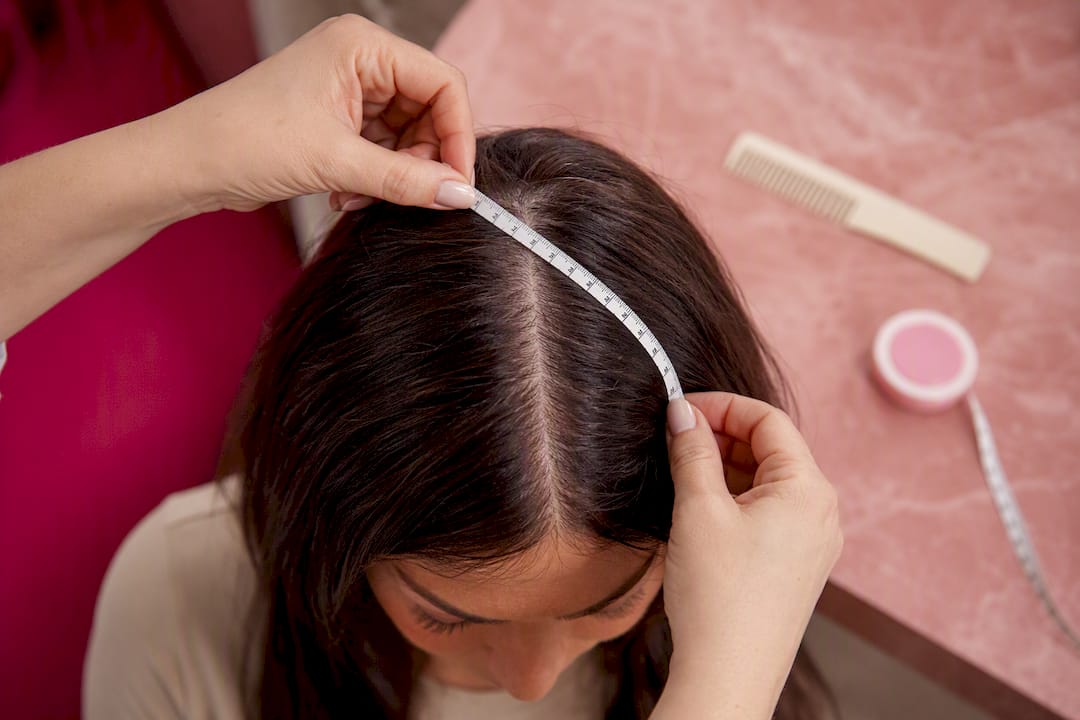
- Part your hair exactly where you normally wear it, so you’re measuring the real thinning zone, not a guess.
- Use a soft measuring tape and take the width and length of the widest points of the thinning area, front to back and side to side.
- Stand between two mirrors angled so you can see the top and back of your head, not just the front. Doing this in front of two mirrors lets you check the crown and part from angles you’d otherwise miss entirely.
- Note where the thinning tapers off, since your base should extend slightly beyond that point rather than stopping right at the edge.
- Write down both measurements in inches or centimeters, and note whether your part is closer to your natural hairline or set further back toward the crown.
Once you have real numbers, matching them to a coverage level gets simpler. Retailers generally group toppers into light, medium, and maximum coverage, and picking the wrong tier is what causes that flat, artificial look buyers often complain about. Light coverage suits early-stage thinning where you mostly need to fill in the part itself. Medium coverage extends further into the crown. Maximum coverage is for more advanced thinning that spans a larger area.
Clip count follows the same logic. A small side-part topper with two to five clips gives you targeted coverage without adding bulk, which is why partial, lightweight pieces are favored for early-stage thinning. Larger bases need more clips, spaced to distribute tension evenly rather than concentrated at the front.
Pro Tip: Measure at the end of the day rather than first thing in the morning. Hair sits differently after hours of movement, humidity, and touching, so an evening measurement gives you a more realistic sense of how the topper needs to perform in real conditions, not just fresh-from-the-shower conditions.
If your numbers fall between standard sizes, or your thinning pattern is irregular, custom sizing through an in-studio consultation is worth the extra step. A fitting also lets someone check things a tape measure can’t, like your natural hair’s exact color depth and whether your growth pattern needs the clips angled differently than standard.
How to Apply and Blend a Side-Part Topper Step by Step
A topper that fits well on paper can still look off if it’s applied wrong. The application sequence matters, especially with an asymmetrical part where uneven tension shows up faster than it would with a centered piece.
- Section and prep your natural hair. Brush through the thinning area and, if you use one, apply a light root-lifting product so your own hair has some texture to grip against.
- Position the topper before clipping anything. Lay it over the thinning area and align the front edge with where your part naturally starts, checking that the density gradient matches your hairline before committing to any clips.
- Clip the back first, then the sides, then the front. Starting at the back anchors the base and stops it from sliding as you tension the front, which is where visibility matters most.
- Check tension by gently tugging at the crown. If the base tents or lifts, loosen the clip and reposition rather than forcing it flatter, which usually just creates a new gap somewhere else.
- Blend the join with a fine-tooth comb. Lightly backcomb the underside of your own hair right at the part line so it meshes with the topper hair instead of sitting as two separate layers.
Pro Tip: If you notice a visible line right where the topper meets your scalp, a root-shadow tint applied to the topper’s part (matched to your own root color) closes that gap better than adding more hair density ever will.
Stealth trimming, thinning a few strands right along the join with texturizing shears, softens any remaining hard edge. This step is small but it’s often the difference between a topper that reads as “styled hair” and one that reads as “a piece.”
Styling a Side-Part Topper for a Natural Look
Once the topper is on and blended, styling is what keeps it looking like your own hair through the day rather than a fixed accessory. A side part in particular needs to hold its line convincingly from more than one angle, since people see you from the front, the side, and occasionally from above.
- Set the part with a small amount of pomade or clay along the root line, then blow-dry it in the direction you want before it sets, which trains both your natural hair and the topper hair to fall the same way.
- Ask your stylist about soft face-framing layers that start a few inches from the topper’s edge. This keeps the transition between your hair and the piece from looking like two distinct lengths.
- Human hair toppers tolerate heat styling within the same general range as your natural hair, so a flat iron or curling wand on a moderate setting, roughly 300 to 350 degrees Fahrenheit, works for most human hair pieces. Always check the specific product’s guidance first.
- If you want to switch your part to the other side occasionally, monofilament bases handle that better than silk bases, since silk is built to lie flat in one direction.
Re-parting isn’t something you should do constantly with a fixed silk-base piece, but for special occasions it’s usually fine to shift the part temporarily and reset it back afterward.
Caring for Your Topper: Washing, Sleep, and Lifespan
A topper’s realistic look depends almost entirely on how it’s maintained, not just how it was made. Wash it every 10 to 15 wears with a sulfate-free shampoo, working from the ends toward the base rather than scrubbing the base itself, which can loosen knots over time. Air-dry when possible, and if you use heat, keep it on the lowest setting your dryer offers.
Sleeping in your topper is the fastest way to shorten its life. Overnight friction against a pillowcase cuts a topper’s usable lifespan roughly in half compared to removing it each night. If you do need to sleep in it occasionally, a silk pillowcase and a loose, low bun reduce the friction that causes tangling and shedding at the base.
Clips need attention too. Rinse them occasionally to remove product buildup, and check that the fabric backing on each clip hasn’t started to fray, since a worn clip is far more likely to slip mid-day. Store the topper on a stand or in its original packaging rather than folded in a drawer, which can crease the base permanently.
On lifespan: a well-maintained human hair topper typically lasts one to two years with regular wear, while synthetic pieces tend to need replacing closer to the four to six month mark because the fiber can’t be reconditioned the way human hair can. The biggest factors shortening that window are heat damage, infrequent washing that lets oil build up at the base, and, again, sleeping in the piece regularly.
Weighing the Pros and Cons of a Side-Part Topper
Toppers solve a specific problem well, but they’re not the right fit for every situation or every budget, and it helps to go in with clear eyes.
On the upside, a topper gives immediate coverage the same day you put it on, with no recovery time and no surgical commitment. You get real styling flexibility, since you can change length, color, and texture without touching your natural hair at all, and it remains one of the more accessible non-surgical alternatives to hair restoration procedures.
On the downside, maintenance is ongoing, not a one-time purchase you forget about. A poorly fitted piece can be visible, especially at the part or hairline, and quality pieces represent a real cost that most people replace every one to two years. Getting comfortable with the daily routine of application takes a few weeks for most people, and it’s worth setting that expectation early rather than getting discouraged in week one.
Watch for these red flags when you’re shopping:
- Visible lace or mesh edges that catch light or show a hard line.
- Density that’s noticeably heavier than your own hair, creating an obvious mismatch.
- Flimsy clips with weak fabric backing that won’t hold through a full day.
Why a Bespoke Fitting Changes the Outcome
Side-part toppers are one of the few beauty products where off-the-shelf and custom-fitted can look like entirely different categories of solution, even when the underlying materials are similar. The difference usually comes down to who is doing the fitting.
Michele, HairLocks’ founder, has spent 30 years working directly with clients on hair enhancement, and that experience shows up most clearly in the details that are hardest to get right from a size chart: matching color undertones exactly, reading how someone’s hair grows at the crown, and adjusting clip placement for an asymmetrical part instead of a standard center one.
The Top~Lock V-Part Topper was built around exactly this problem. Its V-shaped opening follows the natural line of an off-center part instead of forcing a horseshoe-shaped base to work around it, and the clip layout is positioned to hold securely on one side without the tenting that generic U-part bases can cause. Made from human hair, it takes color and heat styling the way your own hair does, which is the detail most buyers say matters most once they’ve lived with a piece for a few months.
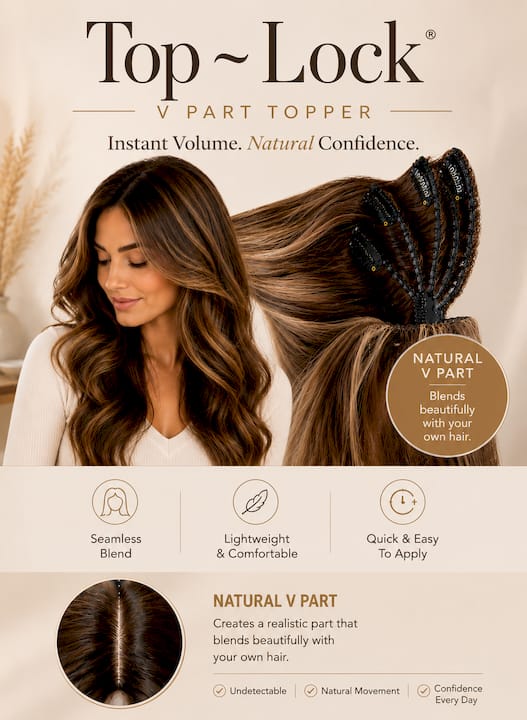
For anyone weighing a purchase, a personalized fitting, whether for a Top~Lock or another piece entirely, tends to catch problems a self-measured order simply can’t.
How We Approach Side-Part Fittings and the Mistakes We See Most
In a fitting, we start with the part itself, not the base. We watch where a client naturally parts their hair, check the thinning pattern under different lighting, and only then talk about base shape and coverage level. Skipping that step is the most common mistake we see in people who’ve bought toppers elsewhere.
The second mistake is sizing for the visible thinning today without accounting for how hair sits after a few hours of wear, once natural volume settles. And the third is picking density that matches a hope rather than the surrounding hair, which is what creates that flat, obvious edge.
Getting the fit right isn’t cosmetic detail work. For most clients, it’s the difference between thinking about their hair all day and not thinking about it at all.
— HairLocks
Get a Side-Part Topper Fitted Right the First Time
Buying a topper online without guidance means guessing at color, density, and base shape, and hoping it works. Hairlockshairextensions takes that guesswork off your plate with a personalized consultation built around your actual part, your hair color, and how you wear your hair day to day.

When you book a fitting or order the Top~Lock V-Part Topper, you get a base shaped for an off-center part, human hair that’s color-matched to your natural shade, and guidance on clip placement specific to your thinning pattern rather than a generic size chart. Michele’s three decades of hands-on fitting experience means the details that usually get missed, root color depth, clip tension, part-line density, get caught before the piece ever leaves the studio. If you’re ready to see what a properly fitted topper looks like on your own hair, book a consultation or explore the Top~Lock collection and take the first step toward a part that actually looks like yours.
Sources
For deeper background on toppers and side-part options, these pages offer useful next steps:
- The Best Women’s Hair Toppers | Top 8 Toppers
- Side Parting Real Human Hair Topper Clip in U-Part Silk Base Hairpiece Straight Seamless Wiglet Crown Replacement Right Part, 22cm, Black
- BAISI Side Part Wavy Partial Topper (NOT A WIG) – BAISI HAIR
FAQ
What Are the Downsides of Using Hair Toppers?
The main downsides are ongoing maintenance, the cost of replacing a piece every one to two years for human hair, and the risk of visible edges or mismatched density if the fit isn’t right. Most people also need a few weeks to get comfortable with daily application.
What Is the Most Realistic Topper for a Side Part?
A human hair topper with a silk or monofilament base and a V-part shape, like the Top~Lock V-Part Topper, tends to look the most realistic because the base hides knots at the part and the human hair blends and moves like your own.
Is There a Side-Part Topper That Uses a String-Based Hairline?
Most side-part toppers rely on silk, monofilament, or lace bases rather than a string-based hairline, since those materials are what hide the knots and create a natural-looking part. A qualified fitter can walk you through which base construction best matches your specific hairline.
Are Hair Toppers Good for Thin Hair?
Yes. Toppers are one of the most common non-surgical solutions for thinning hair, especially when the base size and coverage level are matched to the exact area affected rather than chosen off a generic size chart.