


30 Years’ Salon Experience: Prevent Hair Loss From Extensions
Yes, extensions can cause hair loss, and the mechanism is almost always traction alopecia, damage from sustained pulling at the root. Caught early, this type of hair loss is often reversible once tension stops. Left unaddressed for months or years, it can scar the follicle permanently. If you’re noticing tenderness, redness, or thinning at your part or hairline right now, loosen or remove the extensions and get a professional opinion before the damage progresses.
TL;DR:
- Hair loss from extensions is mainly caused by traction alopecia, which can become permanent if tension persists over months or years.
- Early warning signs include scalp tenderness, redness, broken hairs, and the fringe sign, with no pain signaling more severe damage.
- Light, temporary extension methods and proper care can prevent tension buildup, but heavy or continuous pull styles pose higher risks.
- Reversibility depends on early removal, with inflammation potentially healing within weeks and regrowth possible for up to a year, but scarring follicles are unlikely to recover.
- A well-fitted topper or clip-in can conceal thinning during recovery, but stopping tension and consulting a dermatologist remain essential for long-term hair health.
Table of Contents
- What Causes Hair Loss From Extensions?
- What Are the Early Warning Signs of Extension Damage?
- Is Hair Loss From Extensions Reversible?
- How to Prevent Hair Loss From Extensions
- How to Repair Thinning Hair Caused by Extensions
- When Should You See a Dermatologist About Extension Hair Loss?
- Expert Perspective: What HairLocks Sees in the Salon Chair
- The Uncomfortable Truth About “Safe” Extensions
- A Discreet Option While Your Hair Recovers
- Sources
- FAQ
What Causes Hair Loss From Extensions?
Traction alopecia happens when constant pulling on the hair shaft irritates the follicle, triggering inflammation that, if it continues long enough, converts into scarring. The StatPearls clinical reference on traction alopecia describes this as a mechanical injury: early cases are usually reversible, but years of sustained load can permanently disable the follicle, at which point even medical treatment stops working.
Not every extension method carries the same risk. Some installation choices put far more sustained force on the scalp than others:
- Sewn wefts braided tightly into small sections of natural hair
- Heavy, long extensions that add continuous gravitational pull even without a “tight” install
- Glued or taped anchors that don’t move with the hair as it grows
- Metal micro-rings clamped close to the scalp
- Bulky attachment points or lumps sitting directly against the skin, which can rub against a pillow and physically epilate hair over time, according to The Trichological Society
Some women are simply more vulnerable. Fine or chemically treated hair has less structural reserve to resist tension. A history of previous breakage, wearing extensions continuously without breaks, and nightly friction from tossing on a regular pillowcase all stack the odds against you.
What Are the Early Warning Signs of Extension Damage?
Your scalp usually tells you something is wrong before you see obvious bald patches. Watch for these signs, roughly in the order they tend to appear:
- Tenderness or soreness around the attachment points, especially in the first 48 hours
- Perifollicular redness, small red rings around individual hair follicles
- Broken hairs scattered near the hairline or part, shorter than the surrounding strands
- The “fringe sign,” a band of short, wispy regrowth at the front hairline where longer hair used to sit
- Headaches that persist after the install, not just discomfort on the day
- Pustules or folliculitis, small inflamed bumps that signal infection risk
A smooth, shiny patch with no visible stubble is a different story from stubbly regrowth. Shine usually means the follicle has scarred over, which is a poor sign for regrowth. Stubble means the follicle is still alive and just needs relief from tension.
Pro Tip: Take a photo of your hairline every time you get extensions installed or removed. Comparing photos over a few months is the fastest way to catch a receding fringe before it becomes obvious in the mirror.
If you spot any of these signs, loosen or remove the extensions immediately, drop high-tension styles like slicked ponytails, and call a dermatologist if things aren’t improving within a couple of weeks.
Is Hair Loss From Extensions Reversible?
In most cases, yes, but the timeline depends on how early you catch it. Traction alopecia moves through two rough stages: an inflammatory phase, where the follicle is irritated but intact, and a scarring phase, where the follicle has been replaced by fibrous tissue and can no longer produce hair. The Northwestern Hair clinical team notes that the fringe sign, short baby hairs at the hairline, is a positive indicator that regrowth is still possible.
What the recovery timeline typically looks like:
- Inflammation and tenderness often calm down within weeks of removing tension
- Visible regrowth in early-stage cases usually takes several months to about a year
- Smooth, atrophic patches with no stubble rarely regrow without intervention, and sometimes not at all
Medical support can speed early recovery, though it has limits. Topical minoxidil is the most common first-line option to stimulate follicles still capable of producing hair. Short courses of anti-inflammatory treatment can calm active irritation. Platelet-rich plasma (PRP) injections are sometimes used as an adjunct in select cases, though they work best on follicles that haven’t fully scarred. According to StatPearls, once scarring sets in after years of sustained tension, these therapies stop being effective for the affected follicles.
How to Prevent Hair Loss From Extensions
Prevention comes down to three decisions: what you install, who installs it, and how you care for it between appointments.
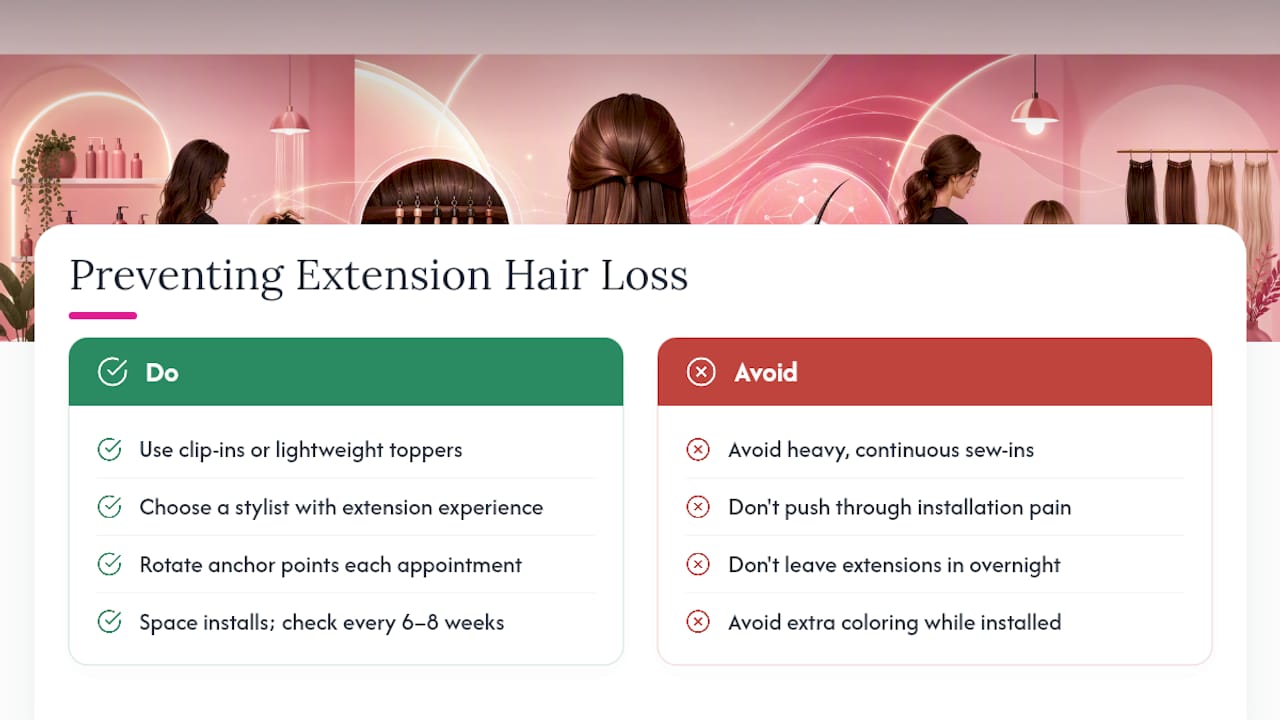
Choosing lower-risk products. Clip-in extensions carry the least risk because you remove them nightly, eliminating the continuous anchor tension that causes most traction damage. Lightweight U-part and topper pieces spread weight differently than sewn wefts, which makes them a sensible option for fine or chemically treated hair. Low-tension tape or micro-bead applications can also work when placed correctly, but heavy, continuous sew-ins are a poor match for hair that’s already compromised. HairLocks breaks down the safest methods ranked by risk in more detail if you’re comparing options.
Setting salon rules before you sit down. Choose a stylist with real extension experience, and treat pain during installation as a stop signal, not something to push through. Ask your stylist to rotate anchor points at each appointment rather than reinstalling in the same weakened spot. Space out installs with real breaks, and check in roughly every six to eight weeks so a professional can catch early tension damage before you do.
Daily habits that reduce cumulative stress. Sleep on a satin pillowcase or wrap your hair to cut down on friction, since nighttime movement is a bigger contributor to breakage than most people expect. Detangle gently from the ends upward, use extension-friendly shampoo and conditioner, and hold off on additional coloring or chemical treatments while extensions are in. The American Academy of Dermatology recommends the same core approach: protective styling, periodic breaks, and professional installation.
Pro Tip: If your scalp hurts on the drive home from your appointment, it’s too tight. Call the salon that day, not next week.
How to Repair Thinning Hair Caused by Extensions
Repair usually runs on two tracks at once: cosmetic coverage while you wait, and medical support to help the follicle actually recover.
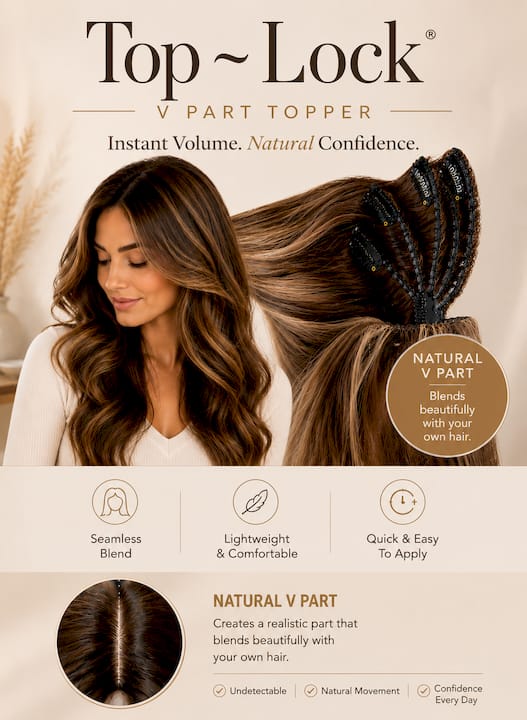
On the salon side, the goal is to hide the thinning without adding more stress to already-weakened follicles. A Top~Lock V-Part Topper sits over the damaged area and blends with your natural hair, giving discreet coverage without any tension at all. Lightweight clip-ins can fill volume elsewhere on the head. The one rule that matters most: never re-anchor a new install in the same margin that’s already thinning. Give it time.
Medically, the same tools used for early recovery still apply here:
- Topical minoxidil to support regrowth in follicles that are inflamed but not yet scarred
- Short-term anti-inflammatory treatment when the scalp is actively irritated or infected
- PRP as an adjunct in select cases, typically alongside other therapies rather than alone
If a dermatologist finds a smooth, scarred patch with no stubble after months of tension-free care, that’s the point where surgical hair restoration, such as follicular unit transplantation, becomes part of the conversation. That decision belongs to a dermatologist or hair restoration surgeon, not a salon, according to the clinical guidance in StatPearls.
When Should You See a Dermatologist About Extension Hair Loss?
See a dermatologist if you notice smooth, shiny patches instead of stubble, ongoing pain days after removal, pustules, or no visible regrowth after several months of wearing your hair loose. A dermatologist will typically ask about your styling history, examine the scalp with dermoscopy, and may take a small biopsy to rule out other causes of thinning.
Come prepared with photos tracking the change over time, a rough timeline of when extensions went in and out, the products you’ve used, and anything you’ve already tried. That history speeds up an accurate diagnosis considerably.
Expert Perspective: What HairLocks Sees in the Salon Chair
HairLocks founder Michele has spent 30 years fitting extensions, and the pattern behind most thinning complaints is consistent: the damage rarely comes from one bad appointment, it comes from repeated tight installs in the same spot with no real break in between. The salon’s conservative protocol favors lower-tension methods for clients showing any early thinning, and toppers or U-parts for coverage while follicles recover. When a client’s history suggests scarring rather than simple traction, HairLocks refers out to dermatology rather than trying to fix it cosmetically.
The Uncomfortable Truth About “Safe” Extensions
Most of the advice circulating about extensions and hair loss focuses on the wrong variable: tightness. Tightness matters, but weight matters just as much, and it gets far less attention. A long, heavy set of extensions that feels comfortable the day it’s installed can still generate hours of continuous gravitational pull on the follicle, day after day, with no obvious “ouch” moment to warn you.
That’s the gap in conventional advice. Women are told to avoid pain, but pain is a lagging indicator. By the time an install genuinely hurts, some inflammation has usually already started. The better standard is proactive weight management: lighter pieces, shorter lengths, and real breaks between installs, regardless of how the tension feels on day one.
If you’re already seeing thinning, prioritize removing tension entirely before you prioritize finding the “right” replacement product. Regrowth windows close. A topper or clip-in can wait a few weeks. A scarring follicle cannot.
— HairLocks
A Discreet Option While Your Hair Recovers
There are real limits to what any hairpiece can do, and HairLocks won’t pretend otherwise: cosmetic coverage is not a substitute for stopping tension or seeing a dermatologist when scarring is suspected. But once you’ve addressed the cause, a well-fitted piece can carry you through the months it takes for regrowth to catch up, without adding a single ounce of pull to a recovering scalp.

The Top~Lock V-Part Topper is built specifically for this situation, designed to sit over thinning areas and blend naturally with your own hair rather than clip into it under tension. For broader volume needs, lightweight U-part pieces and clip-ins add length or fullness without any sustained anchor points. Every consultation includes free personal color matching, so the piece disappears into your natural color rather than sitting on top of it. If you’re weighing your next step, the before-and-after gallery shows what real coverage looks like on hair in recovery, and you can book a consultation to talk through what fits your specific situation.
Sources
Clinical background comes from StatPearls on traction alopecia, the American Academy of Dermatology, and The Trichological Society. For general scalp health, see Joel C Ma Hair Studio’s guide to preventing hair loss naturally.
- Traction alopecia - StatPearls - NCBI Bookshelf
- How to prevent hair damage from a weave or extensions - American Academy of Dermatology
- Hair Extensions Hair Loss | The Trichological Society
- Traction alopecia: How braids, tight ponytails, and extensions cause hair loss - Northwestern Hair
FAQ
Will hair loss from extensions grow back?
Often, yes, if the follicle hasn’t scarred. Early-stage traction alopecia typically recovers within months to about a year once tension is fully removed, according to StatPearls.
Is it normal for hair to fall out after extensions?
A small amount of shedding from brushing and natural hair loss is normal, but breakage or thinning concentrated at attachment points is not; that pattern points to traction damage rather than typical shedding.
Why are my extensions losing hair?
If it’s the extension hair itself thinning rather than your natural hair, that’s usually product shedding from the wefts, not traction alopecia; if it’s your natural hairline receding, the cause is tension at the anchor points.
How can I help regrow thinning hair as a woman?
Remove the source of tension first, then support regrowth with topical minoxidil and, where a dermatologist recommends it, short-term anti-inflammatory treatment or PRP for follicles that are inflamed but not yet scarred.