


Hand Tied vs Machine Weft: Which Fits Your Hair?
For fine or thin hair, hand-tied wefts are the better call. For thick hair or a big volume boost, machine wefts usually win. If you want both a seamless hairline and heavy volume, a hybrid install using both weft types often outperforms either one alone.
The logic comes down to three things: how flat the base sits against your scalp, how much hair density the weft can carry, and what you’re willing to spend on upkeep. Hand-tied wefts win on comfort and blendability because their seam is thinner. Machine wefts win on durability and cost because their reinforced track carries more hair per row and resists tearing better.
-
Fine or fragile hair: hand-tied, for a flatter, lighter base
-
Thick hair or major volume goals: machine weft, for density and durability
-
Mixed priorities: hybrid, hand-tied at the hairline, machine weft underneath
One thing that trips people up: the weft type and the installation method are two separate decisions. Both hand-tied and machine wefts can be sewn onto a beaded row. The weft’s construction determines comfort and thickness; the installation determines how it attaches to your natural hair.
Key Takeaways
Choosing between hand-tied and machine weft comes down to matching seam thickness and density to your hair’s natural strength and your styling goals.
| Point | Details |
|---|---|
| Fine hair favors hand-tied | The thin, flat base sits close to the scalp without adding bulk your natural hair can’t support. |
| Thick hair favors machine weft | Machine wefts carry more density per track, so fewer wefts achieve the same volume. |
| Cost gap is real | Machine wefts can run roughly 30 to 60 percent cheaper than hand-tied options. |
| Maintenance schedule matters more than weft type | Push-up appointments every six to eight weeks protect both weft types equally. |
| HairLocks matches weft to hair | HairLocks offers 100% human hair wefts, including the Genius Weft, plus free color matching to fit each client’s density and goals. |
Table of Contents
- Hand Tied vs Machine Weft: The Core Definitions
- How Construction Affects Seam, Thickness, and Weight
- Pros and Cons: Hand Tied vs Machine Weft
- Matching the Weft to Your Hair Type and Goals
- Installation, Maintenance, and How Long Each Weft Lasts
- Cost, Value, and Salon Appointment Time
- Styling and Blending Tips for a Seamless Result
- What Stylists Actually Recommend
- Environmental and Ethical Considerations in Weft Production
- Mistakes People Make Choosing Between These Wefts
- How to Spot Quality in Either Weft Type
- A Note From the HairLocks Team
- How HairLocks Helps You Choose the Right Weft
- Sources
- FAQ
Hand Tied vs Machine Weft: The Core Definitions
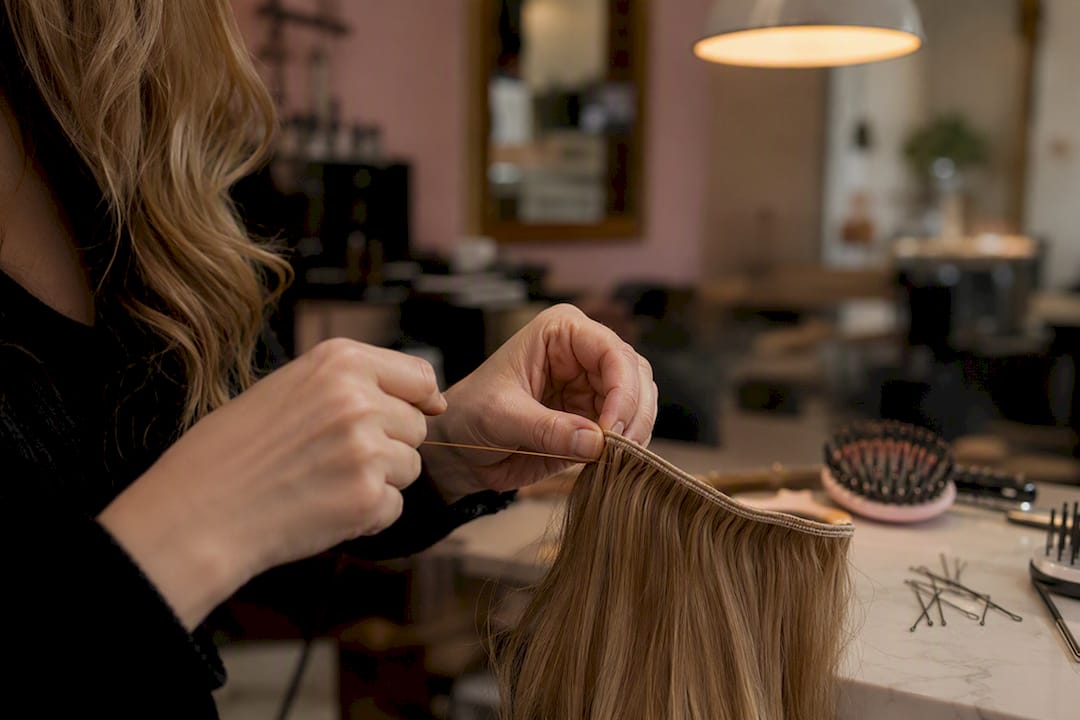
A hand-tied weft is built by tying and knotting individual sections of hair directly to the seam by hand. That process creates an extremely thin, flat base with no bulk at the root, which is why stylists reach for it when a client wants extensions that disappear against the scalp.
A machine weft is sewn using an industrial sewing machine, which stitches hair into a reinforced, denser track. That track holds up to tension and handling far better than a hand-knotted seam, and it can be trimmed to a custom width in the salon chair.
Here’s where most people get confused: “hand-tied” describes how the weft itself was made, not how it goes into your hair. Both weft types can be installed on a beaded row using the same sew-in technique — they just behave differently under that row’s tension because their seams are physically different.
- Hand-tied: knotted by hand, thin flat seam, sold pre-cut
- Machine weft: machine-stitched, thicker reinforced seam, cuttable to size
Pro Tip: Ask your stylist to show you the actual weft seam before installation. A quality hand-tied weft should lie almost flush against a flat surface, with no visible ridge when you run a finger along it.
How Construction Affects Seam, Thickness, and Weight
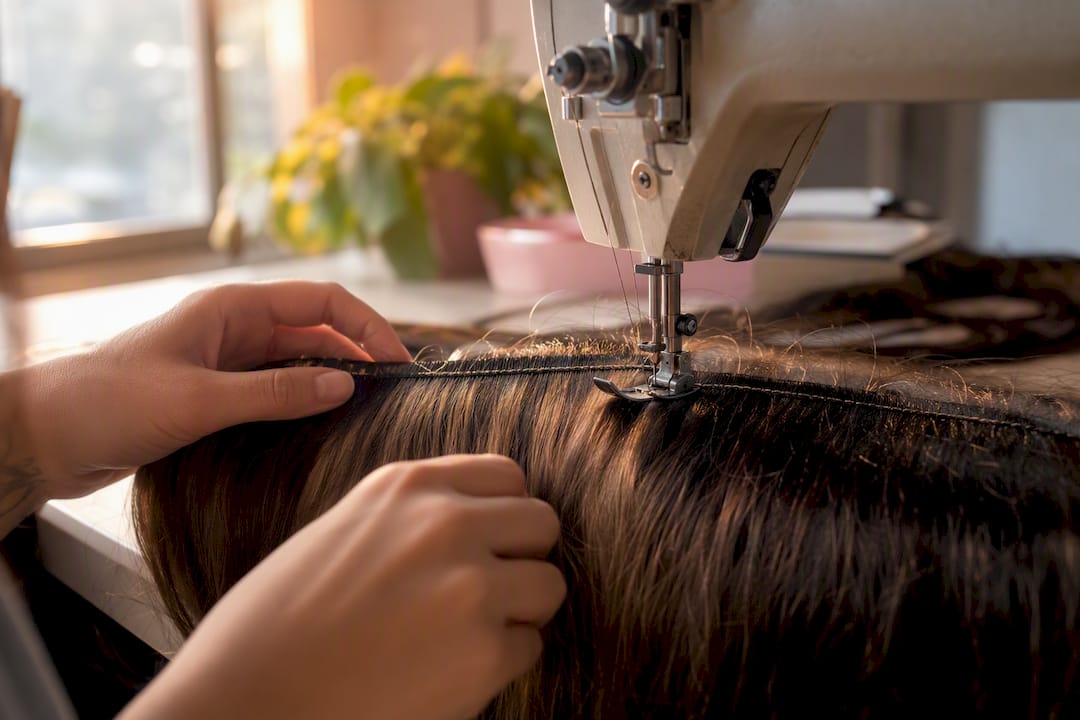
The seam is where these two products really part ways. Hand-tied wefts rely on individual knots, which keeps the base razor thin and light at the root, even when you stack multiple rows for length. Machine wefts rely on continuous machine stitching, which builds a thicker, sturdier track, but that extra structure adds weight and a slightly more noticeable profile close to the scalp.
That thickness difference also determines what you can do with the weft afterward. Machine wefts can generally be cut down to a custom width without compromising the seam, since the stitching holds firm even after trimming. Hand-tied wefts are usually sold pre-cut for a reason: slicing through hand-knotted sections risks unraveling the whole row, so most manufacturers avoid offering them in cuttable form.
- Hand-tied: thinner base, lighter at the root, sold in fixed lengths
- Machine weft: thicker base, sturdier structure, cuttable in-salon
Pro Tip: Check stitch density, not just thickness, when comparing brands. A machine weft with tight, even stitching sheds less than one with loose or irregular rows, even if both look similar at first glance.
Pros and Cons: Hand Tied vs Machine Weft
Every weft type trades something for something else. Here’s how the strengths and weaknesses stack up when you put them side by side.
Hand-tied advantages:
- Ultra-flat base that’s nearly undetectable at the root
- Lighter weight, which suits fine or fragile hair
- Easier to blend at visible partings and the hairline
Hand-tied disadvantages:
- Higher upfront cost per weft
- Can’t be cut down without risking the seam unraveling
- Rougher handling during washing or brushing can shorten its life faster than a machine weft would tolerate
Machine weft advantages:
- Stronger, more tear-resistant track that holds up to daily wear
- Generally cheaper to produce and buy
- Cuttable and customizable for a precise fit
Machine weft disadvantages:
- Thicker seam that can be more noticeable, especially on fine hair
- Heavier at the root, which some clients find less comfortable over long wear
If you only remember one rule from this whole comparison: hand-tied wins where you need invisibility and lightness, machine weft wins where you need volume and toughness. Almost every other decision flows from that.
Matching the Weft to Your Hair Type and Goals
Your hair density should drive this decision more than anything else. Fine or thin hair almost always looks and feels better with hand-tied wefts, since the flat base lies close to straight to wavy textures without adding bulk your natural hair can’t support. Medium-density hair has more flexibility and can often carry either type comfortably. Thick or coarse hair tends to benefit from machine wefts, which can hold two to three times the hair density of a hand-tied row, meaning fewer wefts are needed to hit the same volume.
Sensitive scalps generally do better with hand-tied wefts, thanks to the lighter root weight and reduced tension per row.
Visibility matters just as much as density. Hand-tied wefts are the safer pick anywhere your part or hairline is exposed, since machine seams are more likely to peek through in that zone.
- Everyday natural look: hand-tied throughout, prioritizing a flat, undetectable base
- Maximum volume for an event: machine wefts, layered for density without the cost of an all hand-tied install
- Corrective coverage for thinning areas: hand-tied near the crown and part, for our fine-hair guidance and a seamless finish
A hybrid setup, hand-tied at the crown and hairline, machine weft toward the back and underneath, is worth asking about if your goals split between “natural at the front” and “big at the back.”
Installation, Maintenance, and How Long Each Weft Lasts
Both weft types are typically installed the same way, sewn onto a beaded row your stylist creates along your natural hair. The beaded-row method takes roughly two to two and a half hours for a full head, regardless of which weft you choose, since the row-building process is what takes the time, not the weft itself.
Maintenance runs on a similar clock for both: most clients return every six to eight weeks for a push-up appointment to move the row back up as natural hair grows out. Skipping that appointment is the single biggest reason wefts fail early, since the row slips down and adds unnecessary tension near the ends.
Lifespan depends more on aftercare than on which weft you bought. Rough brushing, sleeping without braiding, and skipping the recommended push-up schedule will shorten either type’s life. Hand-tied wefts additionally suffer if someone tries to cut the seam at home, since unreinforced cutting causes unraveling that a machine weft simply won’t experience.
Neither weft type is inherently “damaging” on its own. The damage risk comes almost entirely from installation tension and aftercare habits, not from whether the seam was hand-knotted or machine-stitched.
Cost, Value, and Salon Appointment Time
Hand-tied wefts cost more to produce because each knot is done by hand, and that labor shows up in the price tag. Machine wefts, by contrast, can run roughly 30 to 60 percent cheaper than hand-tied or genius-style alternatives, while still holding up well against everyday wear.
Appointment time is similar for both weft types during a full install, generally two to two and a half hours, but maintenance visits can differ slightly depending on how many rows your stylist used and how dense your chosen weft is.
- Hand-tied: higher cost, justified when comfort and invisibility are the priority
- Machine weft: lower cost, better ROI when volume and durability matter most
If budget and volume both top your list, our weft extensions cost guide breaks down what typically drives the final price.
Styling and Blending Tips for a Seamless Result
Blending starts at the part. Ask your stylist to stagger hand-tied wefts along visible partings and face-framing sections, since their flat seam disappears more easily under a comb-through than a machine seam would.
A lightweight, silicone-free serum keeps strands smooth without weighing down a hand-tied row.
For a hybrid setup, use hand-tied wefts in the top two to three rows near the crown and part, then switch to machine wefts underneath for bulk. This gives you invisibility where people actually look and density where they don’t.
Pro Tip: Check seam visibility in motion, not just in a still mirror. Walk, shake your head, and check under bright overhead light, since that’s where a thick machine seam is most likely to show.
What Stylists Actually Recommend
Stylists lean on hybrid installs more often than a single weft type, because the two materials solve different problems. A hand-tied row handles comfort and invisibility; a machine weft handles bulk and budget. Combining them lets a client get both without over-compromising on either.
At HairLocks, that logic shapes how we talk clients through their options. A client with fine hair chasing serious length usually gets steered toward hand-tied wefts, including our own Genius Weft, because the flat base won’t overwhelm thin strands. A client with thick hair chasing red-carpet volume is usually better served by machine wefts, since fewer rows achieve the same density.
When in doubt, put hand-tied wefts where the eye lands first, near the part and hairline, and let machine wefts do the heavy lifting underneath. That single rule solves most fitting dilemmas.
Environmental and Ethical Considerations in Weft Production
Both hand-tied and machine wefts start from the same raw material: human hair, usually sourced from donors and processed into bundles before construction. The manufacturing step is where the two diverge. Hand-tied wefts require far more manual labor per unit, since each section is knotted individually, which means production is slower and typically involves more skilled artisan work in the supply chain. Machine wefts rely on industrial stitching equipment, which increases output speed and reduces labor hours per weft.
Neither method is clearly “greener” than the other in a measurable way, but the labor intensity behind hand-tied wefts is worth knowing if you care about where your extensions come from and how they’re made. Reputable suppliers, including HairLocks, source 100% human hair and favor double-drawn processing, which reduces waste by sorting hair more precisely by length before it ever reaches the weft stage. That precision means less unusable hair gets discarded during manufacturing compared to single-drawn, mixed-length batches.
Ethical sourcing also matters more than construction method when you’re evaluating a brand. Ask where the hair originates, whether donors were compensated fairly, and whether the company can explain its supply chain in plain terms. A brand that dodges the question, regardless of whether it sells hand-tied or machine wefts, is a bigger red flag than the weft type itself.
Mistakes People Make Choosing Between These Wefts
The most common mistake is choosing based on price alone, without factoring in hair density. A cheaper machine weft on very fine hair often looks and feels bulky, no matter how well it’s installed, because the seam simply carries more weight than delicate strands can support.
The reverse mistake happens too: clients with thick hair sometimes choose hand-tied wefts expecting a lighter feel, then need double the number of wefts to reach their desired volume, which erases most of the cost savings they thought they were getting.
Another frequent error is skipping the maintenance conversation before booking. Both weft types need push-up appointments roughly every six to eight weeks, and clients who assume a weft is “set and forget” often see faster shedding or discomfort simply from neglected upkeep, not from a flawed product.
Cutting a hand-tied weft at home to save a salon visit is a mistake that shows up almost immediately. Since hand-tied seams aren’t built to be trimmed, an at-home cut usually causes unraveling that a stylist then has to fix, or replace entirely.
Finally, people often assume “hand-tied” automatically means “better,” when it really means “different.” Machine wefts aren’t a downgrade; they’re a different tool built for volume and durability rather than invisibility.
How to Spot Quality in Either Weft Type
Quality varies wildly between brands and salons, and the differences aren’t always obvious at first glance. For hand-tied wefts, run your fingers along the seam. A well-made one should feel smooth and nearly flat, with knots that are tight and evenly spaced rather than loose or clustered. Loose knotting is the first sign of a weft that will shed prematurely.
For machine wefts, check stitch density along the track. Tightly packed, even stitching resists shedding far better than wide, irregular stitching, even when both wefts look similar under a quick glance. A track that feels stiff or brittle rather than flexible is often a sign of lower-grade hair or rushed manufacturing.
Hair quality matters as much as construction. That consistency shows up directly in how natural the extensions look once styled.
Salon reputation is its own quality signal. A stylist who asks detailed questions about your hair density, scalp sensitivity, and styling goals before recommending a weft type is generally more trustworthy than one who pushes a single product regardless of fit. If a salon can’t clearly explain why they’re recommending hand-tied over machine weft for your specific hair, that’s worth a second opinion.
A Note From the HairLocks Team
With 30 years in this industry, we’ve learned that the “best” weft is never universal. It depends entirely on your hair’s density, your scalp’s sensitivity, and what you’re actually trying to achieve. If you’re unsure which fits your hair, an in-salon consultation gives you a far more reliable answer than guessing from a photo online.
How HairLocks Helps You Choose the Right Weft
Picking between hand-tied and machine weft doesn’t have to be a guessing game done alone with a browser tab open. Hairlockshairextensions works through this decision with you directly, matching weft type to your actual hair density, scalp sensitivity, and styling goals rather than pushing whatever’s easiest to install.
Every weft we sell, including our Genius Weft, is made from 100% human hair, and double-drawn options are available for clients who want consistent length and thickness from root to tip. Our free personal color matching service removes another common guessing game, so your extensions blend with your natural color instead of standing apart from it.
If you want to see real results before deciding, browse our before-and-after gallery for a sense of what each weft type looks like on different hair densities. When you’re ready to move forward, book a consultation and we’ll walk you through hand-tied, machine weft, or a hybrid plan built around your hair, not a generic recommendation.
Sources
- Everything to Know About Hand-Tied Hair Extensions
- Machine Weft Hair Extensions Pros and Cons - Alove Hair
FAQ
What is the least damaging hair extension method?
Neither hand-tied nor machine weft is inherently more damaging; damage risk comes mostly from installation tension and aftercare. Hand-tied wefts tend to feel gentler on fine or sensitive scalps because of their lighter, flatter base.
How long do hand-tied wefts last?
With proper maintenance, hand-tied wefts can last through repeated six-to-eight-week push-up cycles, though lifespan depends heavily on aftercare rather than a fixed timeline. Rough handling or skipped maintenance visits shorten their life fastest.
What are the disadvantages of hand-tied hair extensions?
Hand-tied wefts cost more upfront, come in fixed pre-cut lengths, and can unravel if cut without professional reinforcement. They also require more careful handling than a machine weft’s sturdier track.
Are hand-tied hair extensions a better option than tape-ins?
Hand-tied wefts generally offer more comfort over long wear and better blendability at the hairline than tape-ins, since they distribute weight across a beaded row instead of adhesive strips. The right choice still depends on your hair density and how often you want maintenance appointments.
Can I mix hand-tied and machine wefts in one install?
Yes. Many stylists build hybrid installs, using hand-tied wefts near the crown and part for a seamless look, then machine wefts underneath for volume and cost efficiency.
Recommended
- Best Weft Extensions for Natural Volume in Australia – HairLocks Hair Extensions
- Genius Weft | Human Hair | 22" Length | Double Drawn – HairLocks Hair Extensions
- Best Extensions for Fine Hair: Safe Methods That Work – HairLocks Hair Extensions
- Thinning Hair Toppers: Best Australian Providers in 2026 – HairLocks Hair Extensions