


Best Extensions for Fine Hair: Safe Methods That Work
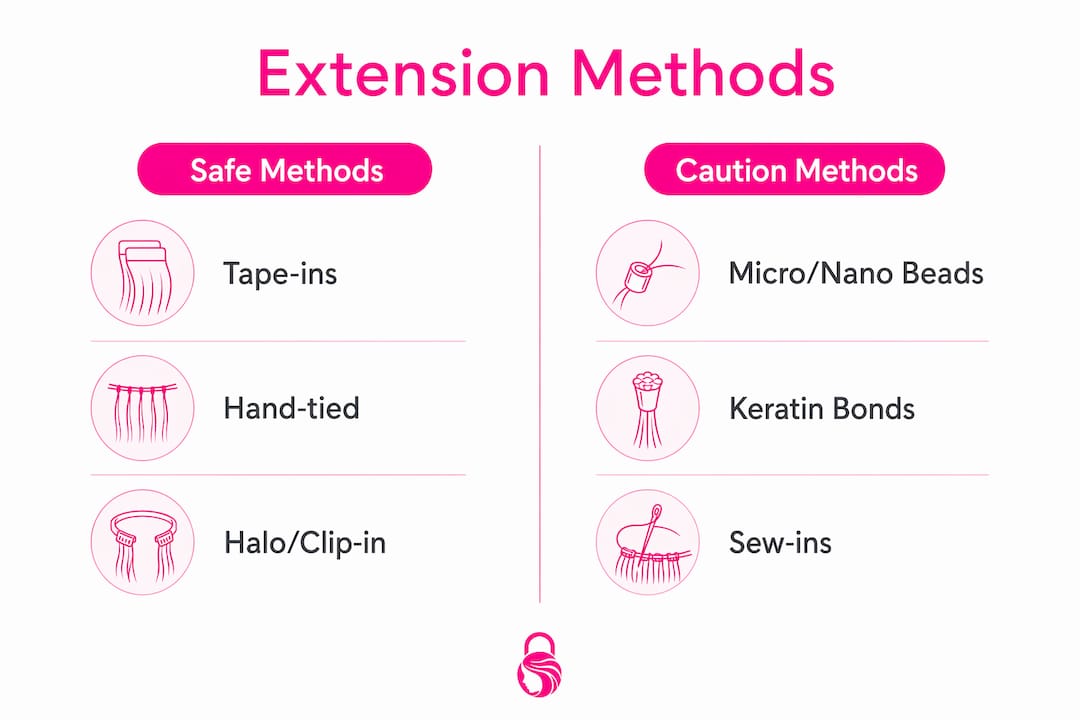
For fine or thinning hair, the safest and most natural-looking options are lightweight tape-ins, hand-tied wefts, halo or clip-in systems, and targeted toppers like the Hairlockshairextensions Top-Lock V-Part Topper. Each method serves a different goal:
- Volume without commitment: Halo and clip-in systems add fullness instantly, with no glue or heat, and come out every night.
- Length with a low damage profile: Lightweight tape-ins and hand-tied wefts distribute weight evenly and lie flat against the scalp.
- Targeted crown or part-line coverage: The Top-Lock V-Part Topper addresses thinning at the top without a full-head install.
If your hair is particularly fragile, start with a temporary clip-in or halo system before committing to anything semi-permanent. Better yet, book a personalized consultation at Hairlockshairextensions so a specialist can assess your hair density and recommend the right method from the start.
Pro Tip: Before any appointment, take a few photos of your hair in natural light from the crown and sides. A stylist can give you a much more accurate recommendation when they can see your density and growth pattern clearly.
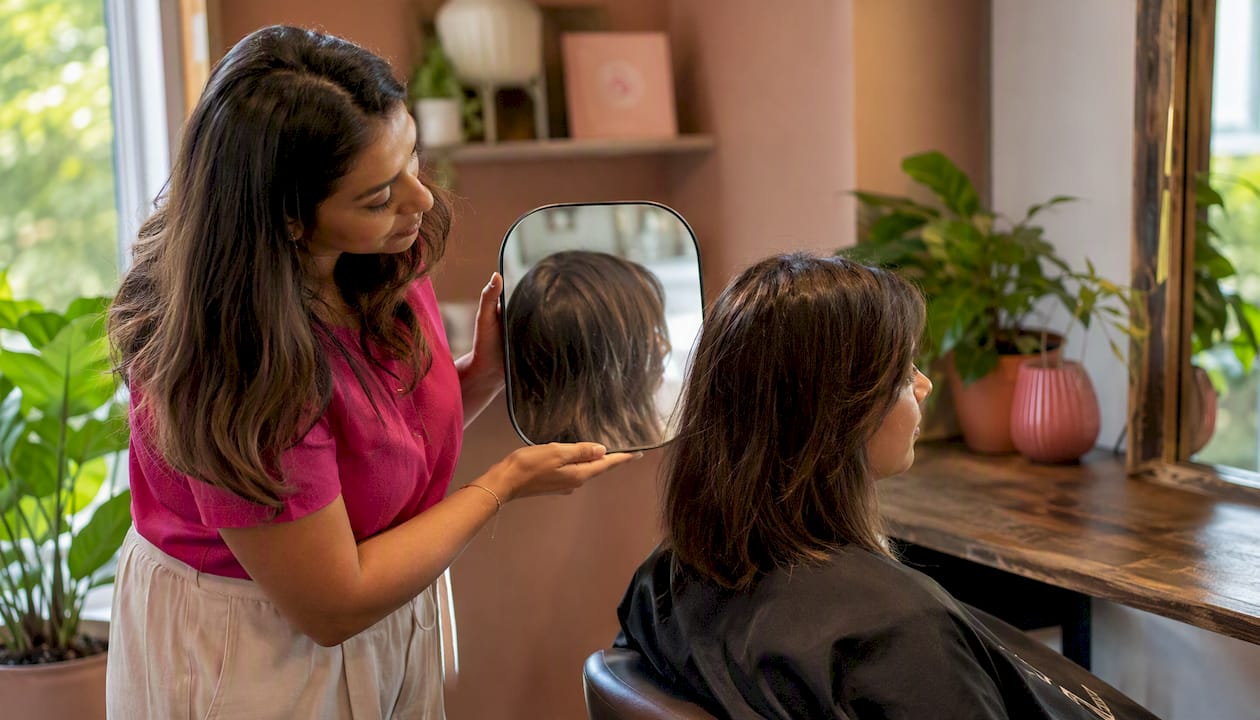
Table of Contents
- Why fine hair reacts differently to extensions
- What to check before choosing extensions for fine hair
- The best extension methods for fine or thin hair, compared
- How to decide which method is right for you
- Daily care and maintenance for extensions on fine hair
- How much do extensions cost, and how long do they last?
- Installation and styling tips for a natural look on fine hair
- Why Hairlockshairextensions is trusted for fine and thinning hair
- Key Takeaways
- What we see most often in consultations
- Fine hair deserves a tailored approach, not a one-size install
- Useful sources
- FAQ
Why fine hair reacts differently to extensions
Fine hair has a smaller strand diameter and lower overall density than medium or coarse hair. That combination means it tolerates less weight, less tension, and fewer attachment points before showing signs of stress. The risks are not hypothetical. Traction from heavy wefts or oversized bonds can cause traction alopecia, a form of hair loss driven by repeated pulling at the follicle. Concentrated bonds, such as large keratin tips applied to a single thin strand, create a leverage point that the hair simply cannot support long-term.
Bulked sew-in wefts are another common problem. When a thick weft is sewn tightly to fine hair, the weight pulls downward constantly, and the braided base adds pressure at the root. Repeated adhesive exposure from tape-ins that are not properly maintained can also weaken the hair shaft over time. Hand-tied wefts and halo systems are frequently recommended as gentler alternatives because they spread weight across a wider area and avoid concentrated attachment points.
Avoid permanent bonded methods entirely if you have an active scalp condition (psoriasis, seborrheic dermatitis), are currently experiencing shedding, or have hair that snaps easily when dry. These are situations where even a well-placed extension can accelerate damage.
Pro Tip: A simple strand test tells you a lot: take a single dry strand and gently stretch it. If it snaps without any elasticity, your hair needs a conditioning treatment before any extension method is considered.
What to check before choosing extensions for fine hair
A quick checklist you can use in a salon or when shopping online:
Material and construction:
- 100% human Remy hair only. Lightweight bases and Remy hair blend more naturally and can be heat-styled to match your texture.
- Single-sided tape or silicone-backed weft construction. Flat bases stay invisible under fine hair.
- Weft weight under 50 grams per row for fine hair installs.
- Bond or bead size scaled to your strand thickness, never a standard large bond on a thin section.
Red flags to avoid:
- Heavy sew-in wefts with a braided base.
- Large keratin bonds applied to single thin strands.
- Clip-in bases with thick, rigid clips that create visible ridges.
- Any stylist who does not ask about your hair history before recommending a method.
Questions to bring to your stylist:
- How will you distribute the weight across my head?
- Can you reduce the bond or tape size for my density?
- What maintenance schedule do you recommend for my hair type?
- Which removal method do you use, and will you do it in-salon?
- Do you carry extension-safe products I can use at home?
- Have you worked with hair at my density level before?
The best extension methods for fine or thin hair, compared
These methods share one quality that matters most for fine hair: they balance lightness, flat installation, and low tension. The right choice depends on your goal, your schedule, and how much commitment you want.
Tape-in extensions
Tape-ins are one of the most popular choices for fine hair because they lie completely flat against the scalp. Medical-grade adhesive strips sandwich a thin section of natural hair, creating a bond that is nearly invisible under fine strands. A full install typically takes about an hour, and the extensions can be reused up to three times with proper care. Single-sided tape-ins are the better option for fragile hair because they apply less pressure to the strand. The main maintenance requirement is a move-up appointment every 6–8 weeks as the natural hair grows.
Best for: Length and volume. Damage risk: Low when maintained correctly. Commitment: Semi-permanent.
Hand-tied wefts
Hand-tied wefts are thin, flexible rows of hair sewn by hand onto small beaded tracks close to the scalp. No heat, no glue. Because the weft is so thin, it distributes weight across the entire row rather than concentrating it at a single point. Skilled stylists can install these so they stay secure for up to eight weeks before a maintenance visit. They are particularly good for clients who want noticeable volume and length without the rigidity of bonded systems.
Best for: Volume and length together. Damage risk: Low with proper bead placement. Commitment: Semi-permanent.
Halo and seamless clip-in extensions
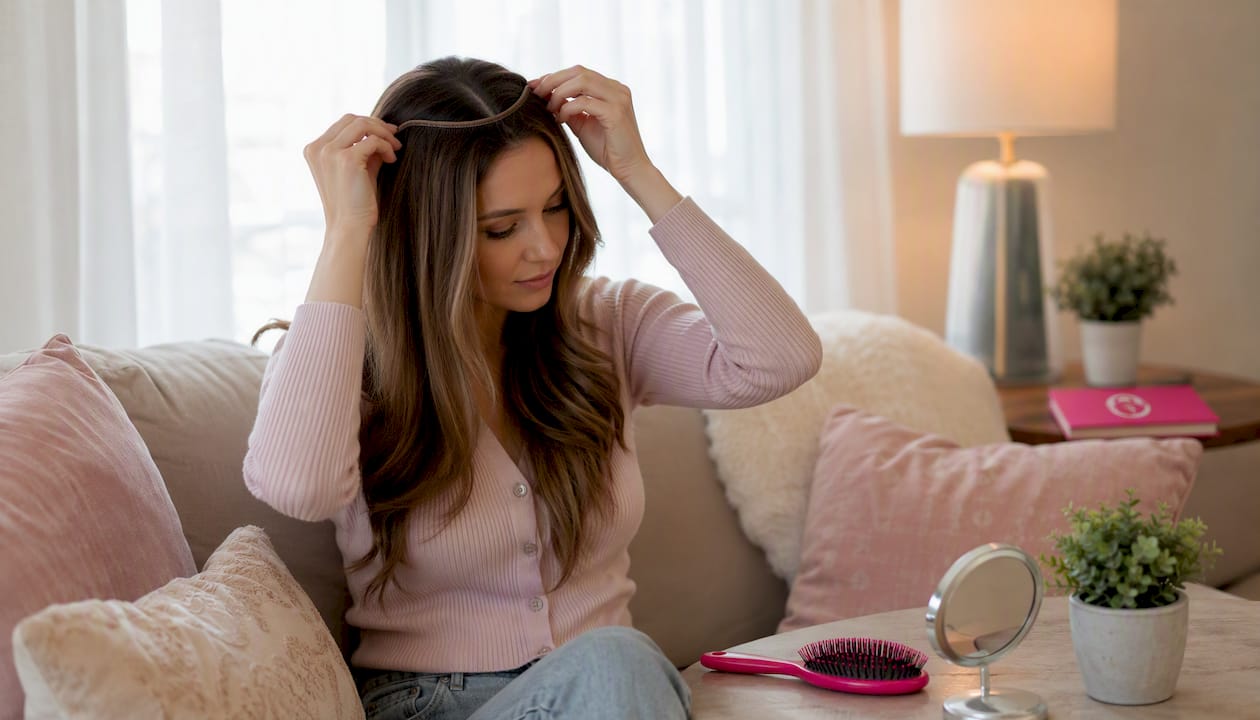
Clip-ins and halo systems require no glue, heat, or permanent bonds and can be removed every night. That makes them the least damaging option available. A halo extension sits on a thin wire that rests on the crown, hidden under the top layer of hair. Clip-ins attach with small pressure clips along sectioned rows. Both are excellent first choices for women who want to test volume or length before committing to a semi-permanent method. The trade-off is daily application time and the fact that they are not suitable for active lifestyles where the hair is frequently wet or pulled back tightly.
Best for: Temporary volume or length. Damage risk: Minimal. Commitment: Temporary.
Micro and nano bead extensions
Micro-link (micro bead) and nano bead systems attach small sections of extension hair to natural strands using tiny metal rings, with no heat or adhesive. Nano beads are smaller than micro beads, making them the better fit for very fine hair. The key technical detail is bead size: a bead that is too large for the strand creates a pressure point that can cause breakage. When sized correctly and installed by an experienced technician, these systems can last 3–4 months with regular tightening appointments. They are not a good choice for hair that is actively shedding or very fragile.
Best for: Length with a natural movement. Damage risk: Moderate if beads are oversized. Commitment: Semi-permanent.
Keratin bond (K-tip) extensions
Keratin bonds fuse small sections of extension hair to natural strands using a keratin polymer. For fine hair, the critical variable is bond size. A technician who reduces the bond to match your strand density creates an attachment that is nearly invisible and exerts minimal tension. Applied with cold ultrasonic technology rather than heat, these bonds are gentler on heat-sensitive or fine hair. With proper care, keratin bonds can last up to six months. They require professional removal, which is non-negotiable for fine hair.
Best for: Long-term length and volume. Damage risk: Low to moderate, depending on bond size and technician skill. Commitment: Permanent until professionally removed.
Toppers for targeted coverage
A topper is a partial hairpiece that clips onto the crown or part line, adding volume and coverage exactly where fine hair is most visible. The Hairlockshairextensions Top-Lock V-Part Topper is designed specifically for thinning or fine hair, providing discreet coverage without a full-head install. Toppers are a lower-risk alternative for women who want to address crown thinning without committing to extensions across the entire head. They are also a practical option for women whose hair is too fragile for any bonded system.
Best for: Targeted crown or part-line coverage. Damage risk: Very low. Commitment: Temporary.
How to decide which method is right for you
Prioritize hair health first, then choose the least invasive method that meets your goal.
Decision flow:
- Assess your hair health. Is your hair actively shedding, breaking, or thin at the scalp? If yes, start with a topper or clip-in only, and address the underlying health issue first.
- Define your goal. Volume only? A halo or topper is enough. Length? Tape-ins or hand-tied wefts. Targeted coverage? A topper.
- Choose your commitment level. Temporary (clip-ins, halo, topper) for flexibility. Semi-permanent (tape-ins, hand-tied wefts, micro/nano beads) for longer wear. Permanent (keratin bonds) for maximum longevity.
- Cross-check against the checklist in the section above. Confirm bond size, base type, and Remy hair quality before agreeing to any install.
- Book a consultation. Hairlockshairextensions offers a free color matching service that also covers method suitability for your hair type.
Red flags that should prompt a second opinion:
- A stylist recommends a heavy sew-in without asking about your density.
- No patch test or allergy check is offered before keratin bonds.
- The stylist cannot explain how they will remove the extensions safely.
- You are told your hair is “fine enough” for any method without a proper assessment.
If you have very short fine hair, read through the guidance on extensions for short hair before your appointment, as length affects which methods are viable.
Daily care and maintenance for extensions on fine hair
Lighter products and gentler handling extend the life of your extensions and protect your natural hair underneath.
Daily and weekly routine:
- Brush from the ends upward using a soft-bristle or loop extension brush before washing and before bed.
- Wash in a downward motion, never scrubbing at the bonds or roots.
- Apply conditioner from mid-length to ends only, keeping it away from tape bonds and bead attachments.
- Sleep with hair in a loose braid or use a silk pillowcase to reduce friction and tangling.
- Let hair air-dry when possible; if using heat, apply a lightweight heat protectant first.
Products to use and avoid:
Use sulfate-free shampoos, lightweight leave-in conditioners, and extension-safe oils applied sparingly to the mid-lengths and ends. The care sheet from Hairlockshairextensions outlines a full routine. Avoid heavy silicone serums, oil-based products near the roots, and any formula with alcohol high on the ingredient list. These break down adhesive bonds and cause buildup at the weft base.
Maintenance schedule by method:
| Method | Maintenance interval | Typical salon check |
|---|---|---|
| Tape-in extensions | Every 6–8 weeks | Re-tape and move up |
| Hand-tied wefts | Every 6–8 weeks | Bead tightening and weft reposition |
| Micro/nano bead | Every 6–8 weeks | Bead tightening or replacement |
| Keratin bonds | Every 3–4 months | Bond check and move-up |
| Toppers | As needed | Clip and base inspection |
On removal: Always have bonded systems (keratin bonds, micro/nano beads) removed by a professional. Attempting to pull or cut bonds at home risks taking natural hair with them. Tape-ins can be removed at home with a bond remover solution, but professional removal is still the safer choice for fine hair.
How much do extensions cost, and how long do they last?
Clip-ins are the most affordable entry point, while semi-permanent methods cost more upfront but deliver longer wear. Here is a realistic picture of what to expect:
- Clip-ins and halo systems: Lower initial cost, reusable for 1–2 years with care. No installation fee. Best for occasional wear.
- Tape-in extensions: Mid-range install cost, with maintenance visits every 6–8 weeks. The extensions themselves can be reused up to three times, which reduces the per-wear cost over time.
- Hand-tied wefts: Higher install cost due to the skill and time involved, with 6–8 week maintenance intervals. Longevity of 3–6 months per set.
- Micro/nano bead extensions: Similar cost range to hand-tied wefts. Last 3–4 months before a full reinstall is needed.
- Keratin bonds: Highest upfront cost. With proper care, they can last up to six months, making the per-month cost competitive with other semi-permanent methods.
- Toppers: One-time product cost, no installation fee, reusable long-term.
Pro Tip: Try a temporary system (clip-ins or a topper) for 4–6 weeks before investing in a semi-permanent method. You will learn exactly how much volume or length you want, which makes the permanent install more precise and cost-effective.
Installation and styling tips for a natural look on fine hair
Small, distributed attachment points and flat bases are what keep extensions invisible on fine hair. A good stylist will section the hair into thin rows, place tape or beads no closer than half an inch from the scalp, and graduate the weft placement so the weight is spread across multiple rows rather than concentrated in one band.
Stylist techniques that matter:
- Using thinner wefts cut to match your head shape rather than standard-width panels.
- Blending the extension hair with a light point-cut or texturizing technique so the ends match your natural hair’s movement.
- Placing lighter-colored extensions near the face and slightly darker ones toward the back to mimic natural dimension.
- Hiding wire or clip bases under a thin top layer of natural hair, secured with a small amount of dry texture spray.
At-home styling:
- Always brush before applying heat, starting at the ends and working upward.
- Use a flat iron or curling wand at a moderate temperature (below 380°F) and keep the tool moving rather than clamping and holding.
- For updos, avoid pulling the hair tight at the attachment points. A loose, low bun or braid is gentler than a high ponytail.
Pro Tip: Ask your stylist to cut a few face-framing layers into the extension hair after installation. This single step does more to blend fine natural hair with extensions than any product or styling technique.
For more ideas on adding fullness, the extensions for volume guide from Hairlockshairextensions covers technique-specific tips in detail.
Why Hairlockshairextensions is trusted for fine and thinning hair
Hairlockshairextensions was founded by Michele, whose 30 years of salon experience is the foundation of every recommendation and installation the brand offers. That depth of experience matters most for fine or thinning hair, where the margin for error is smaller and the consequences of a poor install are more visible.
Every extension Hairlockshairextensions uses is 100% human Remy hair, selected for its ability to blend naturally with fine strands and be styled without the stiffness or shine that synthetic hair produces. The brand’s trust signals for fine-hair clients include:
- Top-Lock V-Part Topper: Designed specifically for thinning hair, providing discreet crown coverage without a full-head install.
- Free personal color matching: Reduces the risk of visible seams and color mismatch before you commit to a purchase.
- Before and after gallery: Real client outcomes showing natural blending and volume results across different hair types.
- Personalized consultations: Every client receives a tailored recommendation based on their hair density, goals, and lifestyle.
View real transformations in the before and after gallery or book a free color match to see which method fits your hair.
Key Takeaways
The safest extensions for fine hair are lightweight, flat-based systems installed by an experienced technician using 100% human Remy hair, with a maintenance schedule matched to your method.
| Point | Details |
|---|---|
| Start temporary | Clip-ins or a halo system let you test volume and length with zero damage risk before committing. |
| Prioritize flat bases | Single-sided tapes and thin silicone-backed wefts stay invisible and reduce tension on fine strands. |
| Maintenance is non-negotiable | Tape-ins and hand-tied wefts need a salon visit every 6–8 weeks to prevent slippage and root stress. |
| Professional removal matters | Bonded systems must be removed by a technician to avoid taking natural hair with the extension. |
| Hairlockshairextensions | Offers the Top-Lock V-Part Topper, 100% human Remy hair wefts, and a free color match tailored to fine hair. |
What we see most often in consultations
The single most common mistake we see is clients arriving with hair that has already been damaged by a previous extension method, usually a heavy sew-in or oversized keratin bonds applied to strands that were too fine to support them. The good news is that most of these cases are recoverable with the right approach.
A typical outcome we see regularly: a client with fine, shoulder-length hair and visible thinning at the crown comes in after years of avoiding extensions because she assumed her hair was “too thin.” After a proper assessment, she leaves with the Top-Lock V-Part Topper for crown coverage and a small set of lightweight tape-ins for length. The result is natural, the installation is comfortable, and her natural hair is not compromised. That kind of outcome is possible for most fine-haired clients when the method is matched carefully to the hair.
The warning worth repeating: overloading fine hair with too many grams of extension weight, or ignoring root health between maintenance visits, undoes every benefit the extensions provide. Extensions should make your hair look better and feel healthier, not the opposite.
Fine hair deserves a tailored approach, not a one-size install
Hairlockshairextensions specializes in exactly the kind of careful, personalized work that fine and thinning hair requires. Michele’s 30 years of experience means every consultation starts with a real assessment of your hair density, not a standard package recommendation.
The Top-Lock V-Part Topper is the brand’s most requested solution for crown thinning, made from 100% Russian human hair and designed to clip in discreetly without any bonding or heat. For clients who want length and volume across the full head, Hairlockshairextensions offers hand-tied wefts, nano and micro bead systems, and keratin bond extensions, all using Remy hair matched to your color through a free personal color match service.
The next step is simple: view the gallery to see real results on fine hair, then book a consultation to get a recommendation built around your specific hair.
Useful sources
Use these resources when preparing for a salon consultation or comparing methods on your own:
- Before and After Gallery, Hairlockshairextensions: Real client transformations showing blending and volume results across hair types.
- Free Color Matching Service, Hairlockshairextensions: Book a free match before purchasing to eliminate color mismatch risk.
- StyleSeat: Hair Extensions for Thin Hair: Practical breakdown of methods suited to thin hair, including tape-in and hand-tied weft comparisons.
- Allure: Best Hair Extensions: Editorial roundup covering temporary and semi-permanent options with damage-risk context.
- ConditionerHacks: Best Extensions for Fine Hair: Buyer-focused guide with material and base-type recommendations for fine hair.
These sources are most useful when you want to walk into a consultation with specific questions about methods, materials, and maintenance already prepared.
FAQ
Which extensions are best for fine hair?
Lightweight tape-ins, hand-tied wefts, halo systems, and the Hairlockshairextensions Top-Lock V-Part Topper are consistently ranked as the best options for fine hair because they distribute weight evenly and use flat, low-profile bases that stay hidden.
Can I get hair extensions with fine hair?
Yes. Fine hair can support extensions when the method, bond size, and weight are matched to your density. A professional assessment before installation is the most reliable way to confirm which system is safe for your specific hair.
Can hair be too fine for extensions?
Actively shedding hair, hair with very low density at the scalp, or hair that snaps without elasticity may not be ready for any bonded system. In those cases, a topper or clip-in is the safer starting point while the underlying hair health is addressed.
Which hair extensions are least damaging for fine hair?
Clip-ins and halo systems are the least damaging because they require no glue, heat, or permanent bonds and can be removed nightly. Among semi-permanent methods, hand-tied wefts and single-sided tape-ins carry the lowest damage risk when installed and maintained correctly.
Recommended
- Extension Friendly Hair Products: Your 2026 Australia Guide – HairLocks Hair Extensions
- Best Extensions for Short Hair in Australia 2026 – HairLocks Hair Extensions
- Best Shampoo for Extensions: Top Picks in Australia – HairLocks Hair Extensions
- Best Hair Extensions Australia: Top 14 Providers Ranked – HairLocks Hair Extensions