


Match Hair Extensions by Testing Mid Length Hair in Sunlight
Get a near-perfect color match by testing swatches against your mid-length hair, not your roots, in natural daylight. Identify your level (how light or dark) and your undertone (warm, cool, or neutral) first. Then confirm the match with a physical sample or a free professional photo review before you commit to a full set.
TL;DR:
- Testing swatches against mid-length hair in natural daylight ensures a more accurate match than roots, which are often darker and more faded.
- Using physical samples or color rings provides a more reliable match than photo-based tools, as lighting and camera quality can distort online matches.
- For multi-tonal or highlighted hair, blending two shades around 60/40 creates a natural look, especially when placing lighter shades near the crown and darker underneath.
- Confirming color with a sample weft reduces costly errors, especially when your hair has warmth, highlights, or recent color treatments.
- Always check the shade in multiple lighting conditions and avoid trusting shade names, which vary widely among brands.
Table of Contents
- What Are Your Color Matching Options: Photo Match, Live Chat, or Samples?
- How Do You Color Match Extensions at Home?
- How Do You Match Balayage, Ombre, or Highlighted Hair?
- Which Testing Tool Actually Gives You Confidence: Rings, Samples, or Apps?
- What Does a Salon-Grade Color Match Look Like?
- What’s the One Habit That Stops Most Color Mismatches?
- Get Your Free Color Match Before You Order
- Sources
- FAQ
What Are Your Color Matching Options: Photo Match, Live Chat, or Samples?
Most extension brands now offer some version of a free colour-match service, usually a photo submission form or a live chat with a stylist who eyeballs your pictures against a shade chart. These work well as a first pass, especially for solid, single-process color. The catch is that photo-based matching depends heavily on lighting and camera settings, and a phone camera can shift a warm caramel toward gold or flatten a cool ash brown into something muddier than it really is.
That is why a physical sample piece or a color ring changes the equation. You are no longer trusting a screen. You are holding the actual fiber next to your hair in your own bathroom mirror.
- Photo match or live chat: free, fast (often same-day), best for close-to-single-shade hair
- Sample weft or single test piece: small cost, a few days’ shipping, ideal for anyone unsure between two adjacent shades
- Color ring: free or low-cost, instant reference, but shows flat tone rather than dimension
- In-person or salon consultation: highest accuracy, best for balayage, grey blending, or color-treated hair
A small sample order tends to prevent costly returns far more reliably than a photo review alone, particularly if your hair has any warmth, highlights, or recent color processing.
How Do You Color Match Extensions at Home?
You do not need a stylist in the room to get this right. You need good light, clean hair, and a method. Here is the checklist we walk clients through before they ever pick up a swatch.
- Prep your hair. Shampoo out any product buildup and skip toners, dry shampoo, or heavy conditioner the day you test. Product residue casts a dull film that throws off both level and undertone.
- Shoot in natural light against a white backdrop. Overhead kitchen lighting or a bathroom vanity bulb will warp your color. Stand near a window at midday, and hold a plain white sheet of paper or towel behind your head.
- Take three photos. One from root to ends showing your natural gradient, one close-up of a mid-length section, and one full-length shot for overall context.
- Run a quick level check. Picture a scale from 1 (black) to 10 (lightest blonde). Most people have a hair color level in the mid-range of the scale. Compare your mid-shaft hair, not your roots, since roots often run a shade or two darker.
- Test undertone with white paper. Hold a plain white sheet next to a strand in daylight. Gold or red flecks mean warm; ash or beige flecks mean cool; barely any shift means neutral.
- Hold the swatch against mid-length hair in sunlight, then check again indoors. A shade that looks perfect under a window can read two tones off under LED bulbs, so always double-check in both settings.
- If your hair is multi-tonal, order two adjacent shades. Blend roughly 60% of your dominant shade with 40% of the secondary tone across the installation for natural depth.
- Use fast fixes for small gaps. A tinted root spray, a dusting of dry shampoo, or a light trim at the blend point can smooth over a shade that is close but not flawless.
Pro Tip: Never judge a swatch against your roots. Your ends have almost always seen more sun, more heat styling, and more fading, so that is the true target zone for a seamless blend.
How Do You Match Balayage, Ombre, or Highlighted Hair?
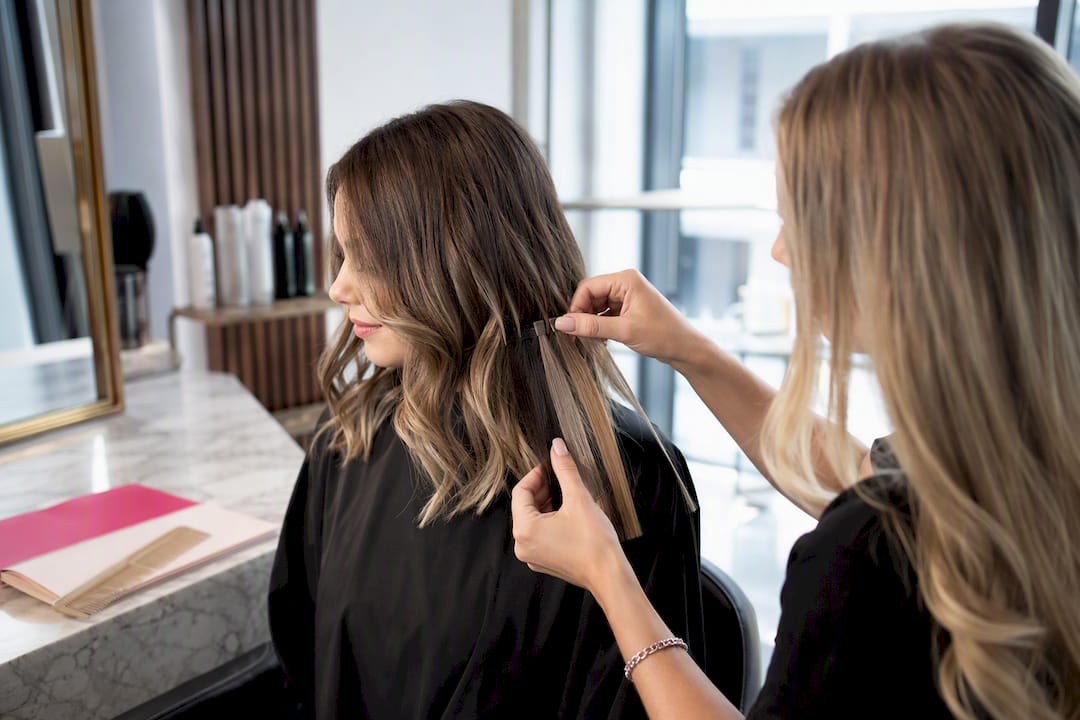
A single flat shade almost never works on dimensional color. Balayage, ombre, and heavily highlighted hair have light and dark pieces woven through them, and a solid-tone extension dropped in the middle of that will look like a stripe instead of a strand.
Two paths solve this. Pre-made ombre or balayage extension sets are built with the transition already baked in, which saves you the guesswork if your gradient is fairly standard. Custom-toned wefts, where a stylist adjusts the base color to match your specific pattern, cost more but fit irregular or heavily lived-in color far better.
- Pre-made ombre/balayage sets work best for classic root-to-tip fades
- Custom toning suits uneven highlights, grown-out color, or grey blending
- Mixing two purchased shades at roughly 60% primary and 40% secondary recreates dimension without a custom order
- Placement matters as much as color. Keep the lighter piece toward the crown and let the darker piece sit underneath, mimicking how sun actually hits natural hair
If your pattern is genuinely irregular, a stylist consult is worth the appointment. Toning ends or extensions before install is a standard professional move for exactly this reason, and it is not something a photo tool can replicate. If you are curious whether your current color could be adjusted to simplify future matching, dyeing extensions safely is worth reading before you commit.
Which Testing Tool Actually Gives You Confidence: Rings, Samples, or Apps?
Each tool answers a different question, and knowing which one you actually need saves time and money.
- Color rings give you a fast tonal reference across a full range, but they show flat, single-dimension color and can’t reveal how a shade behaves once it is layered into your natural hair.
- Sample wefts let you test texture, sheen, and blend in real conditions, under your bathroom light, against your actual part, which matters because fiber sheen and texture cause mismatches that color alone won’t explain.
- AI and photo-match tools speed up the shortlist stage, but they remain dependent on lighting and camera calibration, so treat the result as a starting point, not a final answer.
- Expect sample shipping to run a few days to just over a week depending on the vendor, and a small material cost that is minor compared to reordering a full wrong-color set.
If you are also weighing length alongside color, our length guide explains how longer pieces can shift how a color reads once they are blended in.
What Does a Salon-Grade Color Match Look Like?
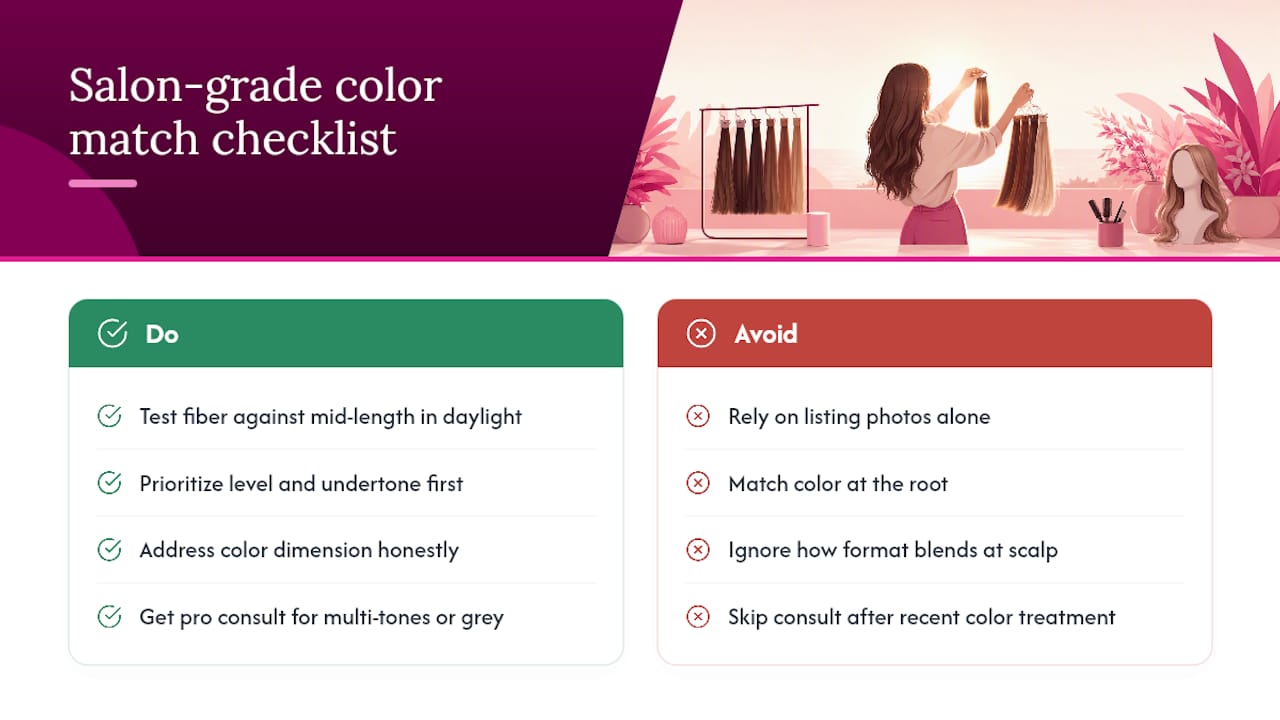
A matching process that follows the same principle a stylist uses chairside: level and undertone first, mid-length reference always, dimension addressed honestly rather than glossed over. Hair extension formats include weft, nano bead, micro bead, and keratin bond extensions, plus toppers designed for women managing thinning hair; each format changes how color needs to be approached since bonded methods blend differently at the scalp than clip-in wefts do.
Experienced stylists bring pattern recognition to that judgment call, catching a mismatched undertone before it ever reaches a photo.
A color that looks right in a listing photo can still fall apart against real hair once it hits daylight. The only way to know for certain is to hold the actual fiber against a section that has lived through sun, heat, and time, which is almost always the mid-length, never the root.
A professional consult earns its cost when your hair carries multiple tones, recent color treatment, or noticeable grey. For close-to-single-shade hair, the at-home checklist above will usually get you there.
What’s the One Habit That Stops Most Color Mismatches?
Most mismatches trace back to three habits: matching at the root, trusting a shade name like “caramel” as if it means the same thing across every brand, and testing under artificial light. Color names vary wildly between manufacturers, so level and undertone matter far more than what a shade is called.
The single habit that fixes this: always hold the swatch against mid-length hair, in daylight, before you buy. When you are still unsure, request a sample piece. It costs little and settles the question a photo never fully can.
— HairLocks
Get Your Free Color Match Before You Order
Guessing your shade from a product photo is how most mismatched extensions end up back in a return box. Some brands offer a free, personalized color-match service to help customers get a stylist’s judgment before ordering, reducing the chance of receiving a set with the wrong color.
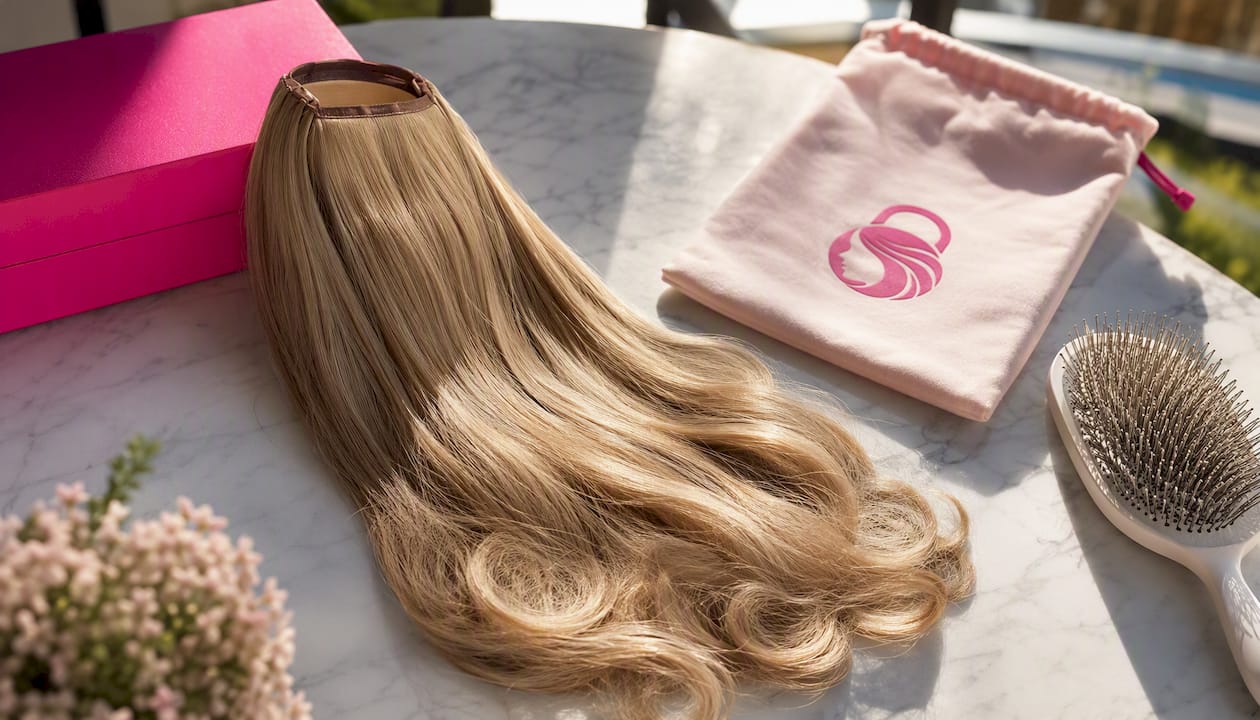
One option worth a close look is the U Part Clip In Hair Extensions in Caramel Blonde, a 24 inch, 260 gram set with a blow-dry wavy finish built for real thickness rather than a thin, see-through weft. To request a match, send photos of your hair root-to-ends in natural light, or ask about a sample piece if your color runs multi-tonal. After ordering, you’ll typically have a window to test the piece against your hair in different lighting before deciding whether to keep it, so you’re never locked into a purchase based on a screen alone. If your hair has thinned rather than just needing length, some teams can also advise whether a specialized topper might be a better fit. Start with the U Part Clip In extensions product page to see current stock and request your match today.
Sources
The Beauty Edit’s color-matching guide breaks down the level-and-undertone technique professionals actually use chairside. Routes Hair Extensions’ interactive colour guide is a useful hands-on tool for narrowing shade options before you order a sample. Byrdie’s tested review of clip-in extensions is worth reading if you want a sense of how shade range affects real-world matching success.
If your hair involves any thinning or scalp concerns alongside color matching, Hair Art Clinics’ free hair analysis offers a diagnostic starting point. Whichever tool you use first, treat a photo-only result as a lead, not a final answer, and confirm with a physical swatch whenever you can.
- How to Color Match Hair Extensions for a Natural Look | The Beauty Edit
- Colour Match | Routes Hair Extensions | Interactive colour guide
- The 9 Best Clip-In Hair Extensions of 2026, Tested and Reviewed | Byrdie
FAQ
How do I color match my extensions?
Compare a physical swatch or sample piece against your mid-length hair in natural daylight, checking both level (how light or dark) and undertone (warm, cool, or neutral) rather than relying on a shade name alone.
How do I find hair extensions that match my hair color?
Start with a free photo-match or live chat service for a quick shortlist, then confirm with a sample weft or color ring, since lighting and camera settings can distort how a shade reads in a photo.
How do I tell what color my hair is for extensions?
Hold a plain white sheet of paper next to a mid-length section in daylight. Gold or red tones flag warm hair, ashy or beige tones flag cool hair, and little shift at all usually means neutral.
Do extensions have to match my hair color exactly?
Not exactly, but they should be close in level and undertone at the blend point. For highlighted or balayage hair, mixing two adjacent shades at roughly 60/40 often looks more natural than forcing a single uniform tone.