


Consultation First: Keratin Bonds for Fine Hair, When to Prefer a Topper
Keratin bond extensions can work well on fine or thinning hair, but only when a stylist chooses the right bond size, spacing, and strand weight for your specific density. The extensions themselves are not the risk; poor application is. Get a professional hair assessment first, and if your thinning is more advanced, ask about the Top~Lock V-Part Topper, a lower-stress alternative.
TL;DR:
- Proper application with smaller, spaced-out bonds and lighter strand weights is crucial for the safety of fine hair during keratin extension installation.
- A professional hair assessment should guide bond size, placement, and spacing, especially for thinning or fragile hair, rather than relying on standard techniques.
- Keratin bonds need regular tightening and proper aftercare, including gentle detangling, sulfate-free products, and avoiding heat damage to prevent breakage and brittleness.
- For widespread thinning or scalp sensitivity, non-bonded options like toppers or lightweight wefts may offer a safer, lower-stress alternative.
- The success and safety of keratin extensions on fine hair depend more on skilled application and personalized treatment than on the extension brand or product alone.
Table of Contents
- Keratin Bonds and Fine Hair: When They Work Best
- How Do Keratin Bonds Actually Attach to Hair?
- Are Keratin Bonds Safe for Fine or Thinning Hair?
- What Should Happen at a Keratin Bond Appointment?
- Aftercare, Removal, and Warning Signs to Watch
- HairLocks and Fine Hair: A Consultation-First Approach
- Which Extension Method Actually Suits Thinning Hair Best?
- What Does a Keratin Bond Install Cost on Fine Hair?
- Could I Have an Allergic Reaction to Keratin Bonds?
- From Consultation to Your First Move-Up: What to Expect
- Fine Hair Deserves Judgment, Not a Default Setting
- Ready to Find Out What Your Hair Can Support?
- Sources
- FAQ
Keratin Bonds and Fine Hair: When They Work Best
Keratin bonds suit fine hair best when your strands are thin but still structurally healthy, with no active scalp inflammation or advanced miniaturization at the follicle. The technique earns its reputation because bonds are tiny and discrete, which lets a skilled stylist distribute tension across many small points rather than a few heavy ones. Guidance from extension educators confirms this only holds true when bond size and spacing are matched to your actual density, not applied at a standard thickness.
Correct application for fine hair generally means:
- Smaller, flatter bonds spaced wider apart than a standard install
- Lighter strand weight per bond to avoid pulling on fine follicles
- Fewer total bonds concentrated away from the most fragile perimeter hair
- A consultation that maps your density before any bonds go in
Pro Tip: Ask your stylist to show you the bond size before it goes in your hair. If it looks the same as what they’d use on thick hair, that’s a mismatch worth questioning.
If your crown thinning is widespread rather than localized, a topper solution can deliver volume without per-strand stress on already-fragile follicles. Either path starts the same way: book a consultation and let a hair assessment guide the decision instead of guessing.
How Do Keratin Bonds Actually Attach to Hair?
A keratin bond is a small pellet of protein-based adhesive fused to the top of a strand of extension hair. Heat from a specialized tool melts the keratin just enough to mold it around your natural strand, and it hardens as it cools, creating a fused connection point.
That adhesive has some give. Keratin expands slightly with heat and humidity and contracts as it cools, which is part of why bonds need periodic tightening rather than lasting forever untouched. On fine hair, this flexibility matters more than on thick hair, because there’s less natural strand strength to absorb any pulling.
Strand weight is the other variable that decides success. Extension companies typically offer light, medium, and heavy strand weights, and merchant guides on flat-tip bonds point out that spreading that weight across more, smaller bonds reduces tension per follicle. When you’re shopping or asking questions at consultation, look for:
- 100% human Remy hair, since cuticles running in one direction reduce tangling and matting
- Flat, tapered tips rather than bulky, rounded ones, which sit less obtrusively against a thin part line
- A stated strand weight option for fine or fragile hair, not just one universal size
Are Keratin Bonds Safe for Fine or Thinning Hair?
The honest answer is conditional: keratin bonds are safe for many fine-haired clients, but they are not risk-free, and the risk profile shifts depending on hair health at the time of install.
The benefits, when application is correct:
- Small, flat bonds blend seamlessly against thin sections, especially near the part
- Light strand weight means less drag on individual follicles than heavier methods
- A well-placed bond can wear for weeks with proper care, giving longer-lasting volume than temporary clip-ins
The risks, when it isn’t:
- Traction on the hair shaft if bonds are too large, too heavy, or placed too close to the hairline
- Heat damage from repeated high-temperature reactivation during application or removal
- Increased stiffness in strands that have been treated with heavy protein or sealing products right before install
Coverage of keratin treatments on fine hair notes that overly strong sealing or frequent high-heat exposure can leave delicate strands brittle over time, which is why lighter formulas and moderated heat matter more for you than for someone with coarse or thick hair.
Women with active scalp conditions, recent significant shedding, or heavily miniaturized hair at the crown are generally better candidates for non-bonded options, like a topper or a lightweight weft, until the scalp stabilizes.
What Should Happen at a Keratin Bond Appointment?
A rushed install is the most common reason fine hair reacts badly to bonds. The process should feel deliberate, not quick.
- Clarifying wash first. Your stylist should start with a clarifying shampoo to strip product buildup, since residue interferes with bond adhesion. Skip heavy protein treatments in the days before your appointment; they can make hair feel stiffer and harder to bond evenly.
- Sectioning and mapping. The stylist sections your hair and identifies where density supports bonds and where it doesn’t, often leaving the most fragile perimeter untouched.
- Bond placement and activation. Each bond is sized to the section, placed with spacing appropriate to your density, then heat-activated and molded around your natural strand.
- Tension check. A good stylist tugs gently on each finished bond to confirm it moves freely and isn’t gripping too close to the scalp.
Bond counts vary by head size and desired fullness, but fine hair installs typically use fewer, more widely spaced bonds than a standard install rather than a fixed number. Expect the appointment to run longer than a basic color service, and expect your stylist to talk you through what a full install costs before starting. Plan on a maintenance visit, or “move-up,” every four to eight weeks to keep bonds from growing out and creating unwanted tension.
Pro Tip: If your stylist can’t explain their bond-spacing logic for your specific density, that’s a signal to ask more questions before you commit.
Aftercare, Removal, and Warning Signs to Watch
Daily care for bonded extensions on fine hair should be gentle by default. Detangle from the ends upward with a loop brush, never starting at the root, and switch to sulfate-free, lightweight shampoos and conditioners so bonds don’t slip prematurely from heavy residue. Lightweight keratin-infused conditioners can add body and reduce visible shedding without weighing down already-fine strands, which makes them a sensible daily pick. Loosely braid hair before bed to reduce friction against the pillow.
Move-up appointments matter because bonds shift as your natural hair grows, and a bond that started at a safe distance from the scalp gradually moves closer to it. A professional should always handle removal using a bond-specific solvent rather than pulling or cutting bonds out, since improper removal technique is one of the more common causes of avoidable breakage.
| Signal | What it usually means | What to do |
|---|---|---|
| Localized thinning near a bond | Bond sitting too close to scalp or grown out | Book a move-up appointment promptly |
| Increased shedding at bond sites | Tension or premature bond slippage | Have a stylist inspect and reposition |
| Persistent scalp tenderness | Bonds too heavy or too tight for your density | Consider removal and a lighter method |
| Stiff, brittle feel at bond points | Heat or product buildup | Switch to gentler aftercare products |
If tenderness, visible thinning, or unusual shedding continues after a professional adjustment, stop wearing the extensions and consult a trichologist. Bonds should never be a source of ongoing pain.
HairLocks and Fine Hair: A Consultation-First Approach
Michele, HairLocks’ founder, has spent 30 years fitting extensions on every hair type, and that depth of experience shapes how the brand approaches thinning or fine hair specifically: consultation before commitment, every time. Rather than defaulting every client into the same bond size, a HairLocks assessment maps your density, discusses colour match, and builds a personalized plan around what your hair can actually support.
For clients whose fine hair is healthy enough for bonds, HairLocks offers keratin bond extension options built around discreet, natural-looking results. For those with more advanced thinning, the Top~Lock V-Part Topper offers volume without individual strand tension. Daily maintenance for either path gets easier with the Frizz-Control serum 50ml, a lightweight formula designed not to weigh down fine strands while smoothing frizz around bonds or a topper’s part line.
Which Extension Method Actually Suits Thinning Hair Best?
Keratin bonds aren’t the only option, and for some fine-haired clients, they aren’t the best one. The right method depends on how much density you have to work with and how much scalp stress you’re willing to accept.
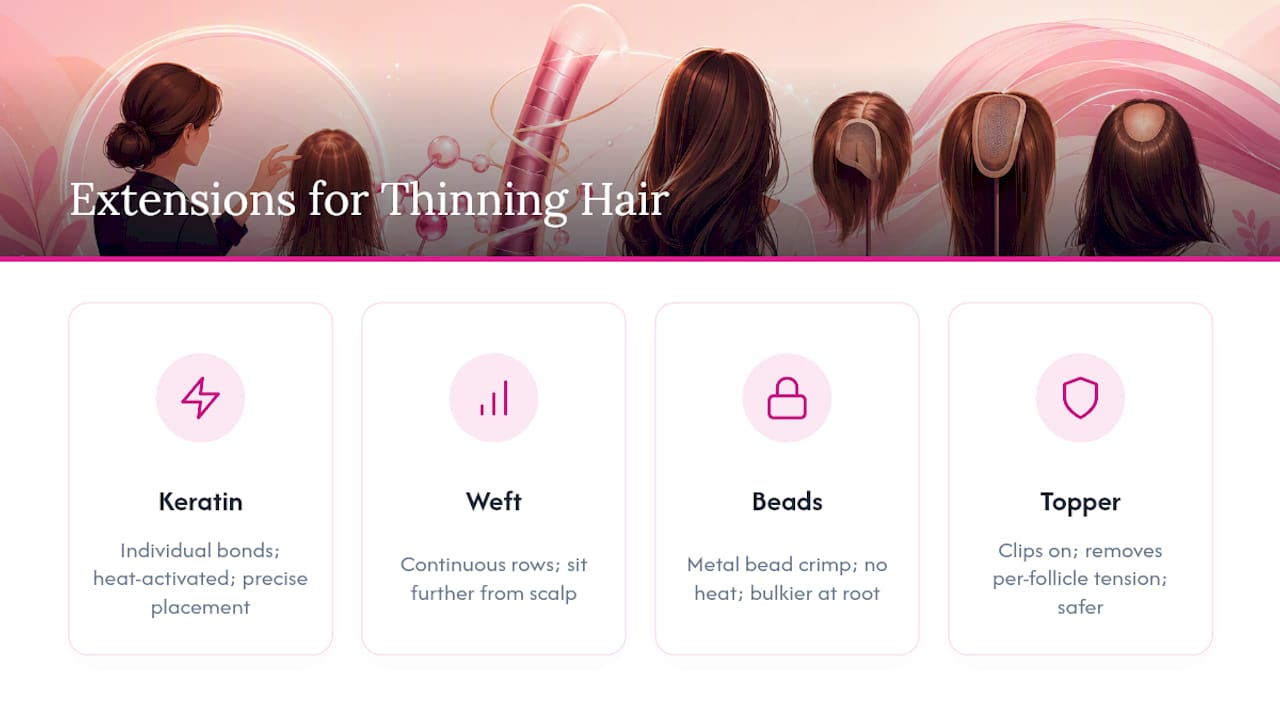
Weft extensions attach in continuous rows rather than individual points, which spreads weight differently across the head. They tend to sit further from the scalp than bonds, but that also means less precise placement around a widening part. Weft-specific guidance for fine hair covers where this method fits and where it doesn’t.
Micro bead or nano bead extensions use a small metal bead crimped around your natural hair and the extension strand instead of heat-activated adhesive. No heat exposure is a genuine advantage for hair already sensitized by color treatments, though the beads themselves can feel bulkier at the root than a well-placed flat-tip bond.
Toppers, like the Top~Lock V-Part Topper, skip individual strand attachment entirely. A topper clips into existing hair and covers a thinning area with volume, which removes per-follicle tension as a variable altogether. This makes toppers the lower-risk choice for anyone with visible crown thinning or active hair loss, even though they don’t offer the same length options as bonded methods.
There isn’t a single best answer here. A broader comparison of extension methods for fine hair is worth reading before you decide, because the right fit depends on your density map, not a general ranking of techniques.
What Does a Keratin Bond Install Cost on Fine Hair?
Pricing for keratin bond extensions depends heavily on how much hair you need and how much coverage your install requires, and fine hair sometimes changes that math in ways clients don’t expect.
At HairLocks, packages range from the Mini Mane at $490 to $600 for targeted volume, up through mid-tier options like The Volume Veil ($735 to $900) and The Signature Full Head ($980 to $1,200), to fuller installs such as All-In Babe ($1,225 to $1,500), Super Star ($1,470 to $1,800), and Rock Star ($1,960 to $2,400) for maximum length and density.
Fine hair doesn’t automatically mean a cheaper install. Because correct application often calls for more, smaller bonds spread across a wider area rather than fewer large ones, labor time can run longer, and that shows up in the final quote. Aftercare adds a smaller, ongoing cost: sulfate-free shampoo, a lightweight conditioner, and a smoothing product like the Frizz-Control serum are worth budgeting for separately from the initial install.
Move-up appointments every few weeks are also part of the real cost of bonds, not an optional extra. Skipping them to save money is how bonds end up too close to the scalp, which is exactly the scenario that causes tension and breakage. If the ongoing maintenance schedule doesn’t fit your budget or your calendar, that’s a legitimate reason to consider a topper instead, since it carries no regular move-up requirement.
Could I Have an Allergic Reaction to Keratin Bonds?
True allergic reactions to keratin bond adhesive are uncommon, but scalp sensitivity is a real and separate concern, especially for fine or thinning hair where the scalp barrier can already be more exposed.
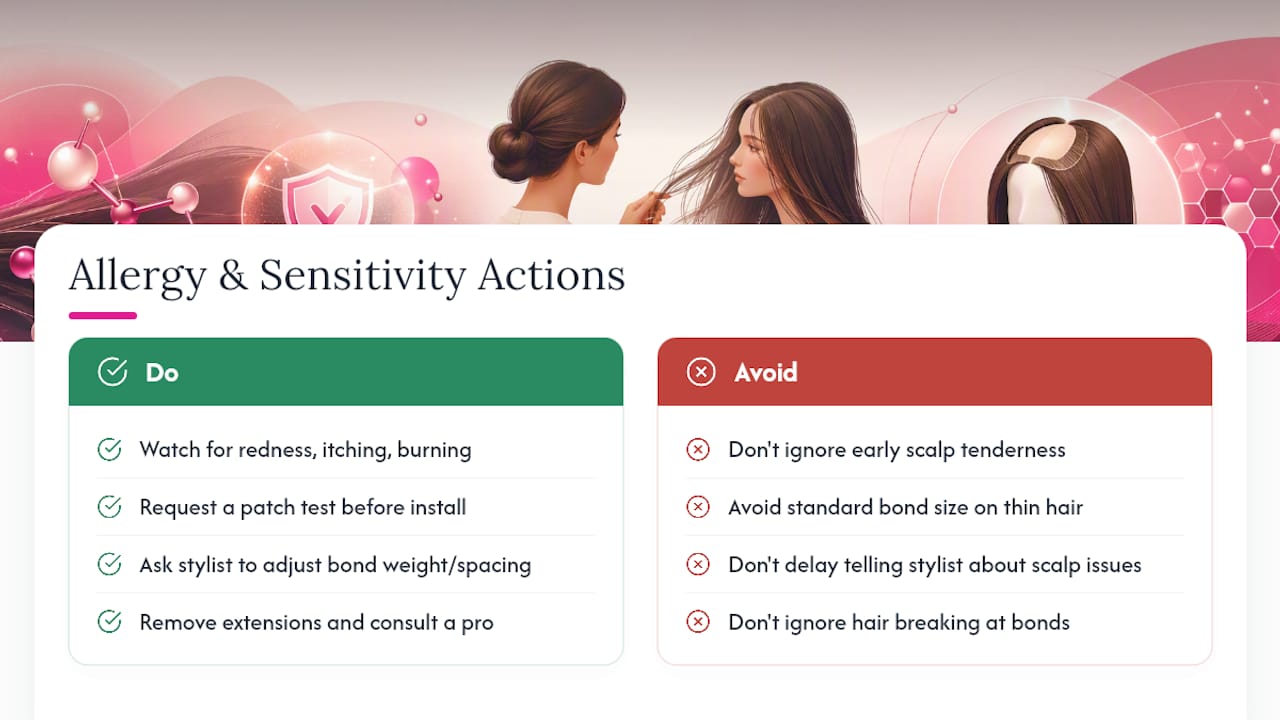
Watch for redness, itching, or a burning sensation at bond sites in the first 24 to 48 hours after application. This is more often a reaction to heat or friction than a true allergy, but either way it’s a signal to have your stylist reassess bond placement or size. A patch test before a full install is a reasonable request if you have a history of scalp sensitivity or reaction to hair products generally.
Fine or thinning hair carries an additional precaution that thicker hair doesn’t: less hair per follicle means less padding between the bond and the scalp itself. That’s part of why correct bond weight and spacing matter more for you than for someone with denser natural hair, and why a stylist should never apply a standard bond size across the board regardless of density.
If you notice tenderness that doesn’t resolve within a few days, localized bumps, or hair breaking off at the bond point rather than growing out normally, remove the extensions and see a professional. Anyone with an active scalp condition, recent hair loss, or a dermatologist-diagnosed sensitivity should raise it at consultation before booking an install, not after noticing a problem.
From Consultation to Your First Move-Up: What to Expect
The realistic timeline for keratin bonds on fine hair runs longer than most people assume, and that’s a good thing when the goal is a safe, long-wearing result.
Consultation (week one). Your stylist assesses density, discusses your goals, and recommends bond size, spacing, and total count based on what your hair can support. This is also when colour matching happens.
Installation day. Expect a longer appointment than a standard color or cut, often several hours, since correct placement on fine hair takes more time than a routine install.
First two weeks. Bonds settle in, and this is when any early tension or discomfort would typically show up. Gentle handling and sulfate-free products matter most during this window.
Four to eight weeks: first move-up. Your stylist checks bond position, tightens or repositions as needed, and assesses how your hair has responded before deciding on the next maintenance interval.
Ongoing cycle. Regular move-ups continue on that same four to eight week rhythm for as long as you wear the extensions, with each visit doubling as a checkpoint for scalp health.
Setting this expectation early avoids the most common disappointment with bonds: assuming they’re a one-time install rather than an ongoing relationship with your stylist.
Fine Hair Deserves Judgment, Not a Default Setting
The biggest mistake in how keratin bonds get discussed online is treating them as universally good or universally bad for fine hair. Neither framing holds up. The real determining factor is whether the person doing the application is willing to size down, space out, and slow down for your specific density, and plenty of installs fail simply because a stylist used their standard approach on hair that needed a different one.
Conventional advice tends to focus on the extension product itself, debating brands and bond types as if that’s where the risk lives. It mostly doesn’t. Professional skill in placement and spacing outweighs brand choice by a wide margin, and that’s the question worth spending your consultation time on.
If you take one thing from this, prioritize the hair assessment over the aesthetic outcome you’re picturing. A stylist who tells you bonds aren’t right for your current density, and steers you toward a topper instead, is giving you better advice than one who says yes to everything.
— HairLocks
Ready to Find Out What Your Hair Can Support?
Suitability is the whole decision here: if your fine hair is healthy, a professional consultation and correctly sized bonds can give you natural volume and length that lasts for weeks between visits. If thinning is more advanced, the Top~Lock V-Part Topper gets you fullness without any per-strand tension at all.
HairLocks builds every recommendation around Michele’s 30 years of hands-on experience rather than a one-size install, which is the real difference between extensions that last and extensions that damage fine hair. Browse the full pricing list to see where your budget fits, explore the Top-Lock V Part Topper collection if crown coverage is your priority, and add the Frizz-Control serum 50ml to your cart to keep bonds smooth between appointments. Book a personalized consultation today to get a real answer for your hair, not a generic one.
Sources
- Volumizing keratin conditioner for thinning hair — Keranique
- Are keratin extensions good for thin hair? — Alpha Hair Extension
- Keratin for fine hair: helpful or harmful? — Chère Fine
FAQ
Are Keratin Bonds Good for Fine Hair?
Yes, when a stylist uses smaller bonds, lighter strand weight, and wider spacing suited to your density. Success depends far more on application skill than on the extension brand itself.
Is Keratin Good for Fine, Thin Hair in General?
Keratin can strengthen and add body to fine hair when formulas are lightweight and heat is moderated. Overly strong sealing or frequent high heat can leave delicate strands stiff or brittle, so the formula and technique matter as much as the ingredient.
What Are the Downsides of Keratin Bond Hair Extensions?
The main downsides are traction if bonds are too heavy or placed too close to the scalp, heat exposure during application and removal, and the ongoing need for move-up appointments every four to eight weeks. These risks are largely preventable with correct sizing and a skilled stylist.
Can Keratin Extensions Be Used on Thin Hair?
Yes, keratin extensions can work on thin hair when the install uses small, flat bonds spaced to protect fragile follicles. For more advanced thinning, a topper like HairLocks’ Top-Lock V Part Topper is often a lower-stress alternative worth discussing at consultation.