


Plan for $150–$2,600: Nano Bead Extensions Cost in Australia
A full nano bead installation typically runs $150 to $2,600 once you combine hair, fitting, and your first maintenance visit. Hair quality and strand count drive most of that spread, not the salon’s postcode. Getting an exact number always means booking a consultation, since your natural hair density and desired look change the math.
TL;DR:
- The cost of nano bead extensions depends mainly on hair quality, strand count, and the salon’s pricing method, with total prices often ranging from $150 to $2,600.
- Most full-head installations require 100 to 200 strands, and prices increase with longer lengths, lighter colors, and lower hair quality.
- Maintenance costs, including re-lifts every six to eight weeks and potential removal or re-hair processing, significantly add to the total yearly expense.
- Higher-grade, cuticle-intact Remy hair offers better longevity and fewer replacements, reducing long-term costs despite higher initial prices.
- Accurate estimates come from personalized consultations that determine strand count, hair grade, and exact pricing, rather than relying on online quotes or approximate ranges.
Table of Contents
- What Drives Nano Bead Extensions Cost, Piece by Piece
- How Many Nanos Do You Actually Need?
- Installation and Maintenance: The Costs After Day One
- What Actually Pushes Your Price Up or Down
- Why 30 Years of Fitting Experience Changes Your Quote
- Beyond Hair and Fitting: Other Costs to Plan For
- Our Take: Stop Budgeting for the Install and Start Budgeting for the Year
- Get an Accurate Quote With a Free Consultation
- Where These Price Estimates Come From
- Sources
- FAQ
What Drives Nano Bead Extensions Cost, Piece by Piece
The final number on your invoice is really two separate purchases stitched together: the hair itself, and the labor to fit it strand by strand. Salons rarely advertise it this way, but understanding the split helps you spot a fair quote from an inflated one.
Human hair for nano bead work is typically sold by weight, and quality moves the price more than length does. Wholesale and salon rates for good quality bundles commonly land between roughly $60 and $180 per 100 grams in comparable markets, with double-drawn Remy hair sitting at the top of that range because every strand keeps its cuticle intact and its thickness right to the tip.
Labor is where nano beads separate from other methods. Because each bead is applied one strand at a time, fitting takes longer than a weft or tape-in job, and salons charge for that time in one of three ways:
- Flat install fee — a single price covering the whole appointment regardless of how long it runs.
- Per-hour charge — billed for the stylist’s time, which can stretch past three hours for a full head.
- Per-pack charge — a fee added for every 100 g pack of hair fitted, on top of the hair’s own price.
Some salon service listings advertise installs “starting from” a set figure, then add on for extra packs or thicker requests, so always ask what triggers an increase before you book.
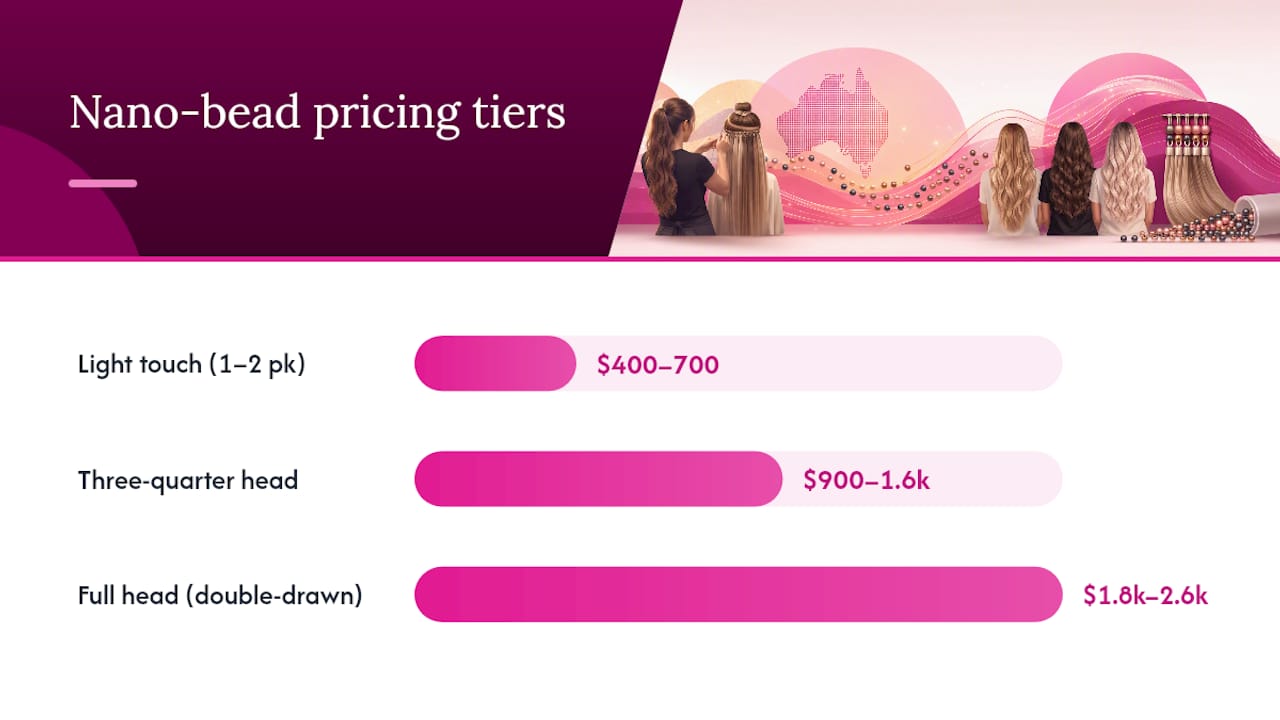
Here’s how those pieces stack up in practice. A light volume touch, using one or two packs, might land around $400 to $700 all in. A three-quarter head, built for noticeable length and thickness, often runs $900 to $1,600. A full head transformation with premium double-drawn hair and a longer fitting session can reach $1,800 to $2,600, consistent with the upper end of the market range. Salon price lists that itemize nano bead bundles and full-head packages show exactly this kind of tiering, which is worth checking before you settle on a budget.
How Many Nanos Do You Actually Need?
Strand count, not length, is the number that decides your final bill. A stylist calculates it from your natural density and the look you want, but a few benchmarks help you budget before that conversation happens.
- Volume boost only — around 50 to 80 strands, usually one pack, aimed at fine or flat hair rather than added length.
- Half head — roughly 80 to 120 strands, blending through the crown and sides for subtle thickness.
- Three-quarter head — around 120 to 160 strands, the most common request for noticeable length and body.
- Full head — 100 to 200 or more strands depending on how dense your natural hair already is.
Working the math is straightforward once you have that number: multiply the packs required by your hair-quality price per 100 g, then add the salon’s install fee. A three-quarter head using two packs at $150 each, plus an $800 flat fitting fee, lands around $1,100 before any color work. A consultation is still the only way to get strand counts exact, since two people with the same head size can need very different amounts depending on how fine or coarse their natural hair is.
Installation and Maintenance: The Costs After Day One
Nano bead extensions are not a one-and-done purchase. Budgeting only for install day is the single biggest mistake first-timers make, because the beads loosen as your natural hair grows and need to move up with it.
Most salons recommend a re-lift or “move-up” appointment roughly every six to eight weeks. That visit typically costs a fraction of your original install, since the hair itself is being reused rather than repurchased. Skipping it too long risks matting near the roots, which shortens the life of even premium hair.
A few other costs worth planning for:
- Removal — some salons charge a separate fee to take extensions out safely, especially if you’re not reinstalling the same day.
- Rehair processing — good quality hair can often be reused for a second or even third install cycle after a cleaning and re-bonding fee.
- Color matching or toning — blending your natural regrowth with the extension hair sometimes adds a small charge per visit.
- Trims or reshaping — a cut to blend ends usually costs the same as a standard salon trim.
Pro Tip: Spending more on cuticle-intact Remy or double-drawn hair upfront usually costs less over time, because it survives multiple re-lift cycles instead of needing replacement after one. Pairing that hair with the right aftercare routine stretches the lifespan even further.
What Actually Pushes Your Price Up or Down
Four factors decide whether your quote lands near the low end of the range or the high end, and most of them are within your control.
- Hair grade matters more than any other line item. Remy, double-drawn, or virgin human hair costs more per 100 g but resists tangling and shedding far better than acid-stripped hair, which sheds quickly and often needs early replacement.
- Length and color processing are the easiest ways to accidentally double your bill. Longer lengths need more grams, and any lightening or toning to match your natural color adds a separate service fee.
- Salon experience and location affect the hourly labor rate, since a senior stylist fitting hundreds of strands by hand commands a different price than a junior technician.
- Your starting hair condition matters too. Thinning hair, recent color treatments, or previous extension damage can extend the fitting session and raise the labor portion of your quote.
If you’re deciding where to spend and where to save, put your money into the hair grade first. It’s the variable that determines how many maintenance cycles you get before you’re paying for a full replacement.
Why 30 Years of Fitting Experience Changes Your Quote
Getting an accurate nano bead extensions cost estimate depends heavily on who’s doing the assessment.
A rushed color match or an underestimated strand count is usually what turns a reasonable quote into a disappointing result. Getting both right the first time is what actually controls your long-term cost.
That’s the thinking behind offering free personal color matching before any commitment. Hairlockshairextensions recommends premium human hair specifically because it holds up across more maintenance cycles, which lowers what you spend over a year even though the upfront number looks higher.
Beyond Hair and Fitting: Other Costs to Plan For
The quoted price for your nano bead extensions rarely covers everything you’ll actually spend in the first few months. A handful of smaller costs tend to catch first-timers off guard.
GST is already built into most Australian salon and retail pricing, so the number you’re quoted is usually the number you pay, but it’s worth confirming with any salon that lists prices as “plus GST.” Tipping isn’t a standard expectation at Australian hair salons the way it is in some other countries, though it’s always appreciated for a longer or more complex session.
The bigger hidden cost is aftercare products. Nano beads sit close to the scalp and can be damaged by standard sulfate shampoos, silicone-heavy conditioners, or rough brushing, so most stylists recommend switching to extension-safe formulas. Budget for a sulfate-free shampoo and conditioner, a leave-in detangler, and a loop brush designed for bonded extensions. These usually cost no more than premium salon haircare generally, but they’re an ongoing expense most first-time buyers forget to price in alongside the install and re-lift schedule.

Our Take: Stop Budgeting for the Install and Start Budgeting for the Year
Most pricing guides treat nano bead extensions like a single purchase decision. That’s the wrong frame. The real cost is a twelve-month relationship between your hair and a maintenance schedule, and the number that matters most isn’t the install-day total. It’s the cost per re-lift multiplied by however many cycles cheap hair forces you into before it needs replacing.
Conventional advice tells budget-conscious buyers to find the cheapest install. In practice, that’s usually the most expensive path, because low-grade hair tangles, sheds, and gets pulled out early, sending you back to square one within months. Prioritize hair grade first, strand count second, and salon reputation third. Get your strand count from an actual consultation, not a generic online calculator, since your natural density changes the math more than any price guide can account for.
— HairLocks
Get an Accurate Quote With a Free Consultation
Every price range in this guide is a starting point. Hairlockshairextensions turns it into an exact number through a personal consultation, where strand counts, hair grade, and color matching get worked out before you commit to anything.
If nano beads feel like a bigger step than you’re ready for right now, temporary and semi-permanent options give you a preview of the look without the strand-by-strand commitment. The Itips Human Hair in 22 inch double drawn offers a similar strand-based, longer-lasting result for readers weighing permanent methods against upfront cost. For thinning hair specifically, the Top-Lock V Part Topper delivers volume and coverage without any bead application at all. And if you want instant length for an event before committing to a full nano bead schedule, the U Part Clip In Hair Extensions in Caramel Blonde or the INSTAGLAM 3/4 piece in Sparkling Amber Brown clip in and out same day.
Every quote starts with the same first step: book a free personal color matching consultation and walk out with a real price instead of an estimate.
Where These Price Estimates Come From
Cost ranges in this guide draw on Australian market data from Airtasker’s hair extension pricing survey, salon price lists showing per-bundle nano bead pricing, and supplier guidance on strand and gram requirements. For a broader comparison across extension methods, see the Australian hair extensions cost guide.
Sources
- How much do hair extensions cost in Australia?
- Eve Hair Extensions salon price list (nano bead examples)
- INCH Hair service/pricing listing
- Nano Ring Extensions - Alove Hair
- How Much Are Nano Ring Hair Extensions - Emeda hair
FAQ
How many nanos do I need for a full head?
Most full-head installations use 100 to 200 or more strands depending on your natural hair density, though a stylist confirms the exact count during a consultation.
How long do nano bead extensions last?
With regular re-lifts every six to eight weeks and proper aftercare, quality Remy or double-drawn hair can last multiple maintenance cycles before needing replacement.
What are the downsides of nano bead extensions?
The strand-by-strand application takes longer than wefts or tape-ins, which raises labor cost, and low-grade or acid-stripped hair tends to tangle and shed faster than cuticle-intact Remy hair.
How much does it cost to get nano extensions fitted?
Fitting alone, separate from the hair itself, typically follows a flat install fee, an hourly rate, or a per-pack charge, and combines with hair cost to bring a full installation to $150 to $2,600 depending on strand count and hair grade.
Can nano bead hair be reused after removal?
Yes, good quality human hair can often be reused for a second or third install cycle after a cleaning and re-bonding process, which lowers the cost of your next round compared with buying new hair.