


Stop Weft Extension Damage: Salon Backed 6–8 Week Consultation Checklist
Weft extensions are not inherently damaging when applied and maintained correctly. The damage that does happen almost always traces back to one thing: excess tension, excess weight, or a rushed installation. Persistent tightness or pain after your appointment is your body’s early warning system, and it means you stop and get it looked at, not push through. The rest of this guide walks through why weft extensions damage hair when things go wrong, which setups carry more risk, and exactly what to check before, during, and after wearing them.
TL;DR:
- The highest risk of damage occurs with sew-in or cornrow wefts due to sustained tension at the hairline, especially if left in for more than six to eight weeks.
- Adhesive-based wefts can cause scalp dermatitis and weaken hair fibers over time, particularly with repeated reapplications involving heat or solvents.
- Fine, thin, chemically treated, or inflamed scalps are more vulnerable to damage and should opt for lighter or alternative extension options.
- Early warning signs like persistent tightness, localized shedding, or scalp inflammation require immediate loosening or removal to prevent permanent damage.
- Proper consultation, load distribution, and following a structured wear cycle significantly reduce the risk of traction alopecia and scalp stress.
Table of Contents
- What Causes Weft Extensions Damage: Traction, Adhesives, Heat, and Occlusion
- Which Weft Methods Carry Higher or Lower Risk?
- Who Is Most at Risk From Extensions Damage?
- Warning Signs That Mean It’s Time to Act
- What to Ask For at Your Extension Consultation
- How to Take Care of Weft Extensions Day to Day
- Removing Extensions Safely and What Recovery Looks Like
- How HairLocks Supports Lower-Risk Extension Wear
- Why the Safety Conversation Usually Starts Too Late
- Finding the Right Extensions for Your Hair and Goals
- Sources
- FAQ
What Causes Weft Extensions Damage: Traction, Adhesives, Heat, and Occlusion
Hair extensions damage happens through a handful of specific mechanisms, and knowing them changes how you evaluate a stylist’s recommendations. The biggest one is traction: sustained pulling at the follicle, concentrated at the frontal and temporal hairline where the shaft is finer and the anchoring points are smaller. That is why thinning along the edges shows up before anywhere else.
Adhesive-based wefts add a second layer of risk. Bonding agents and the solvents used to remove them can disrupt the skin’s barrier and trigger contact dermatitis at the scalp. Heat-fused bonds carry their own cumulative cost, weakening the hair fiber with every reapplication cycle. And tracks worn tightly for weeks create a warm, occlusive environment that can encourage microbial imbalance and inflammation around the follicle, according to dermatologic research on extension-related scalp stress.
- Traction: concentrated pulling at hairline and part lines
- Adhesive exposure: barrier disruption and dermatitis risk from bonding agents and removers
- Thermal stress: repeated heat-fusing weakens the shaft over time
- Occlusion: trapped heat and moisture under dense tracks raises inflammation risk
Which Weft Methods Carry Higher or Lower Risk?
Not every weft installation stresses your hair the same way. Sew-in wefts anchored to cornrows tend to carry the highest cumulative risk because the braid itself applies constant, linear tension for the entire wear cycle. Beaded or micro-ring wefts trade that sustained pull for focal compression at each ring, which is gentler over a wide area but can still cause breakage if the rings sit too tight. Bonded wefts add heat or adhesive exposure on top of any mechanical load.
Clip-ins and halo systems sit at the opposite end. Worn intermittently rather than left in for weeks, they’re widely regarded as the lowest-risk option because they avoid persistent anchorage altogether.
- Sew-in/cornrow wefts: highest risk from sustained linear tension
- Beaded/bonded wefts: focal compression plus heat or adhesive trade-offs
- Clip-ins/halos: lowest cumulative risk with intermittent wear
- Regardless of method, weight, density, and how evenly the load is distributed change the risk profile more than the method name alone.
Who Is Most at Risk From Extensions Damage?
Some hair and scalp types tolerate weft extensions far better than others, and knowing where you fall changes how cautious your plan should be. Fine or thin hair has less shaft mass to anchor weight, so the same weft that’s fine on thick hair can overload finer strands fast. If you already have edge thinning or an inflamed, atopic scalp, you’re starting from a more vulnerable baseline.
Age and prior chemical treatment matter too: adolescents and anyone with color-treated or previously bleached hair should be more conservative with added weight, since the shaft is already compromised. A history of scalp allergies or skin conditions warrants a patch test and, ideally, a conversation with a clinician before installation. Raise all of this at your consultation, not after you notice a problem. If your hair is fine or thinning, ask specifically about weft options suited to fragile hair before booking.
- Fine hair, thinning edges, or inflamed scalps increase vulnerability
- Adolescents and chemically treated hair need lighter, more conservative setups
- Prior allergy or scalp-disease history calls for a patch test and clinician input
- Bring all of this up at consultation, before the appointment, not after symptoms start
Warning Signs That Mean It’s Time to Act
Certain symptoms are not “part of getting used to it.” They’re signals that the follicle is under more stress than it can handle, and catching them early is what keeps the damage reversible. Early-stage traction alopecia usually reverses itself once the tension is removed, but only if you act while the follicle is still inflamed rather than scarred.
- Persistent tightness, headaches, or scalp tenderness. This is not normal “settling in.” If it lasts more than a day or two, the install is too tight.
- Localized shedding or the “fringe sign.” Thinning specifically along the hairline or temples is a classic early marker of traction damage.
- Pustules, crusting, or inflamed anchor points. These suggest dermatitis or infection, not simple irritation, and may need clinical attention.
- Ask your stylist to loosen or remove sections immediately if any of the above appear, rather than waiting for your next scheduled appointment.
A tight scalp on day one that eases within 24 hours is common. Tightness that persists into week two is not, and understanding why your scalp feels tight can help you tell the difference before it becomes a bigger problem.
Pro Tip: Take a photo of your hairline before your first install. It’s the easiest way to spot subtle thinning early, since gradual change is much harder to notice in the mirror than in a side-by-side comparison.
What to Ask For at Your Extension Consultation
A good consultation is where most damage actually gets prevented, or doesn’t. Ask directly about your stylist’s experience with weft application, their hygiene and ventilation protocols, and what anchor materials they use. Wider bonds and silicone-lined rings spread load across more surface area, which meaningfully lowers stress on any single follicle, since added mass ideally stays under roughly 10 to 15 percent of your native hair’s weight to avoid exceeding what the follicle can safely bear.
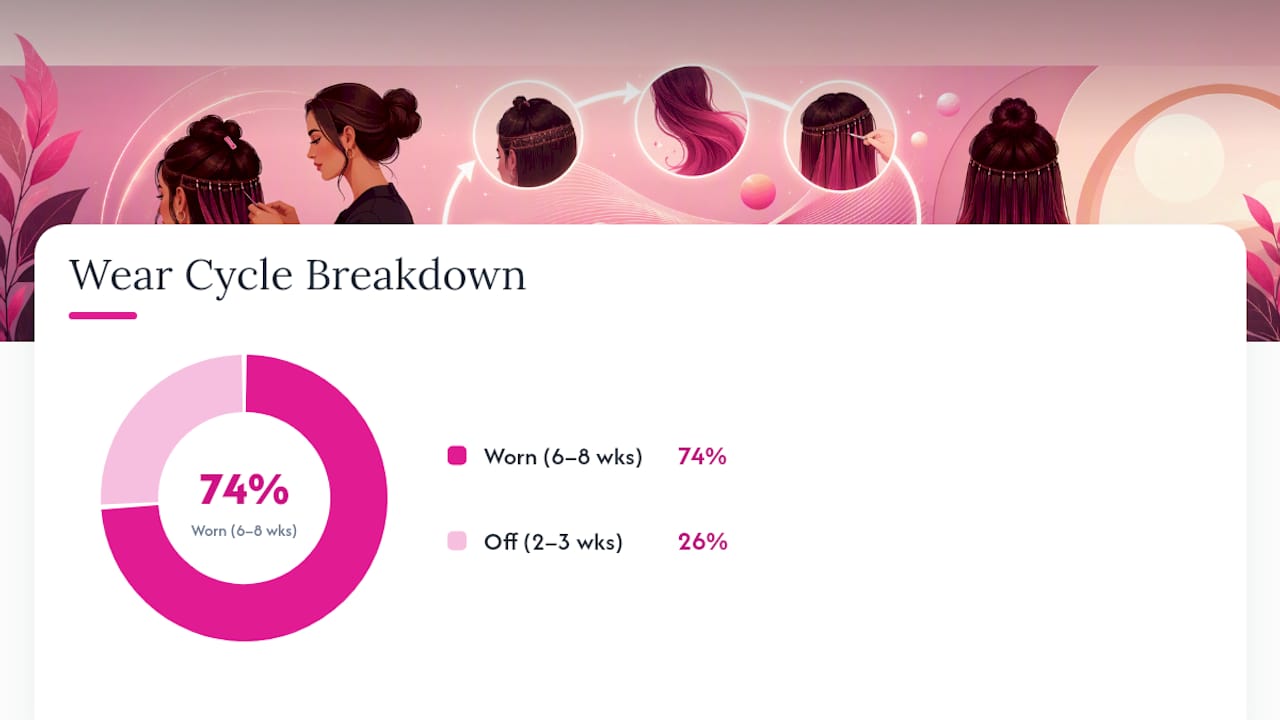
Salons that follow a structured wear cycle, typically six to eight weeks worn, followed by two to three weeks off, give the scalp real recovery time between installs rather than compounding stress appointment after appointment.
- Ask about the stylist’s specific experience with weft installations, not just extensions generally
- Confirm hygiene and ventilation practices to reduce inflammation risk
- Request wider bonds or silicone-lined rings for better load distribution
- Come in with a clean, well-conditioned scalp, and flag any broken or irritated skin before the appointment.
How to Take Care of Weft Extensions Day to Day
Daily habits do more to prevent extensions damage than any single salon visit. Wash two to three times a week with a low-pH, sulfate-free cleanser, and follow with a ceramide-rich conditioner focused on your mid-lengths and ends rather than the roots, where it can loosen bonds prematurely.
Detangle with a loop brush or wide-tooth comb, starting at the ends and working upward, never dragging through knots from the root. At night, loosely braid your extensions or switch to a satin pillowcase, and never sleep with wet hair; damp hair under tension is a setup for both breakage and mildew odor at the wefts. Book maintenance appointments every four to six weeks so your stylist can check tension, tighten or move bonds as your hair grows, and catch early irritation before you would. Choosing products formulated to be extension-friendly makes this routine easier to stick to.
- Wash two to three times weekly with a low-pH, ceramide-supportive cleanser and conditioner
- Detangle from ends to roots with a loop brush before bed
- Braid loosely or use a satin pillowcase; never sleep on wet hair
- Schedule tension checks every four to six weeks
Removing Extensions Safely and What Recovery Looks Like
Bonded and fused wefts need professional solvent removal, not a DIY pulling session. Ripping out bonds risks tearing hair at the root, and adhesive removers left on too long can strip the scalp’s natural barrier and increase water loss through the skin. A proper keratin bond removal process keeps solvent dwell time short and handles hair gently at each step.
After removal, mild shedding and tenderness that resolve within a few weeks are normal. Thinning that persists past a couple of months, or shows scarring at the follicle, needs a dermatologist’s evaluation rather than a wait-and-see approach. Short-term aftercare should focus on barrier repair and gentle handling; longer-term, options like topical minoxidil have real evidence behind them, while PRP and laser therapy are supportive add-ons, and exosome treatments remain investigational.
- Have bonded wefts removed professionally, never pulled out at home
- Mild shedding for a few weeks post-removal is typical; scarring or prolonged thinning is not
- Focus early aftercare on barrier repair with gentle, low-friction handling
- Ask a dermatologist about minoxidil or PRP if regrowth stalls past two to three months
How HairLocks Supports Lower-Risk Extension Wear
The company applies experienced fitting techniques and emphasizes weight and texture matching rather than treating every scalp the same. The brand’s six to eight week wear cycle is built around the same load-distribution principle dermatology and trichology research both point to: give the follicle scheduled recovery instead of continuous stress.
For anyone dealing with thinning rather than just wanting length, there are V-Part Toppers offered that provide coverage without adding tension to fragile areas. Some customers report increased confidence when their hair holds naturally and requires less daily maintenance. None of this replaces a dermatologist’s opinion when clinical signs appear; it’s a starting point for a lower-risk fit, not a substitute for medical care.
- 30 years of hands-on fitting experience behind every consultation
- A structured wear-cycle plan designed to reduce traction risk
- V-Part toppers built specifically for thinning areas, not just added length
Why the Safety Conversation Usually Starts Too Late
Most extensions advice treats damage as something that happens to careless people. It doesn’t. It happens to people who never got a real consultation, whose stylist never asked about their hair’s baseline health, or who assumed tightness on day one was just “breaking it in.” The research is fairly consistent on this: damage is a function of load and time, not bad luck.
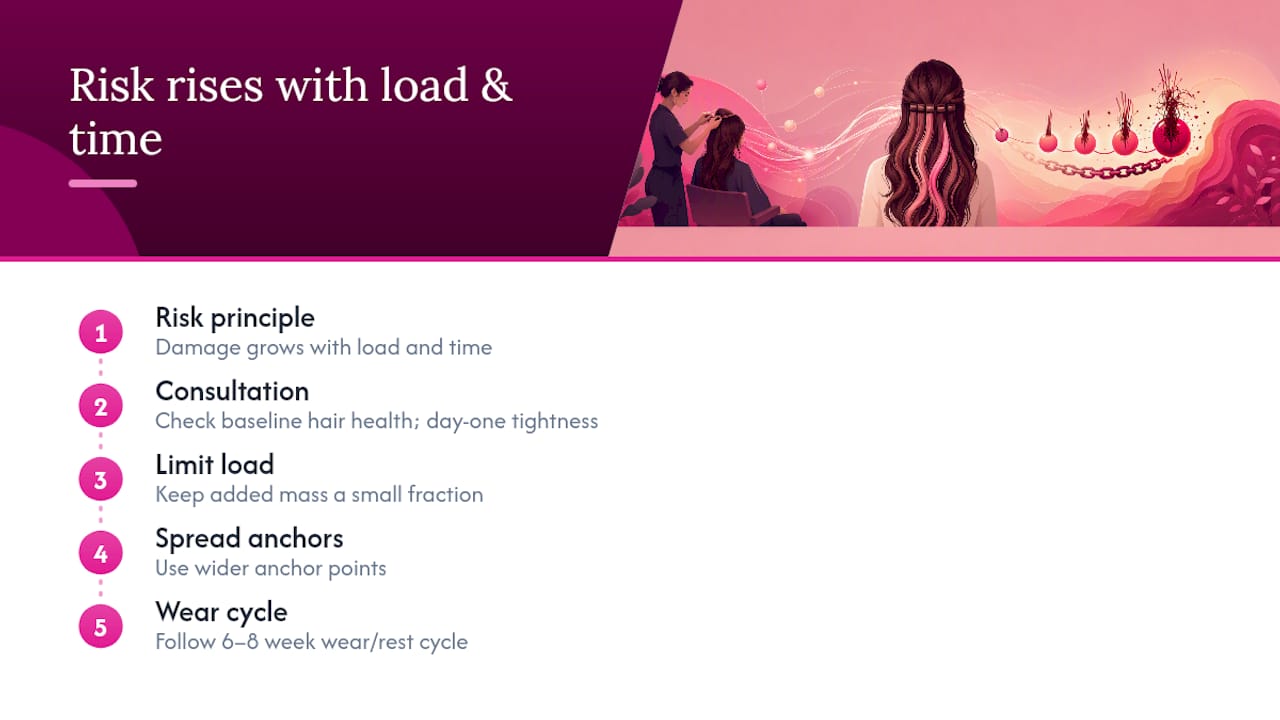
What gets underrated is how modifiable this actually is. Limiting added mass to a sensible fraction of your native hair’s weight, spreading that load across wider anchor points, and sticking to a real wear-and-rest cycle prevent the majority of traction problems before they start. What gets overrated is the idea that any one product or install method is universally “safe.” Clip-ins are lower risk because you’re not wearing them for six weeks straight, not because they’re magic.
If you take one thing from this guide, take this: treat your consultation like a diagnostic appointment, not a shopping trip. Ask about weight, materials, and wear cycles before you ask about color match.
— HairLocks
Finding the Right Extensions for Your Hair and Goals
If you want the flexibility to skip the tension question altogether, halo and clip-in styles like the Pearl & Oak 18 inch piece give you volume and length you put on and take off the same day, with zero sustained anchorage to worry about between wears.
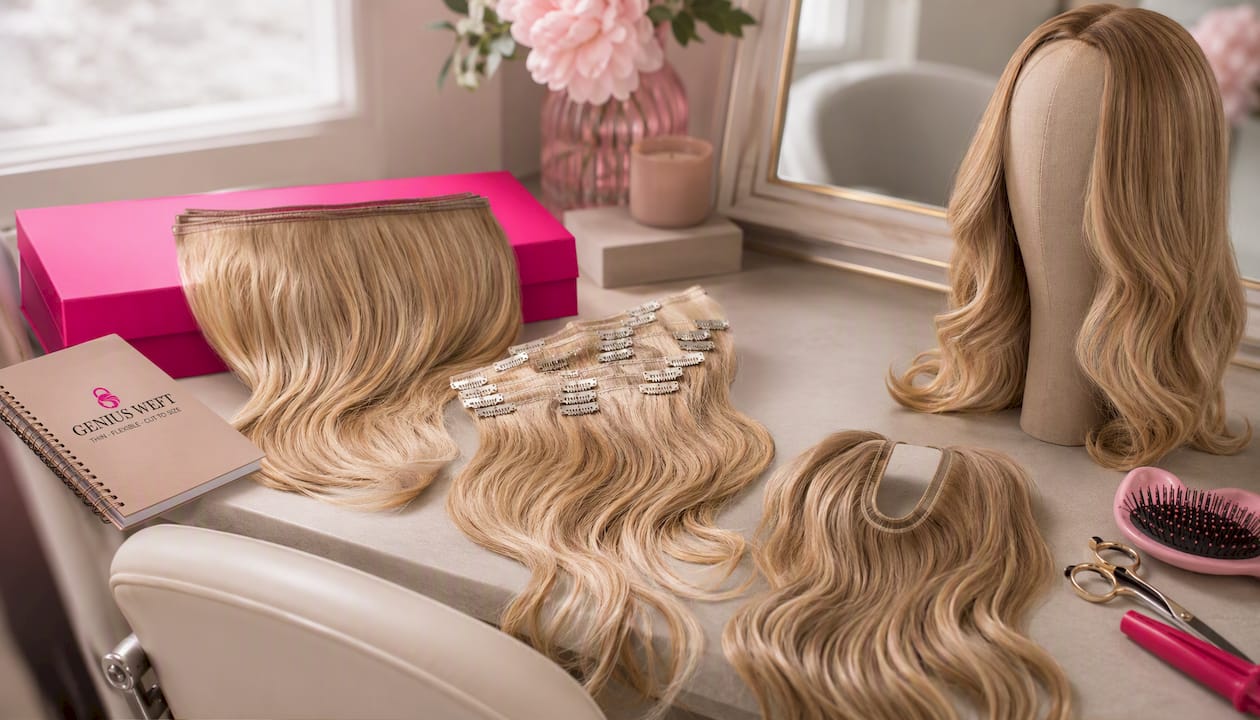
For those ready for longer-term wear with proper salon support, the Genius Weft in double-drawn human hair is built for exactly the kind of even weight distribution this guide keeps coming back to. If you want serious volume without committing to a bonded install, the caramel blonde U-part clip-ins deliver thickness at 260 grams while staying fully removable. And if thinning is the real concern rather than length, HairLocks’ V-Part toppers and personalized consultations start with an honest look at your hair’s baseline before recommending anything. Browse the full range at Hairlockshairextensions and book a consultation to get a plan matched to your actual hair, not a generic one.
Sources
- Hair extensions: Anatomic, biological, and… — Journal of Craniofacial Surgery Open
- Do Hair Extensions Damage Your Hair? Experts Explain — Women’s Health
- Traction alopecia clinical resource — NCBI Bookshelf
FAQ
What Are the Downsides of Weft Extensions?
The main downsides are traction on the hairline, potential adhesive or heat exposure depending on the method, and scalp irritation if tracks are worn too tight or too long without a break.
What Are the Worst Types of Extensions for Your Hair?
Sew-in wefts anchored to tight cornrows and left in for extended periods carry the highest risk because they apply constant, sustained tension at the follicle; clip-ins and halos carry the least.
How Often Should I Replace Weft Extensions?
Most wefts need a maintenance check every four to six weeks and should follow a six to eight week wear cycle followed by two to three weeks of rest before reinstalling.
Will My Hair Go Back to Normal After Extensions?
In most cases, yes. Mild shedding and tenderness after removal typically resolve within a few weeks, and early-stage traction alopecia usually reverses once tension is removed, though thinning that persists for months warrants a dermatologist’s review.