


Extensions for Mature Women: Volume, Not Length, Is the Goal
Yes, extensions work well for mature women when the goal shifts from dramatic length to subtle fullness and natural-looking coverage. The safest starting points are lightweight, low-tension pieces: clip-ins, halos, toppers like the Top~Lock V-Part Topper, and ultra-mini tape and micro-bead sets fitted by an experienced stylist.
- Best first moves: clip-ins, hidden-wire halos, or a topper offering discreet root coverage.
- Salon options worth considering: ultra-fine tape or micro-bead, but only with a technician experienced in fine or thinning hair.
- Stop and consult a professional if: you have active scalp pain, sudden increased shedding, or you’re mid-treatment for a medical condition affecting your hair or scalp.
Key Takeaways
Extensions work best for mature women when the method is matched to strand weight and scalp sensitivity rather than chosen for maximum length.
| Point | Details |
|---|---|
| Start with low-tension options | Clip-ins, halos, and toppers add volume without adhesive or heat commitment. |
| Match weight to density | More thinner strands spread wider create fullness without straining follicles. |
| Watch for traction signs | A widening part or ongoing soreness means stop and see a professional. |
| Prefer non-adhesive during pregnancy | Clip-ins and halos avoid the chemical and heat exposure of bonded methods. |
| Hairlockshairextensions specializes in thinning hair | Michele’s 30 years of fittings and the Top~Lock V-Part Topper focus specifically on subtle, age-appropriate fullness. |
Table of Contents
- Benefits of Extensions for Mature Hair
- Best Extension Types for Fine or Thinning Hair
- Getting the Shade, Texture, and Cut Right
- Application, Maintenance, and Knowing When to Remove
- Styling Extensions So They Stay Discreet
- Risks and Situations That Call for Extra Caution
- Why Trust This Guide
- What This Guide Gets Right That Most Advice Misses
- Ready for a Fitting Built Around Your Hair, Not a Standard Set
- Sources
- FAQ
Benefits of Extensions for Mature Hair
Most women over 50 who try extensions aren’t chasing waist-length hair. They want the fullness they remember having in their thirties, and that changes everything about how they should approach the decision.
A little volume does more visual work than most people expect. Adding thickness at the crown and through the mid-lengths can soften the look of a widening part or a thinning ponytail without touching color or cut. It also opens up styling options that thin hair simply can’t support: a proper low bun, a ponytail with body, or waves that hold shape past noon.
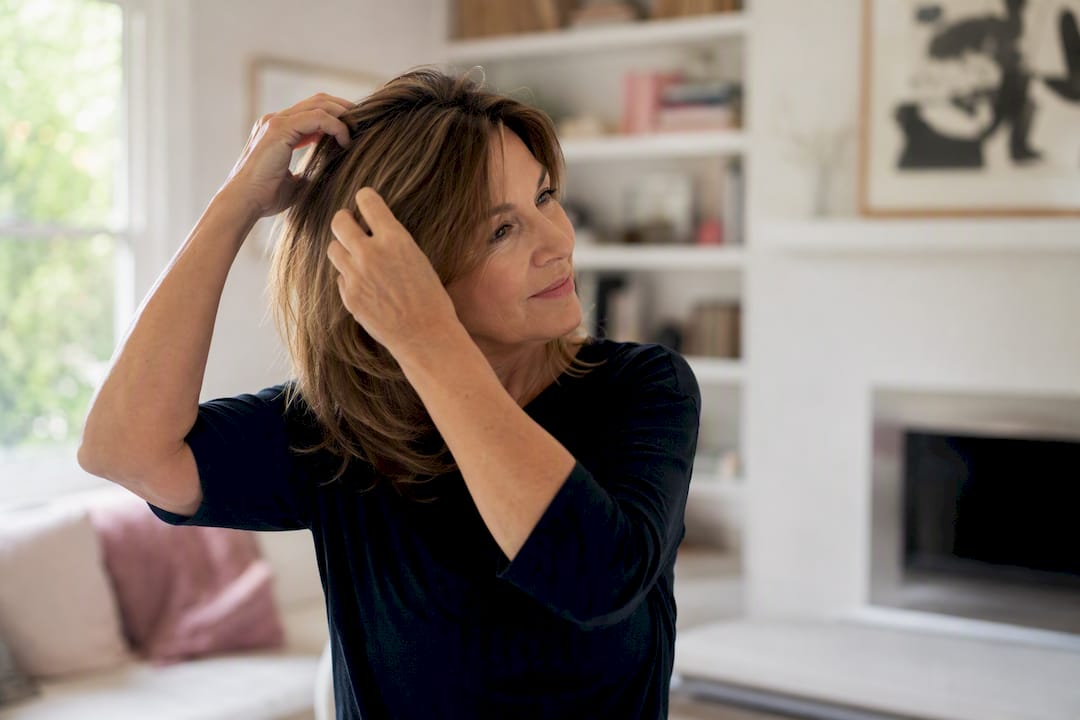
There’s a practical upside too. Fuller hair is often easier to style, not harder, since it holds curl and shape longer and needs less product to look finished. For special events, that means less time at the mirror.
The psychological piece matters as much as the visual one. Salon professionals report a steady rise in women over 50 seeking discreet fullness rather than extreme length, often after menopause-related thinning changes how their hair behaves day to day. Getting familiar styles back tends to restore confidence that thinning quietly chips away.
Pro Tip: Bring a photo of your hair from five or ten years ago to your first consultation. Stylists use it to gauge the density and shape you’re trying to recover, not just the color.
Best Extension Types for Fine or Thinning Hair
The safest extensions for mature hair share one trait: low tension on the follicle. That rules out heavy, permanent methods and points toward pieces that distribute weight gently or sit away from the scalp entirely.
- Clip-ins. No adhesive, no heat commitment, and you control exactly when they go in and come out. Best for occasional volume, events, or testing whether extensions suit your lifestyle before committing further.
- Halo or hidden-wire pieces. These sit under a thin wire that rests on the crown rather than clipping into strands, which makes them a genuinely low-risk option for daily volume without adhesives or salon bonding.
- U-part and 3/4 pieces. A middle ground between clip-ins and a full set, giving more coverage while keeping your own hairline exposed for a natural blend.
- Ultra-mini tape or micro-bead/nano-bead, applied by a stylist who specializes in fine hair. Salons that work with mature clients now use much smaller tape widths and micro-rings than the standard-size sections meant for thick hair, which is what makes these methods viable at all for finer strands.
Approach fusion bonds and tightly sewn-in wefts with caution. Both concentrate weight and tension on small sections of hair, which fine or already-thinning strands tolerate poorly. If you and your stylist decide a semi-permanent method is right, ask specifically about strand diameter and total grams. More thinner strands spread across a wider area add fullness without the bulk that pulls on individual follicles, and a good stylist will weigh the set against your existing density rather than applying a standard amount.
Pro Tip: If a stylist can’t tell you the gram weight of the set they’re proposing, ask again before booking. Weight, not just method, determines how much strain your scalp will carry.
Getting the Shade, Texture, and Cut Right
A flawless method means nothing if the extensions look pasted on. Blending is where mature hair needs extra attention, mostly because gray and multi-tonal color are harder to match than a single flat shade.
- Ask for root shadowing or a multi-tonal blend rather than one solid color. Hair with any gray coming through rarely matches a single-dye-lot extension convincingly.
- Match texture and strand thickness, not just color. A wavy set on straight fine hair, or vice versa, creates a visible seam no matter how well the shade matches.
- Consider shorter, layered lengths. Long, blunt extensions tend to look heavier and less natural on mature faces than softly layered pieces that move with your own hair.
- Have your stylist cut and thin the extensions at installation, blending them into your existing layers instead of leaving them as a separate, uniform block underneath.
Application, Maintenance, and Knowing When to Remove
Timing and upkeep depend entirely on which method you choose, and mismatched expectations are where most damage complaints start.
- Tape-in sets typically need reapplication every six to eight weeks as the tape shifts down with natural hair growth.
- Micro-bead or nano-bead sets generally run longer, around eight to twelve weeks, since the beads sit further from the tape’s adhesive limits.
- Salon-bonded methods vary by technique, but most require professional check-ins on a similar schedule to catch any tension buildup early.
- Clip-ins and halos need no reapplication schedule at all. Just remove them nightly and store them flat or on a hanger to protect the wefts.
Daily care matters more than people assume. Use a loop brush or extension-safe brush that glides through the bond area without pulling, wash gently with the water running downward rather than scrubbing at the roots, and avoid oil-heavy products near tape bonds since oils break down adhesive faster than normal wear. Loosely braiding hair before bed reduces overnight friction and tangling at the attachment points.
Removal deserves the same care as application. Improper removal or excess tension can damage follicles and increase shedding, which is exactly why professional removal is worth the appointment even for methods marketed as “easy to take out at home.” If you notice scalp soreness, a part line that seems to be widening, or shedding that looks patchy rather than evenly spread, stop wearing the extensions and see a stylist or dermatologist before continuing.
Pro Tip: Keep a simple note on your phone of your install date and method. It’s the easiest way to know when you’re approaching a reapplication window before tension starts building.
Styling Extensions So They Stay Discreet
The goal isn’t hiding that you wear extensions. It’s making the whole head of hair look like it simply belongs to you.
- Layered bobs and soft, textured cuts hide wefts and clips better than one-length styles, since the layers naturally disguise where synthetic and natural hair meet.
- Low buns and wrapped ponytails conceal the base of a topper or halo particularly well, especially when you wrap a small section of your own hair around the elastic.
- Keep heat styling to a moderate range on both extensions and natural hair, and always apply a heat protectant first. Human hair extensions behave like natural hair under heat, which means they can dry out and split just as easily.
- Ask your stylist to soften the hairline at installation, and use a root-concealer powder sparingly along your part for an extra layer of blend on windy or humid days.
Risks and Situations That Call for Extra Caution
Extensions carry real risks when the wrong method meets the wrong hair, and mature readers should weigh these honestly before booking.
- Traction alopecia is the main concern with any attached method. Watch for a part line that seems to be widening or soreness that doesn’t fade within a day of installation.
- Adhesive chemicals in some bonding products can irritate sensitive scalps, and certain solvents used in removal carry their own risks, so a patch test before full application is worth the extra appointment.
- Pregnancy and breastfeeding call for non-adhesive, non-heat methods like clip-ins or halos as the safer default, with a healthcare provider consulted for anything beyond that.
- Severely fragile or sensitive scalps may do better with toppers, wigs, or cosmetic hairpieces that avoid direct attachment altogether. Menopause-driven thinning is one of the most common reasons mature women reach this point, and it’s a legitimate reason to skip attached methods entirely.
Why Trust This Guide
HairLocks was built around one specialty: helping women whose hair has changed with age or health find extensions that actually work with what they have left to work with.
- Founder Michele brings 30 years of experience fitting 100% human hair extensions, with a specific focus on fine and thinning hair rather than general-purpose length sets.
- The Top~Lock V-Part Topper was developed specifically for discreet root and crown coverage, the exact concern this guide keeps circling back to.
- Readers can review real results in the before-and-after gallery and follow the care sheet for day-to-day maintenance once a piece is fitted.
Women don’t come to us asking for the longest hair in the room. They come asking to look like themselves again, just fuller.
What This Guide Gets Right That Most Advice Misses
Most extension content online is written for twenty-somethings chasing mermaid hair, then lightly edited to add “for mature women” to the title. That mismatch is the real problem, not extensions themselves.
The conventional advice treats every extension type as interchangeable, differing only by price. That’s backwards for readers dealing with fine or thinning strands. Method matters far less than strand diameter, total weight, and who’s holding the applicator. A skilled stylist doing ultra-mini tape can be gentler than an inexperienced one doing clip-ins.
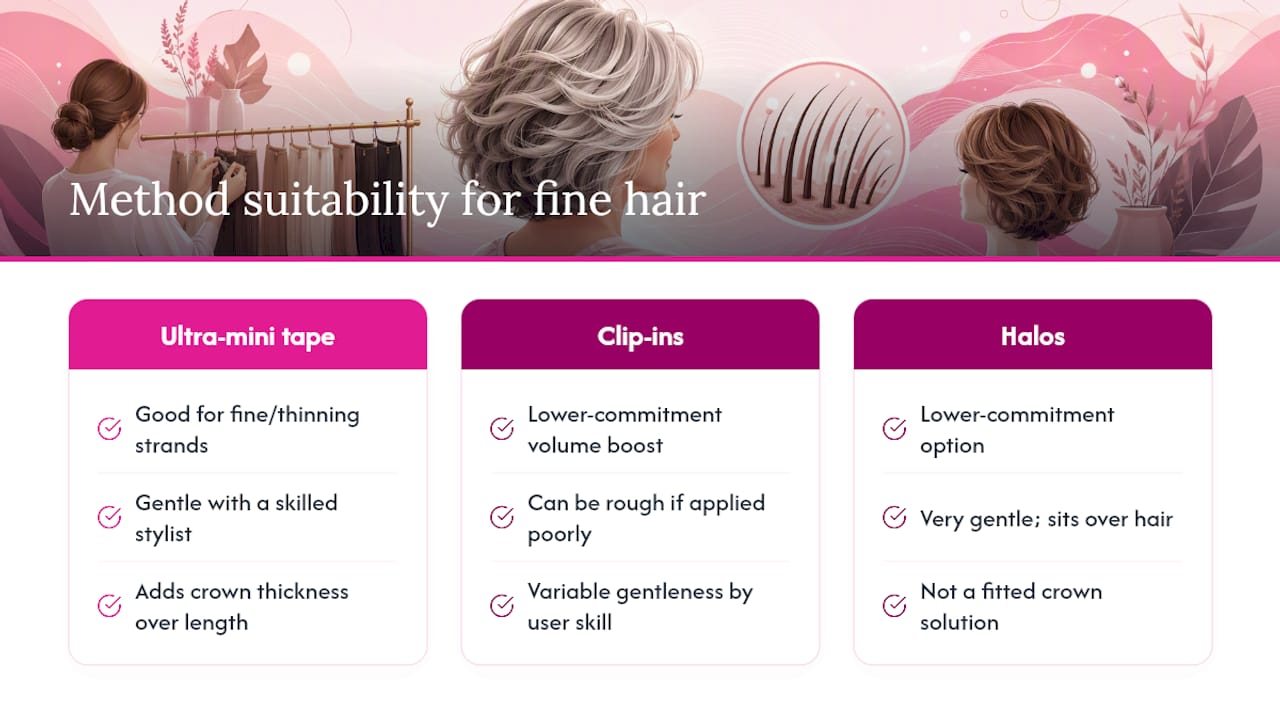
The bigger miscalculation is treating length as the default goal. For most women past 50, the real win is thickness at the crown and a part line that doesn’t show scalp in bright light. That’s a fundamentally different fitting than the one most salons default to, and it’s worth saying so plainly before you book anything.
Prioritize the fitting, not the marketing copy on the product page. Ask your stylist how many grams they’re proposing and why, and don’t be talked into more length than you actually asked for.
Ready for a Fitting Built Around Your Hair, Not a Standard Set
Salon consultations and generic extension menus rarely account for what fine or thinning mature hair actually needs, which is why so many women end up with pieces that are too heavy, too long, or the wrong shade entirely. Hairlockshairextensions builds every recommendation around strand diameter, existing density, and the subtle fullness this guide has focused on, not a one-size length chart.
The Top~Lock V-Part Topper remains the most direct option for crown and part-line coverage, while the ready-to-wear ponytail extensions suit readers who want fullness for events without any commitment to a longer-term application. Both options reflect the same age-first, hair-health-first philosophy Michele has applied across three decades of fittings.
If your priority is coverage rather than length, browse the full product catalog or check the pricing and booking page to schedule a consultation and get a recommendation matched to your own hair’s density and condition.
Sources
- Hair Extensions: The Complete Guide for Women Over 50 | NextTribe
- Hair Extensions | BabyMed
- Women Over 50 Driving New Demand for Hair Extensions, Says London Salon | Hobbs Independent
- Why hair thins after menopause: causes and UK treatments
FAQ
Do hair extensions look good on older women?
Yes, when the method and length match the hair’s current density and texture. Extensions chosen for subtle fullness rather than dramatic length tend to look far more natural than long, uniform sets.
What are the best hair extensions for women over 60?
Lightweight, low-tension options like clip-ins, halos, and toppers such as the Top~Lock V-Part Topper are usually the safest starting point, since they avoid adhesive and heat exposure entirely.
What are some good hair extensions for women over 50?
Ultra-mini tape and micro-bead sets can work well when fitted by a stylist experienced with fine hair, while clip-ins and halos remain the lowest-commitment option for occasional volume.
What hairstyle makes a 65-year-old woman look younger?
Softly layered cuts with visible movement, paired with subtle root shadowing to blend gray, tend to read as more youthful than long, blunt lengths or a single flat color tone.
Recommended
- Extensions for Volume: Best Options for Women – HairLocks Hair Extensions
- Hair Extension Length Guide: Find Your Perfect Match – HairLocks Hair Extensions
- Hair Extension Lifespan: Your 2026 Australian Guide – HairLocks Hair Extensions
- How to Store Hair Extensions So They Stay Soft for Months – HairLocks Hair Extensions