


How to Store Hair Extensions So They Stay Soft for Months
That single habit does more to protect your investment than any product you can buy.
Before you tuck a set away, run through this quick checklist:
- Clean: wash out product buildup, sweat, and oils before storage.
- Detangle: comb from tips to roots with a wide-tooth comb or extension brush.
- Dry completely: any trapped moisture invites mildew and matting.
- Secure the shape: lay wefts flat or hang clip-ins upright, never folded.
- Protect from light and air: use a breathable, UV-blocking bag or box, not a sealed plastic tub.
Treated this way, a well-made human hair set from HairLocks clip-in hair extensions can realistically serve you for 6 to 12 months of regular wear, which is exactly the kind of return that makes proper storage worth the two extra minutes it takes.
Key Takeaways
Proper storage, not the price of the extensions, is the biggest factor in how long a temporary set stays soft and reusable.
| Point | Details |
|---|---|
| Dry completely before storing | Trapped moisture causes mildew and matting; never pack away a damp set. |
| Detangle every time | A wide-tooth comb from tips to roots after each wear prevents most matting. |
| Store flat or hanging, never folded | Use a breathable, UV-protected bag or box at stable room humidity around 40 to 50%. |
| Wash every 6 to 8 wears | Buildup shortens lifespan; a full wash before long-term storage keeps hair reusable for 6 to 12 months. |
| HairLocks provides tailored routines | HairLocks’ care sheet and Top~Lock V-Part Topper guidance, backed by founder Michele’s 30 years of experience, tell you exactly how to store its clip-ins and toppers. |
Table of Contents
- Why Proper Storage Matters for Your Extensions
- The Step-by-Step Storage Routine That Actually Works
- Which Storage Method Should You Use?
- Storage Tips by Extension Type
- How Often to Wash and Deep-Condition Extensions
- Fixing Tangles, Mats, and Loose Clips
- How Long Can You Wear Extensions, and How Long Will They Last?
- What HairLocks Recommends for Storing Its Extensions
- Get the Right Storage Accessories and Care Support
- Sources
- FAQ
Why Proper Storage Matters for Your Extensions
Storing extensions correctly stops the three things that ruin a set fastest: tangling, cuticle damage, and adhesive breakdown. Skip that step and even the best quality hair starts to look tired within weeks.
Each failure mode has a different cause. Moisture left in the hair after washing creates a breeding ground for mildew and a musty smell that never fully airs out. Direct sunlight or a warm, bright shelf fades color and dries out the cuticle layer, making strands feel like straw instead of silk. Tossing a set loose into a drawer lets strands rub against each other and against fabric, which roughens the cuticle and causes tangling. And for tape-in or pre-bonded pieces, exposure to heat or humidity softens the adhesive prematurely, so the bond weakens before you ever get to use it again.
The payoff for avoiding all that is straightforward:
- Longer usable life: a properly stored set can be reworn for months instead of weeks.
- Fewer replacements: you spend less over a year buying new pieces.
- Better styling results every time: hair that goes into storage smooth comes out smooth, ready to blend and curl without a fight.
Picture two identical wefts a month after purchase. One got shoved into a makeup bag damp and tangled after a night out. The other was combed through, air-dried, and laid flat in a breathable pouch. The first is matted at the root and smells faintly of old shampoo. The second still moves like it did on day one.
Statistic Callout: Extensions should be stored fully dry and kept at a relative humidity around 40 to 50 percent, which keeps the hair cuticle closed and stops any leftover adhesive on tape wefts from softening or seizing up in the bag.
The Step-by-Step Storage Routine That Actually Works
The routine boils down to five moves: detangle, wash if needed, condition lightly, dry completely, then shape and pack. Do these in order every time you take a set out, and you eliminate almost every storage-related problem before it starts.
- Detangle gently first. Start at the ends with a wide-tooth comb or an extension-specific brush and work upward. Never brush from root to tip on hair that isn’t attached to a scalp. It has no natural oils replenishing it, so friction damages it faster than your own hair.
- Wash only when needed. If the set has visible product buildup or has been worn several times since the last wash, clean it before storing it rather than packing away dirty hair.
- Condition without weighing it down. Apply a lightweight, silicone-free conditioner or leave-in from mid-shaft to ends. Skip the roots and clips or tape tabs entirely.
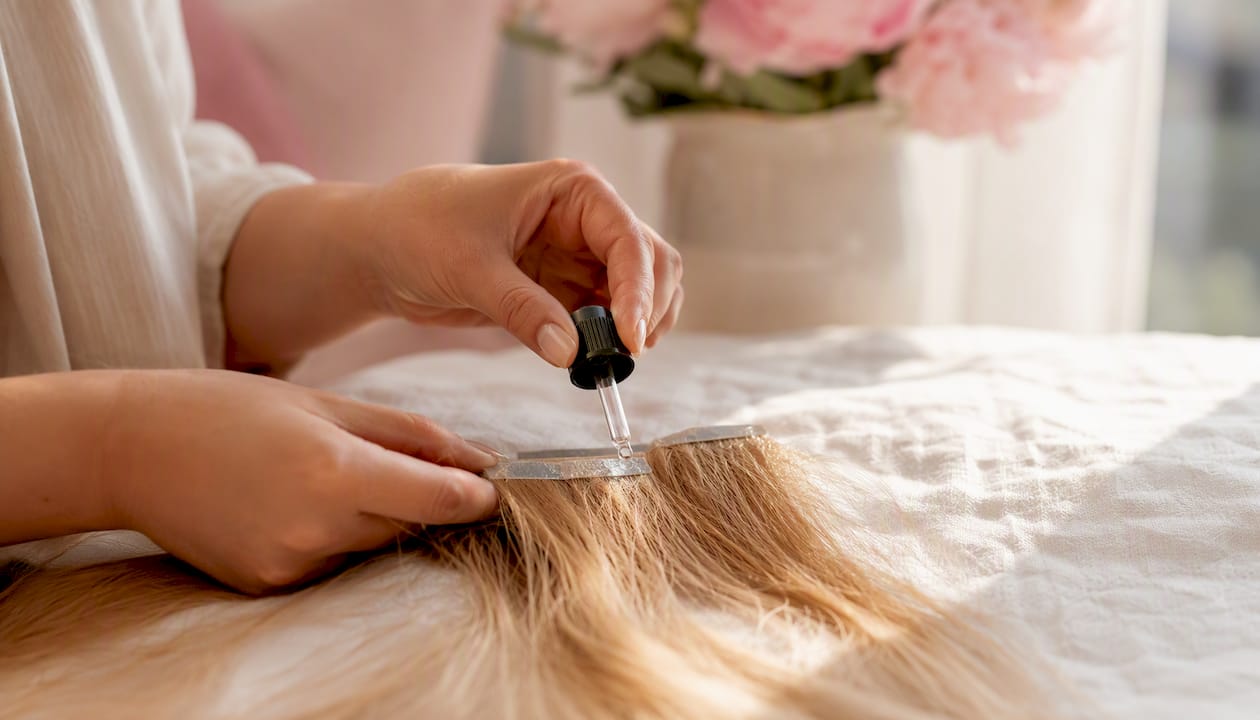
- Remove any adhesive residue carefully. If a tape weft has picked up stray residue, work a small amount of oil-based remover along the tab only, never soaking the hair itself.
- Air-dry completely, never store damp. Lay the piece on a towel or hang it somewhere with airflow. This step alone prevents most of the mildew and odor complaints extension wearers report.
- Shape for the storage method. Curly or wavy sets benefit from a loose braid or twist to preserve pattern; straight sets do better laid flat.
- Final comb-through and pack. One last gentle detangle, then place the piece in its container so it isn’t compressed or bent at a sharp angle.
Stick to sulfate-free shampoo and a silicone-free detangler or a light oil like argan when conditioning. Heavy silicone-based products build up over multiple wears and eventually make hair look coated rather than soft, which defeats the purpose of careful storage in the first place.
Pro Tip: If tape residue is stuck to the hair near a bond, don’t pull or comb it out. Dab a small amount of oil-based adhesive remover directly on the residue, let it sit for sixty seconds, then slide it off with your fingers. Pulling at dry residue is what actually strips hair at the root, not the adhesive itself.
Which Storage Method Should You Use?
For most people, hanging clip-ins in a breathable, UV-opaque bag or laying wefts flat in a satin-lined box beats every other option for both short-term and long-term storage. The wrong choice, particularly sealed plastic, traps moisture and undoes all the drying work you just did.
A few quick rules before the full breakdown:
- Do hang or lay flat, never fold a weft at a sharp angle.
- Do keep containers away from windows, vents, and bathroom humidity.
- Don’t use a fully sealed plastic bag unless the hair is bone dry and packed with a desiccant for travel only.
- Don’t leave extensions in a hot car, near a heater, or on a sunny windowsill.
| Storage Method | Best Use | Pros | Cons and Warnings |
|---|---|---|---|
| Hanger with breathable bag | Daily or weekly wearers | Keeps shape, easy access, good airflow | Needs closet space away from direct light |
| Satin bag or flat box | Long-term storage, curly sets | Reduces friction, protects color and softness | Must be fully dry before sealing |
| Hard case | Frequent travelers | Prevents crushing, structured protection | Bulkier to pack, can trap heat if left in sun |
| Sealed plastic with desiccant | Short trips only | Compact, blocks moisture in transit | Only safe if hair is completely dry; unsuitable for long-term use |
Whichever method you choose, remember that reusing weft hair extensions successfully depends more on how they’re stored between wears than on the quality of the hair alone.
Storage Tips by Extension Type
Clips and toppers tolerate simple hanging or flat storage just fine, but adhesive-based pieces need their bonds protected or they degrade before you get a second wear out of them. Knowing which category your set falls into changes how carefully you need to treat it.
- Clip-ins: hang on a padded hanger or lay flat in a breathable bag; snap clips closed so they don’t catch on fabric.
- Halo and wraparound sets: coil loosely rather than folding the wire band, which can kink and show under hair if bent sharply.
- Ponytail extensions: store upright in a container that supports the wrap band without crushing the hair against the sides.
- Tape-ins and pre-bonded wefts: if unused, leave the backing fully intact and store the sheets flat in a cool, dry spot away from any heat source.
- Toppers, including the HairLocks Top~Lock V-Part Topper: lay flat on a soft surface or store on a wig-style stand so the base material doesn’t crease, since a topper’s base is more delicate than a standard weft.
The warning that matters most for adhesive systems: never expose tape to heat, never peel the backing until you’re ready to apply it, and never store an unused tape weft folded or standing on its edge. A softened bond can’t be reversed once it’s happened.
How Often to Wash and Deep-Condition Extensions
A light refresh every 2 to 3 wears, a full wash every 6 to 8 wears or before any long-term storage, and a deeper conditioning treatment every couple of months keeps extensions soft without over-processing them. Wash too often and you strip the cuticle; wash too rarely and buildup weighs the hair down and shortens its life.
| Maintenance Task | Recommended Frequency | Purpose |
|---|---|---|
| Light refresh (dry shampoo, brush-through) | Every 2 to 3 wears | Removes surface oil and light product residue |
| Full wash | Every 6 to 8 wears, or before storing long-term | Clears buildup that leads to tangling and dullness |
| Deep conditioning treatment | Every 2 to 3 months, more often with heat styling | Restores softness and manageability |
| Reseal or trim weft edge (if fraying) | As needed | Prevents shedding from the stitch line |
Stick with sulfate-free shampoo and silicone-free oils for daily care. Heavy waxy styling products and alcohol-heavy adhesive removers, used too liberally, leave a film that dulls the hair and makes it feel coarse within a few wears. If you heat-style often, shorten the interval between deep conditioning sessions since heat pulls moisture out of the hair faster than normal wear does. A routine built around extension-friendly products protects your investment far more than an expensive one-time treatment ever will.
Fixing Tangles, Mats, and Loose Clips
The first move for any tangle is a gentle detangle from tips to roots with conditioner or a dedicated detangling spray, never a dry brush forcing its way through knots. Most storage-related tangling responds to patience and the right tool before it needs anything more drastic.
- Detangle wet, not dry, for stubborn mats. Dampen the area lightly, apply conditioner, and work through in small sections.
- Loosen mats with your fingers first. Separate the tangle from the outside in rather than yanking a comb straight through it.
- Re-secure a loose clip by checking the small metal teeth for bends; a gentle squeeze with pliers usually restores the grip.
- Repair a fraying weft edge with a few hand stitches in matching thread if you’re comfortable with a needle, working along the existing stitch line rather than creating a new one.
- Know when to stop and call a professional. A full re-weft, adhesive reapplication, or major matting that won’t release is a job for someone trained to do it.
Some shedding is normal, since even the best hair sheds a handful of strands after each wear. What signals the end of a set’s life is excessive shedding at the root, visible thinning, or exposed weft stitching that no longer holds hair securely. Once you see that, replacing the piece is more cost-effective than continuing to repair it.
Pro Tip: For a tight tangle that won’t budge, work a small amount of conditioner or a drop of light oil directly into the knot, then use your fingers to gently separate the strands from the bottom up. Skip the heat and skip the scissors. Cutting a knot out of a weft weakens the stitch line permanently.
How Long Can You Wear Extensions, and How Long Will They Last?
Clip-ins are designed to go in and come out the same day, ideally worn no longer than 8 to 12 hours at a stretch, while tape-ins and other semi-permanent styles can stay in for several weeks between professional maintenance visits. Leaving any temporary piece in overnight or for multiple days invites tangling at the root and unnecessary strain on your natural hair.
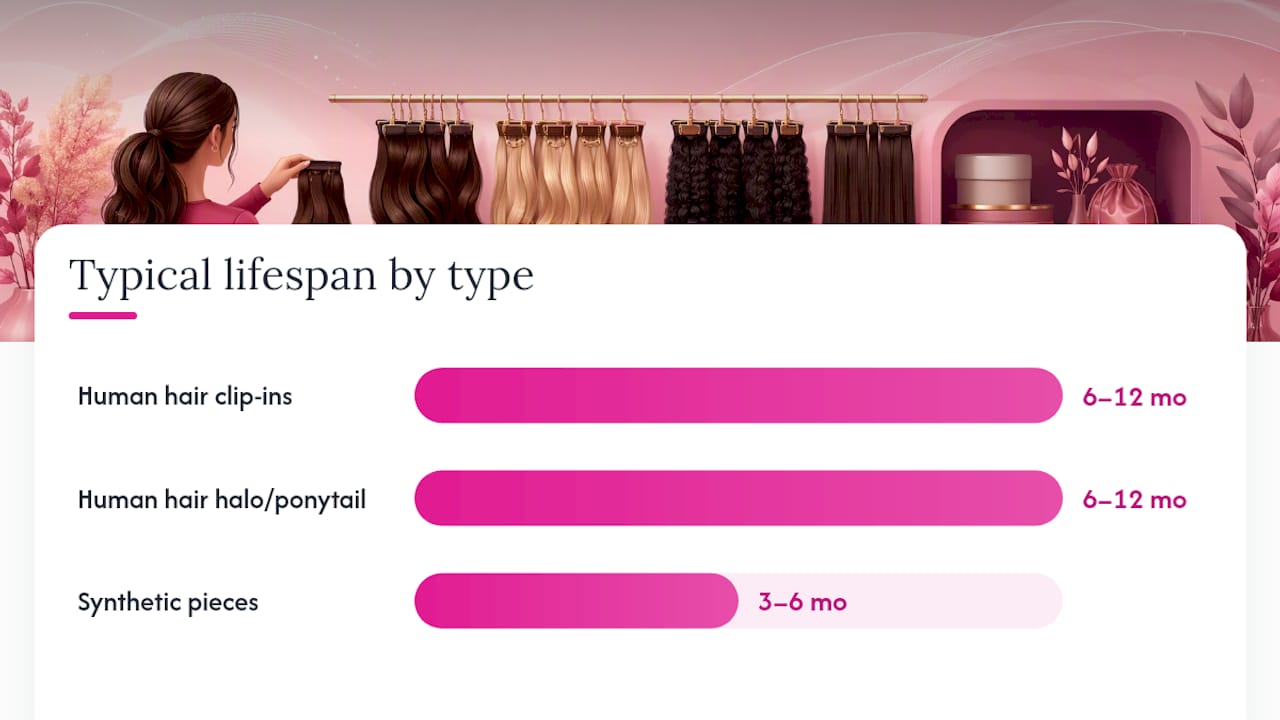
In terms of overall lifespan, human hair wefts commonly last 6 to 12 months with consistent care, while synthetic extensions typically last 3 to 6 months before they lose their shine and start to look plastic-like.
| Extension Type | Typical Wear Window | Approximate Total Lifespan | Pre-Reuse Checks |
|---|---|---|---|
| Human hair clip-ins | 8 to 12 hours per wear | 6 to 12 months | Shedding at clips, smell, cuticle smoothness |
| Human hair halo or ponytail | Full day wear, remove at night | 6 to 12 months | Wrap band integrity, tangling at attachment point |
| Tape-in or pre-bonded | Several weeks between salon visits | Varies with reapplication cycle | Bond strength, residue buildup |
| Synthetic pieces | 8 to 12 hours per wear | 3 to 6 months | Fiber texture, color fading |
A small habit that pays off later: label each set with its install date and last-wash date on a tag inside the storage bag. It takes ten seconds and makes it obvious when a set is approaching the end of its realistic lifespan instead of guessing months later.
What HairLocks Recommends for Storing Its Extensions
HairLocks recommends the same core routine outlined above, tailored specifically to its clip-in sets and the Top~Lock V-Part Topper: clean, dry, detangle, then store flat or hanging in breathable, UV-protected packaging. That advice isn’t guesswork. It comes from founder Michele, who brings 30 years of hands-on hair extension experience to every product HairLocks designs and every care instruction it publishes.
The brand’s Before & After gallery shows exactly what that care routine produces over time: hair that keeps its blend, its softness, and its shine wear after wear rather than looking tired by month three. For the Top~Lock V-Part Topper specifically, lay it flat on a soft surface or a topper stand so the base doesn’t crease, and avoid folding it the way you might fold a standard clip-in weft.
HairLocks’ own care sheet walks through product recommendations in more detail, and it’s worth a read before your first wash cycle if you want to match the exact routine the brand designed its extensions around. The accessories that map best to the storage comparison above, breathable bags, padded hangers, and structured travel cases, are the same categories covered in the application and accessory collection, so you’re not left guessing which product solves which storage problem.
Why Small Daily Habits Beat Occasional Deep Fixes
The single biggest lesson buried in all of this advice is that consistency beats intensity every time. A detangle after every wear and a proper drying step before every storage session do more for a set’s lifespan than an occasional deep-conditioning marathon ever will.
Think of a set of clip-ins that got the two-minute treatment every single time they came out: quick comb-through, hung on a padded hanger, never packed away damp. Six months later that set still blends seamlessly, while an identical set stored carelessly in a drawer starts showing frizz and tangling by month two. The difference wasn’t the hair. It was the ten seconds spent doing the small thing correctly, every time, instead of occasionally doing a big thing well.
If building that habit feels like one more thing to remember, a quick consultation with HairLocks can help you set up a routine that fits how often you actually wear your extensions.
Get the Right Storage Accessories and Care Support
HairLocks makes it simple to store and maintain your extensions correctly, with a published care sheet, a visual gallery of results, and accessories built for exactly this purpose.
If you’re shopping for storage solutions, the application and accessory collection covers the hangers, bags, and travel cases that pair with the methods covered above. Wearers considering their first set, or a replacement for one that’s reached the end of its life, can browse the clip-in extensions built for exactly this kind of long-term reuse, or look at the Top~Lock V-Part Topper if thinning hair is part of what you’re managing day to day.
For a more personal starting point, book a consultation through HairLocks’ main site or browse the Before & After gallery to see what a properly maintained set looks like six months in. Either way, the next step is simple: pick the piece that matches your hair goals, and let the care sheet guide you from there.
Sources
These sources back the storage, cleaning, and lifespan guidance covered above, and they’re worth a closer look if you want more detail on any single step.
FAQ
What is the best way to store hair extensions?
Store them clean, fully dry, and detangled, either hanging on a padded hanger or laid flat in a breathable, UV-protected bag or box, away from heat and direct sunlight.
How do you store hair extensions when you’re not wearing them?
Between wears, keep them on a hanger or in a satin-lined case in a closet, and reserve airtight plastic containers only for short trips, and only when the hair is completely dry.
How do I keep my extensions soft and silky?
Use a sulfate-free shampoo, a silicone-free conditioner or light oil like argan, and detangle gently after every wear; heavy silicone products cause buildup that makes hair feel coated rather than soft.
How long can hair extensions be left in?
Clip-ins should come out after 8 to 12 hours of wear, while tape-ins can stay in for several weeks between salon visits; either way, remove them before sleeping to avoid tangling and strain on your natural hair.
How long do stored extensions actually last?
Human hair wefts, including HairLocks clip-in hair extensions, commonly last 6 to 12 months with proper care, while synthetic pieces typically last 3 to 6 months before they lose their shine.
Recommended
- Hair Extension Lifespan: Your 2026 Australian Guide – HairLocks Hair Extensions
- Extension Friendly Hair Products: Your 2026 Australia Guide – HairLocks Hair Extensions
- Best Shampoo for Extensions: Top Picks in Australia – HairLocks Hair Extensions
- Best Extensions for Fine Hair: Safe Methods That Work – HairLocks Hair Extensions