


How Many Grams of Hair Extensions Do You Need?
For most people, a natural-looking full head of extensions falls somewhere between 100–150g, a full and blended result sits around 150–200g, and a dramatic, high-volume look calls for 200–250g or more. Those are your starting tiers. Your exact number shifts based on your hair’s length, density, and the method your stylist uses, so treat these as a starting point rather than a fixed prescription.
Quick-reference tiers at a glance:
- Subtle/natural boost: 100–130g — adds length or light volume without visible bulk; works well for fine to medium hair
- Full, blended look: 150–200g — the most common full-head range for medium density hair
- Dramatic/high-volume: 200–250g+ — needed for thick hair, very long lengths, or maximum impact
| Result | Gram Range | Best For |
|---|---|---|
| Subtle/natural | 100–130g | Fine to medium hair, short to shoulder length |
| Full, blended | 150–200g | Medium density, shoulder to mid-back |
| Dramatic/voluminous | 200–250g+ | Thick hair, long lengths, maximum volume |
When in doubt, a professional fitting with a stylist is the fastest way to land on the right number. Density, texture, and method all shift the recommendation in ways that a chart alone can’t fully capture.
Key Takeaways
Choosing the right gram weight comes down to three things: your hair’s length, its natural density, and the method you’re using — get all three right and the result looks seamless.
| Point | Details |
|---|---|
| Measure your ponytail first | A ponytail under 2" is fine, 2–3" is medium, over 3" is thick — this maps directly to your gram range. |
| Match grams to length | Longer extensions need more grams; 24"+ lengths typically require 200g or more to avoid thin ends. |
| Method changes the math | Tape-in tabs run 2.5–3g each; micro-ring strands run 0.5–1g each — calculate totals by piece count, not pack labels. |
| Avoid undersized “full head” claims | Any seller claiming a full head at 24" for under 180–200g is likely undersupplying hair. |
| Hairlockshairextensions | Clearly labeled gram weights across the full product range, plus free color and weight matching consultations. |
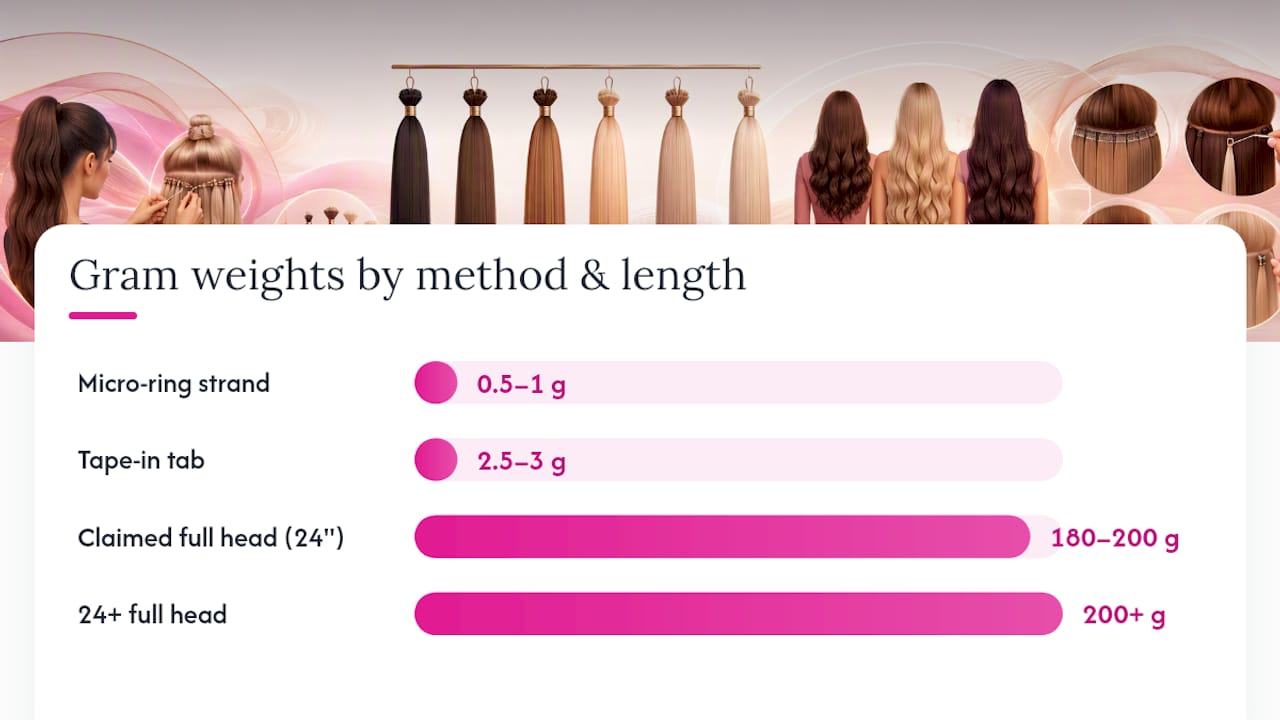
Table of Contents
- How many grams of hair extensions are actually in a set?
- Gram ranges by extension length
- How many grams you need based on your hair’s thickness
- How gram needs change by extension method
- Practical steps to choose the right gram weight
- Why professional fitting matters for getting grams right
- The mistake most people make when choosing grams
- Getting the right grams with HairLocks
- Sources
- FAQ
How many grams of hair extensions are actually in a set?
The gram figure on a product page tells you the total weight of hair in that pack or set. For clip-in extensions, it’s the combined weight of every weft in the box. For tape-ins, sellers typically report grams per pack or per individual tab. Sew-in bundles are usually sold by the bundle, and you add the weight of each bundle to get your total.
Understanding this distinction matters because “full head” claims vary wildly between brands. One seller’s 120g “full head” clip-in set and another’s 200g set are not the same thing, even if both use that label.
How to calculate your total grams:
- Clip-ins: count the wefts in the box, then check the per-weft weight if listed; the box total is your number
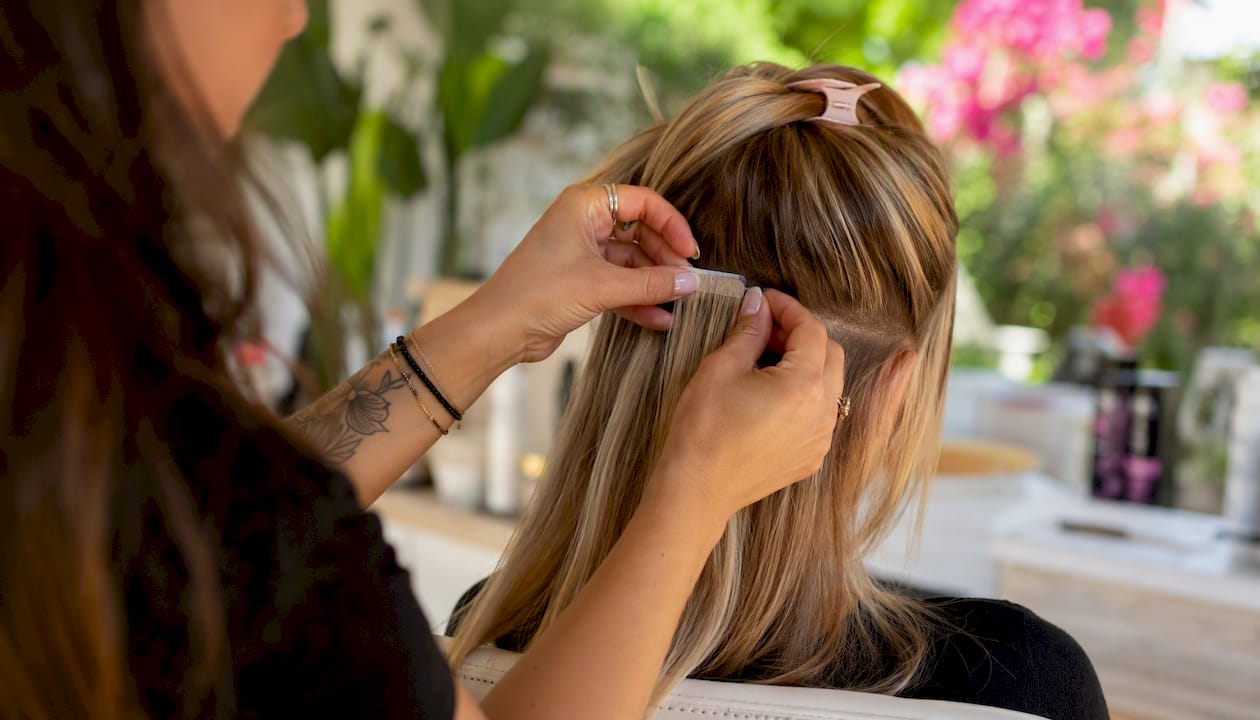
- Tape-ins: each tab weighs roughly 2.5–3g; multiply by the number of tabs to get your total
- Bundles (sew-in/weave): add the gram weight of each bundle; a typical full head uses 2–4 bundles depending on length
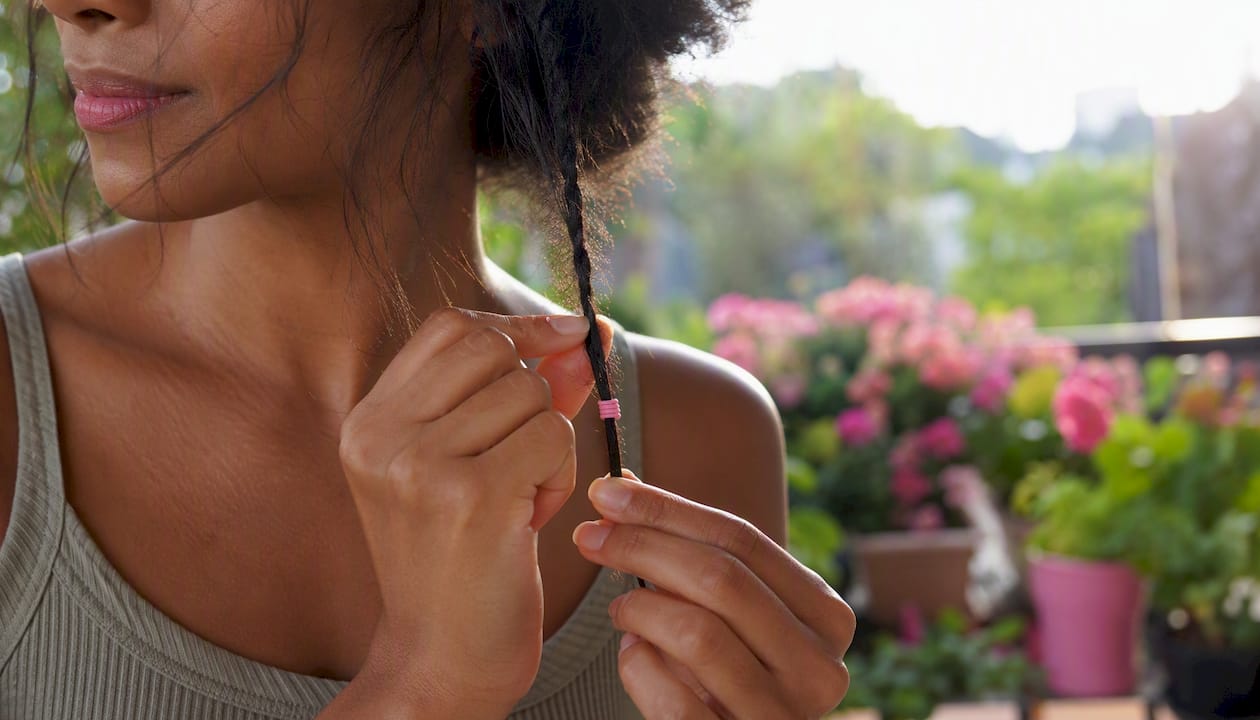
- Micro-ring or keratin bond strands: each strand is usually 0.5–1g; multiply by strand count
Length also changes how a given gram weight looks. The same 150g set at 14" will look noticeably fuller than at 22", because the hair mass is distributed over a longer shaft and the ends carry less density. Curl pattern plays a role too: wavy or curly textures appear denser at lower gram weights than straight hair does, so curly-haired clients sometimes need fewer grams to achieve the same visual fullness.
Pro Tip: Always check the gram weight per pack on the product page, not just the “full head” label. Then calculate your total by multiplying packs by grams per pack. Comparing by length and grams per pack is far more reliable than comparing by marketing claims.
Gram ranges by extension length
Length is the single biggest driver of how many grams you need. Longer hair requires more grams to keep the ends looking full, because the weight is spread across a greater surface area. The table below maps common length brackets to suggested gram ranges and the visual result you can expect.
| Length | Suggested Grams | Typical Visual Result |
|---|---|---|
| Short (12" / 30 cm) | 80–120g | Subtle volume, light length boost |
| Shoulder (14–16" / 40 cm) | 100–150g | Natural blend, moderate volume |
| Mid-back (20" / 50 cm) | 150–200g | Full, blended look with visible length |
| Long (22–24" / 60 cm) | 180–220g | Dramatic length, needs density at ends |
| Waist/very long (24"+ / 60+ cm) | 220–280g+ | Maximum volume; thin ends are a real risk below 200g |
As a practical example: if your natural hair sits at 22" and you have medium density, you’d typically land in the 180–200g range for a full, natural-looking result. Going lighter than 180g at that length often produces thin, wispy ends that are difficult to blend.
A few things to keep in mind as length increases:
- Each additional 2–4" of length typically adds 20–40g to your recommended range
- Very long extensions (24"+) often require substantially more grams than buyers expect; sellers who claim a full head at 24" for under 200g are usually undersupplying
- If you’re adding length AND volume simultaneously, start at the higher end of the range for your bracket
How many grams you need based on your hair’s thickness
Hair density changes the gram equation just as much as length does. Fine hair needs fewer grams to blend, but it also has less natural volume to hide attachment points. Thick hair needs more grams to match its natural density, but it can carry more weight without strain.
How to assess your own density:
- Visual check: Part your hair and look at your scalp. If it’s clearly visible with minimal effort, your hair is fine or low-density. If you have to look carefully to see the scalp, you’re medium. If the scalp is barely visible, you’re thick or high-density.
- Ponytail test: Gather your natural hair into a low ponytail at the nape of your neck. Measure the circumference with a soft tape measure. Under 2" (5 cm) is fine, 2–3" (5–7.5 cm) is medium, and over 3" (7.5+ cm) is thick.
Gram guidance by density:
- Fine hair (ponytail under 2"): Stay in the 80–130g range. Going heavier risks visible weight and stress on fine strands. Prioritize lightweight methods like tape-ins or micro-beads.
- Medium hair (ponytail 2–3"): The 130–180g range covers most looks. You have flexibility to go toward the lower end for a natural result or the higher end for more volume.
- Thick hair (ponytail over 3"): You’ll likely need 180–250g or more to match your natural density. Under-buying here is the most common mistake — thin extensions on thick natural hair look mismatched immediately.
Blending risk is real when the gram weight doesn’t match your density. Extensions that are too light for thick hair sit on top of the natural hair rather than blending into it. Extensions that are too heavy for fine hair can cause breakage at the attachment points over time. Fine to medium hair typically suits 100–130g for a natural boost, while very thick hair and maximum-impact looks often call for 180–220g or more.
How gram needs change by extension method
Every method reports and distributes weight differently. Knowing how your chosen method counts grams helps you buy the right amount and understand why two installs at the same total gram weight can feel completely different.
| Method | How Grams Are Reported | Subtle Look | Full Look |
|---|---|---|---|
| Clip-in | Total grams per set | 80–120g | 150–200g |
| Tape-in | Grams per pack or per tab (~2.5–3g/tab) | 40–60g (16–24 tabs) | 80–120g (20–40 tabs) |
| Sew-in/weave | Grams per bundle | 2–3 bundles | 3–4 bundles |
| Micro-ring | Per strand (0.5–1g each) | 50 strands | 100–150 strands |
| Keratin bond | Per strand (0.5–1g each) | 50 strands | 100–150 strands |
| Ponytail wrap | Total grams per piece | 85g (natural) | 180g (full/dramatic) |
| Topper/V-Part | Total grams per piece | Varies by coverage area | Varies by coverage area |
Method-specific guidance shows that tape-in installations are calculated by tab count rather than a single set weight. At roughly 2.5–3g per tab, a subtle tape-in look might use 20 tabs (50–60g total) while a full head uses 40 or more tabs (100–120g+).
The distribution of attachment points also changes how weight feels. Micro-ring and keratin bond extensions spread weight across 100+ individual attachment points, so even a higher total gram weight feels lighter on the scalp than a single heavy clip-in set. Clip-ins concentrate weight at fewer points, which is why very heavy clip-in sets can feel uncomfortable after a full day.
Pro Tip: When calculating how many packs or bundles to order, always add one extra pack to your estimate. Running short mid-install means a visible gap in density, and dye-lot variations make it hard to match a reorder exactly.
Practical steps to choose the right gram weight
Choosing grams doesn’t have to be guesswork. A short self-assessment before you buy saves you from ordering too light or too heavy.
- Measure your ponytail circumference. Use a soft tape measure at the nape of your neck. This single number tells you whether you’re fine, medium, or thick, and maps directly to the gram ranges above.
- Decide on your target length. Pick the length bracket from the table in the length section and note the suggested gram range for your density tier.
- Choose your result tier. Natural boost, full blend, or dramatic volume? Move to the lower, middle, or upper end of your range accordingly.
- Check the method. Confirm how your chosen method reports grams (per set, per pack, per strand) and calculate your total using the method table above.
- Order a lighter set first if you’re unsure. For clip-ins especially, starting with a 100–120g set and adding a second pack later is easier than returning an oversized order. Clip-in options with clear gram labels make this comparison straightforward.
- Confirm with a stylist before a permanent install. For tape-ins, micro-rings, or keratin bonds, a professional fitting is worth the time — the cost of a bad install far exceeds the cost of a consult.
Red flags to watch for:
- A “full head” claim at 24" length for under 180–200g — this almost always produces thin ends
- No gram weight listed on the product page at all
- Sets that list only the number of wefts or pieces without total grams
- Disproportionately thin ends after install, which usually means you needed 20–40g more than you bought
For longer clip-in lengths, the gram-per-length check is especially important because the visual difference between 150g and 200g at 24" is significant.
Why professional fitting matters for getting grams right
Gram charts give you a strong starting point, but a professional fitting closes the gap between “probably right” and “definitely right.” An experienced stylist can assess your natural density in person, check your scalp health, and match your extension weight to your specific hair structure in a way that a tape measure alone can’t replicate.
What a professional fitting covers that a chart doesn’t:
- Exact density assessment under salon lighting, which reveals fine sections that are easy to miss at home
- Color matching alongside weight matching, so the blend is seamless at the root and the ends
- Method recommendation based on your hair’s condition, not just its thickness
- Scalp health check to confirm the chosen gram weight won’t stress your natural hair over time
Hairlockshairextensions founder Michele brings 30 years of hands-on extension experience to every consultation. That depth of practice means she can identify, for example, that a client with a medium ponytail measurement but fine individual strands needs a lighter gram weight than the chart suggests, and a different attachment method to protect those strands.
HairLocks product examples with gram labels:
- HairLocks Genius Weft — a 22" double-drawn weft with a clearly labeled gram weight, suited for sew-in or beaded weft installs where total grams are built from individual weft pieces
- HairLocks Ponytail Extensions (85g) — the lighter ponytail option for a natural, everyday look
- HairLocks Ponytail Extensions (180g) — the fuller option for a dramatic, high-volume ponytail
- HairLocks Top~Lock V-Part Topper — designed for targeted coverage and volume at the crown, with gram weight matched to the coverage area rather than a full-head install
A free personal color and weight matching service is available through Hairlockshairextensions, and in-salon consultations are bookable for clients who want a full fitting before committing to a method.
The mistake most people make when choosing grams
The most common error we see is buying for the look you want rather than the hair you have. A client with fine hair sees a dramatic 200g result on someone with thick hair and orders the same weight, then wonders why the extensions look heavy and the attachment points are visible. The gram range is only half the answer. The other half is matching that range to your actual density.

The second mistake is trusting “full head” marketing language without checking the gram number behind it. A 120g set is not a full head at 22" for anyone with medium or thick hair. Check the number, not the label.
Pro Tip: When layering multiple weft packs for a sew-in or beaded install, stagger the weft lengths slightly rather than stacking them all at the same point. A staggered layout distributes weight more evenly and avoids a visible “shelf” line at the ends where all the wefts terminate together.
Getting the right grams with HairLocks
Knowing your gram range is the first step. Finding the right product to match it is where Hairlockshairextensions makes the process straightforward.
Every product in the HairLocks range carries a clear gram label, so you’re never guessing what you’re buying. The Genius Weft suits clients building a full sew-in or beaded weft install, with gram weights that let you calculate your total precisely. The 85g ponytail and 180g ponytail options show exactly what the weight difference looks like in a finished style. Micro-bead extensions are available for clients who want a distributed, lightweight install. Browse the before and after gallery to see how different gram weights translate to real results across hair types.
For a personalized recommendation, book a consultation with Michele’s team. They’ll assess your density, confirm your length goal, and match you to the right gram weight and method before you spend a dollar on product.
Sources
- Hair Extension Weight: How To Match It To Your Desired Look?
- How Many Grams of Hair Extensions Do I Need? Ultimate Guide | Yoghair
FAQ
Is 100g of hair extensions enough?
For fine to medium hair at shoulder length (14–16"), 100g can deliver a natural, blended result. At longer lengths or for thicker hair, 100g typically produces thin ends and poor blending — you’d need at least 150g or more.
How many grams of hair extensions is normal for a full head?
A full head for fine to medium hair commonly falls in the 100–150g range, while medium to thick hair usually needs 150–200g or more. Very long or very thick hair can require 220–280g for a genuinely full result.
Is 50g of hair extensions a lot?
No. At 50g, you’re looking at a very light volume boost or a partial fill — not a full head. Tape-in installs at 50g use roughly 16–20 tabs, which covers a targeted area rather than the whole head.
Is 150g of hair extensions a lot?
For fine hair at shoulder length, 150g is on the fuller side and may feel heavy. For medium density hair at mid-back length, 150g sits right in the middle of the recommended full-head range and is a common, practical starting point.
Recommended
- Hair Extension Length Guide: Find Your Perfect Match – HairLocks Hair Extensions
- Extensions for Volume: Best Options for Women – HairLocks Hair Extensions
- Hair Extensions Cost in Australia: 2026 Price Guide – HairLocks Hair Extensions
- Best Extensions for Fine Hair: Safe Methods That Work – HairLocks Hair Extensions