

Stop Hair Extension Headaches in Under an Hour with a Salon Fit
Yes, hair extensions can cause a genuine headache when the attachment points create sustained pulling on your scalp. If the pain is sharp, persistent, or concentrated at a specific spot, loosen or remove those attachments right away. Most cases ease within a short period once traction is relieved; persistent pain or neurological symptoms require medical attention.
TL;DR:
- Heavy wefts, tightly packed rows, or bonded attachments near sensitive areas increase traction headache risk by concentrating tension on the scalp’s nerves and tissues.
- Headaches from extensions typically start during or immediately after installation and improve within an hour of loosening or removing tight bonds.
- Using lighter, well-distributed attachment methods and avoiding tight hairstyles can significantly reduce the likelihood of tension headaches.
- Persistent pain, neurological symptoms, or headache lasting over an hour after removal require immediate medical attention and professional reassessment.
- Honest communication with the stylist about discomfort during installation and regular scalp tension checks during fitting help prevent long-term damage and traction alopecia.
Table of Contents
- What Causes a Hair Extensions Headache
- Is This Headache From My Extensions or Something Else?
- How Long Should the Pain Last, and What Helps Right Now
- Preventing Headaches Before They Start
- Traction Alopecia: The Long-Term Risk Behind the Pain
- What a Salon-Backed Consultation Should Actually Cover
- Which Extension Methods Are Less Likely to Cause Headaches
- Talking to Your Stylist About Pain and Fit
- Hair Extension Headaches: A Practical, Not Fearful, Take
- A Safer Fit Starts With the Right Consultation
- Sources
- FAQ
What Causes a Hair Extensions Headache
The scientific term for what you are feeling is external-traction headache, a recognized diagnosis under the ICHD-3 criteria. The mechanism is straightforward: your scalp is covered in a dense network of pericranial muscles, connective tissue, and sensory nerves. When extensions pull on the hair shaft at the root, that force transmits directly into those tissues. Enough sustained tension, and the nerves respond the way any overworked muscle would: with pain.
Not every installation carries equal risk. Certain choices raise it substantially:
- Heavy wefts sewn or bonded too close together, which concentrates weight instead of spreading it
- Too many rows placed in a small section of scalp, creating dense pull points rather than distributed tension
- Bonds fastened too tightly at the root, especially on fine or fragile hair
- Attachment zones clustered near the temples or nape, where the scalp is thinner and more sensitive
Headaches are not always purely mechanical, either. Adhesive-based methods can trigger localized irritation or inflammation that mimics tension pain. Sleeping on one side with pressure directly on bonded areas can aggravate it further, and anyone with existing migraine sensitivity may find extensions act as a trigger rather than a cause. If you notice any of this, tell your stylist specifically: ask for fewer rows per section, lighter grams per weft, and attachment points staggered rather than stacked.
Is This Headache From My Extensions or Something Else?
The clearest signal is timing and location. A traction headache from extensions typically starts during or shortly after the appointment, feels strongest right at the attachment site, and eases noticeably once the hair is let down. That pattern lines up with the ICHD-3 diagnostic criteria for external-traction headache, which describes pain that peaks during sustained pulling and resolves once the traction stops.
Compare that to how a migraine or tension headache usually behaves. Migraines tend to throb and often come with light sensitivity or nausea. Tension headaches feel like diffuse pressure, often across the whole forehead or the back of the head, not isolated to one row of bonds.
Here is a quick way to sort it out:
- Note when the pain started. Right after application, during a ponytail, or after sleeping on it? That points toward traction.
- Press gently at the point where extensions attach. If that spot is tender and matches where the headache feels worse, traction is the likely cause.
- Loosen or release the hair and wait fifteen to twenty minutes. Real improvement is a strong indicator that tension was the trigger.
- Watch for red flags: pain lasting more than an hour after removal, vision changes, numbness, or fever. Those need a clinician, not a hairbrush.
How Long Should the Pain Last, and What Helps Right Now
A narrative review on external-compression and external-traction headaches describes them as usually mild-to-moderate, typically resolving in under an hour once the pulling stops. If your pain outlasts that window or keeps building instead of fading, it is worth getting checked rather than waiting it out.
In the meantime, a few steps usually help:
- Ask your stylist to loosen or remove the tightest rows first
- Rest with your head in a neutral position, avoiding any ponytail or bun that adds pull
- Try a cool compress on the scalp and a gentle massage around, not directly on, the bonds
- An over-the-counter pain reliever is reasonable if you have no reason to avoid one
Pro Tip: Bring a simple checklist to your appointment: which rows feel tightest, where the pain sits, and how it changes when your stylist tests loosening one section at a time. That gives them exact information instead of a vague complaint.
If pain is severe at the time of application, do not wait for the appointment to end. Remove the affected section immediately and book a follow-up rather than tolerating it through a multi-hour installation.
Preventing Headaches Before They Start
Prevention comes down to weight, distribution, and honest communication with whoever is doing your hair. The American Academy of Dermatology recommends professional fitting and loosening any style that causes pain during installation, rather than assuming discomfort will pass.
A few habits make a measurable difference:
- Choose a total weight and attachment method suited to your hair’s actual density. Fine or fragile hair generally does better with fewer, lighter sections, which is why guides on safe methods for fine hair matter more than they might seem to at first glance.
- Ask your stylist to check scalp tension at the fitting, not just at the end of the appointment, and schedule a recheck every four to eight weeks.
- Avoid tight ponytails or buns that sit directly over bonded areas.
- Brush gently, starting at the ends and working up, and use products designed not to build up around attachment points.
- Sleep with hair loosely braided or in a low, soft style rather than pulled up tight.
If your scalp is sensitive or you have a history of headaches, a permanent method may not be the right starting point. Temporary options such as clip-ins or a topper let you test volume and length without sustained tension. Understanding the differences in weft installation pros and cons helps clarify which method fits your scalp before you commit to something semi-permanent.
Traction Alopecia: The Long-Term Risk Behind the Pain
Repeated tension does more than trigger a headache. Over time, it can damage the hair follicle itself, a condition called traction alopecia. The pulling gradually weakens the follicle’s attachment, and depending on how long the damage has gone on, it can become permanent.
Watch for these signs, which dermatology guidance flags as early warning signs of traction alopecia:
- Persistent scalp pain or tenderness beyond the appointment
- Broken hairs or thinning concentrated at the hairline or attachment rows
- Redness, swelling, or small bumps around bonds
- Itching or burning that does not resolve with basic aftercare
If you notice any of these, stop wearing tight styles immediately and talk to your stylist about lower-tension alternatives. If symptoms persist past a few weeks, a dermatologist referral is the right next step. The AAD’s guidance on preventing extension-related hair damage is built around exactly this: professional fitting up front, and loosening anything that hurts.
What a Salon-Backed Consultation Should Actually Cover
HairLocks approaches every fitting with founder Michele’s three decades of hands-on experience, which means the consultation is built to catch tension problems before they start rather than fix them after the fact. A proper consultation should walk through scalp assessment, density mapping, and a discussion of which method and weight actually suit your hair, not just what looks fullest in a photo.
Here is what that process typically includes:
- A scalp and hair density check before any method is chosen
- An honest conversation about pain tolerance and what “too tight” should feel like
- A recommended weight and attachment plan matched to your actual scalp, not a one-size approach
- Scheduled follow-ups to test tension as your natural hair grows out
| What to expect | Why it matters |
|---|---|
| Scalp and density assessment | Confirms which method your hair can support without excess pull |
| Pain tolerance discussion | Sets a clear baseline so “too tight” gets fixed immediately |
| Follow-up scheduling | Catches loosening or shifting bonds before they cause damage |
For readers dealing with related discomfort, step-by-step fixes for an itchy scalp with extensions and guidance on allergic reactions to extension adhesives cover related aftercare issues in more detail.
Which Extension Methods Are Less Likely to Cause Headaches
Not all methods place equal stress on the scalp. Weft-based systems that sew or bond in flatter, more distributed sections tend to spread weight over a wider area, rather than concentrating it at a handful of bonds. That distribution matters more than most people realize when they are choosing between options.
Nano and micro bead methods, done correctly, can also reduce concentrated pulling because each attachment point carries a smaller portion of the total weight. The key variable is not the method’s name but how it is executed: too many bonds packed into one section undoes the advantage of any technique.
For anyone with a history of tension headaches or a sensitive scalp, a topper is worth serious consideration over a full permanent installation. A well-fitted topper adds coverage and volume through a base that rests across the crown rather than pulling at individual root points, which sidesteps the traction mechanism almost entirely. It is a particularly practical option for thinning hair where the goal is discreet volume, not length.
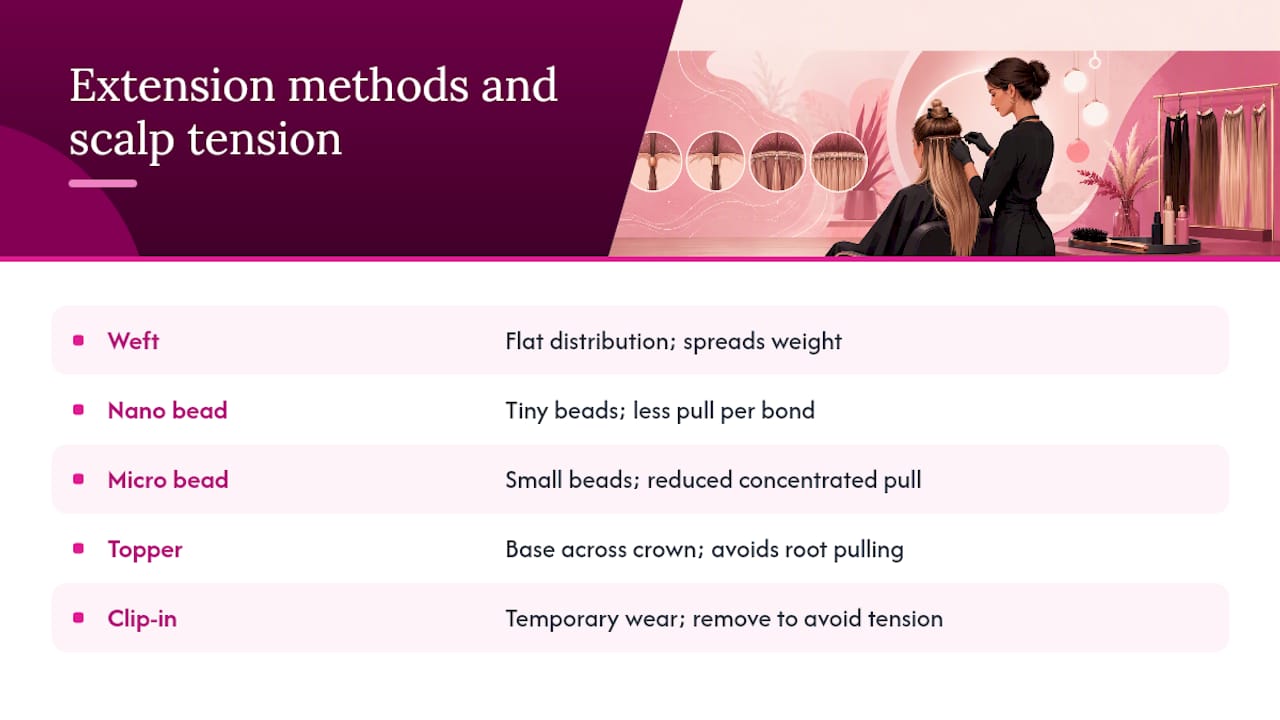
Clip-in styles offer a similar advantage for anyone easing into extensions for the first time. Because you control exactly when tension is applied and removed, they let you gauge your scalp’s sensitivity before committing to something worn continuously for weeks. If headaches have been a recurring problem with permanent methods, testing a lighter or temporary option first is a reasonable and low-risk way to find out what your scalp can actually tolerate.
Talking to Your Stylist About Pain and Fit
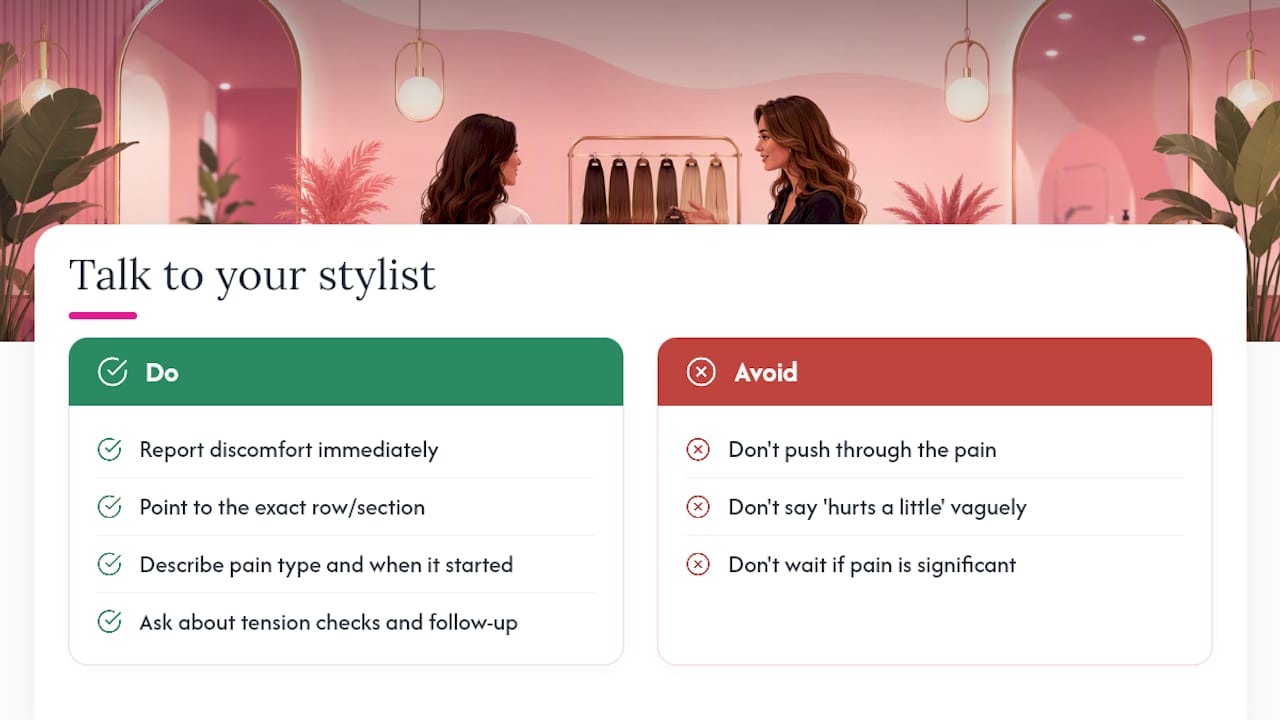
Discomfort during or after an installation is information, not something to push through politely. A good stylist wants to know the moment something feels wrong, not after you have lived with a headache for three days.
Be specific rather than general. Instead of saying it “hurts a little,” point to the exact row or section. Say whether the pain is sharp and localized or a dull ache across a wider area, and mention whether it started during application, after you tied your hair up, or overnight. That level of detail lets your stylist test one section at a time instead of guessing.
It also helps to set expectations before the appointment even starts. Ask how they handle tension checks, whether they adjust attachments in the chair if something feels too tight, and what their process is for follow-up if pain develops after you leave. A stylist who has done this for years, the way Michele has over three decades of practice, should welcome those questions rather than treat them as a complaint.
If you are already wearing extensions and something feels off, do not wait for your next scheduled appointment if the pain is significant. Call and describe the symptom clearly: where it is, how long it has lasted, and whether loosening the hair at home changed anything. That information helps your stylist decide whether you need an urgent adjustment or whether it can wait a few days.
Hair Extension Headaches: A Practical, Not Fearful, Take
The instinct with any headache tied to a beauty treatment is to either dismiss it as normal or panic and assume permanent damage. Neither reaction fits what the evidence actually shows. External-traction headache is a recognized, well-defined condition with a predictable pattern: it starts with pulling, it peaks at the attachment site, and it resolves once tension is gone. That is a mechanical problem with a mechanical fix, not a mystery.
Where conventional advice falls short is the “give it a few days” messaging that circulates informally. Persistent pain past that short window is not something to wait out. It is a signal to reassess the fit, not a normal adjustment period.
Prioritize this above everything else: if a headache starts during your appointment, say so immediately. A stylist cannot fix tension they do not know exists. Pair honest, real-time communication with a properly weighted, well-distributed installation, and headaches stop being a mystery you have to solve after the fact.
— HairLocks
A Safer Fit Starts With the Right Consultation
If tight, heavy, or poorly distributed extensions have left you dealing with headaches, the fix is not to give up on length and volume. It is choosing an installation built around your scalp instead of a one-size template. Hairlockshairextensions approaches every fitting through a personalized consultation first, matching method and weight to what your hair can actually support rather than what looks fullest on paper.
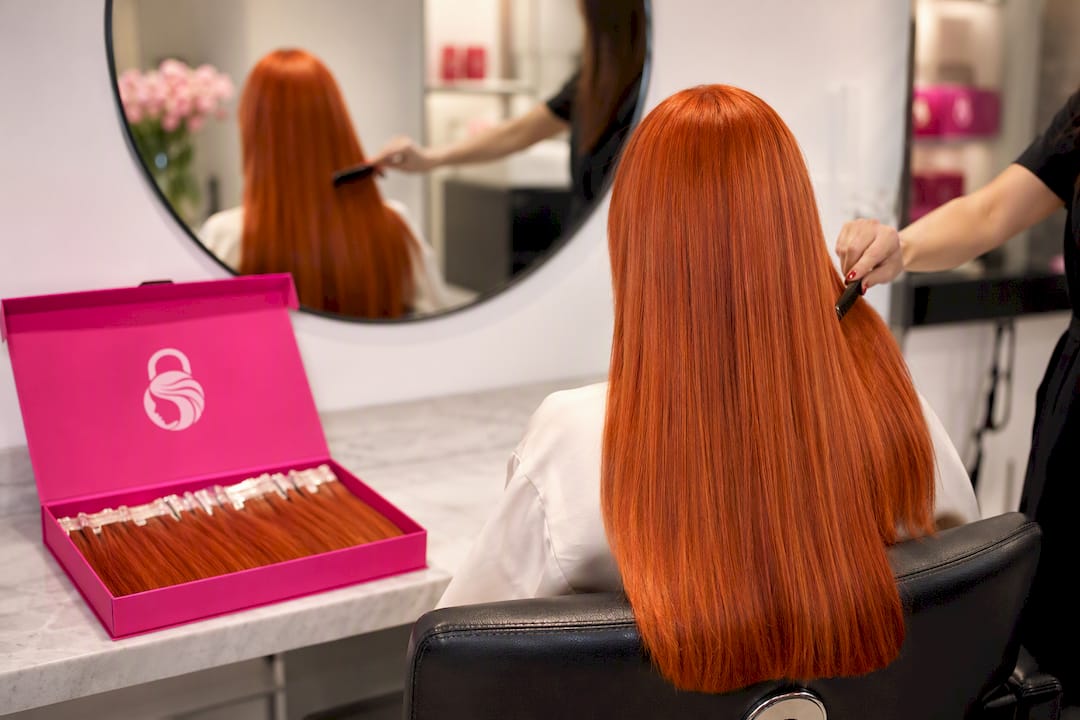
The Signature Full Head, built with 22 inch, 100 gram, Premium European Grade 7A hair, is designed for readers who want a fuller, more even result without concentrating weight into a few overloaded bonds. If a permanent method still feels like too much tension for your scalp, the Top-Lock V Part Topper offers volume and coverage without individual attachment points pulling at the root. During a consultation, expect a scalp check, a tension plan built around your comfort, and scheduled follow-ups to catch any tightness before it becomes a headache. Check the full pricing and package list and book a consultation to get fitted properly the first time.
This article is general information, not a substitute for advice from a qualified doctor. Consult a qualified healthcare professional about your own circumstances before acting on anything here.
Sources
- 4.6.2 External-traction headache - ICHD-3
- Primary Headache Attributed to External Compression or Traction to the Head: A Narrative Review (PMC)
- How to prevent hair damage from a weave or extensions — AAD
FAQ
What Are the Side Effects of Hair Extensions?
Beyond traction headaches, common side effects include scalp tenderness, itching, and in some cases traction alopecia if tight styles continue long term, according to AAD guidance. Adhesive-based methods can also cause localized irritation for people with sensitive skin.
What Are the Red Flag Warning Signs for Headaches?
Pain that lasts more than an hour after loosening the extensions, or that comes with vision changes, numbness, or fever, needs medical review rather than home remedies. These features fall outside the expected pattern of external-traction headache and point toward a different cause.
How Long Does Your Head Hurt After Getting Extensions?
Most traction-related pain eases within about an hour once the attachments are loosened or removed, based on the ICHD-3 criteria for this headache type. If discomfort continues well past that window, it is worth having your stylist reassess the fit.
How Do I Know If My Hair Is Causing Headaches?
Check whether the pain started during or after installation, sits right at an attachment point, and improves when you let the hair down or loosen a section. That pattern is the clearest sign of traction rather than an unrelated headache. Booking a personalized consultation with a stylist who checks tension properly is the most reliable way to confirm it.