


Enzymatic Repair for Keratin Bond Damage on Bonded Extensions
Keratin bond extensions don’t automatically damage hair, but poor application, overloaded sections, or careless removal can cause real breakage, thinning, and shedding at the bond site. If you’re already seeing brittleness, scalp tenderness, or patchy loss near your bonds, stop trying to remove them yourself and book a trained stylist right away. Lab-backed repair treatments can rebuild strength, but stylist skill and a correct removal protocol matter more than any product you apply afterward.
TL;DR:
- Proper application with small bonds, even sectioning, and controlled iron temperature reduce the risk of hair damage from keratin extensions.
- Damage primarily results from cuticle disruption, broken disulfide bonds, and tension caused by heavy or improperly placed bonds.
- Fine, porous, or chemically treated hair is more vulnerable to damage, especially if bonds are overdue for removal or placed too close to the scalp.
- Removal must involve thorough solvent soaking and gentle extraction to prevent cuticle tears and long-term hair harm.
- Enzymatic repair treatments can help rebuild hair strength over multiple sessions, but damage from poor installation or delayed removal is often irreversible.
Table of Contents
- What Keratin Bond Extensions Are and How They Attach
- How Keratin Bonds Can Damage Hair: The Real Mechanisms
- Who’s Most at Risk and What Early Damage Looks Like
- How to Prevent Bond Damage Before It Starts
- Safe Removal and Repair: What Actually Works
- HairLocks’ Approach to Safer Bond Application and Repair
- The Truth About Keratin Bonds That Most Guides Skip
- Why HairLocks Is the Safer Path to Bonded Extensions
- Sources
- FAQ
What Keratin Bond Extensions Are and How They Attach
Keratin bond extensions, sometimes called fusion or single-strand extensions, attach when a stylist melts a small keratin protein tip using a heated tool, then presses it against a section of your natural hair to fuse the two together as it cools. The bond hardens into a small, seed-sized attachment point that holds the extension strand in place for months, unlike tape-ins or clip-ins that come out daily or every few weeks.
The mechanics of that fusion determine almost everything about your risk. A stylist working with small, evenly distributed sections and a properly calibrated iron creates a bond that sits comfortably on the hair shaft without pulling excess weight onto any single strand. A stylist rushing through oversized sections, or running an iron too hot, creates bonds that are heavier, harder, and more likely to strain the hair anchoring them.
Bond behavior also shifts depending on moisture. Keratin swells slightly when wet and contracts as it dries, and that expansion and contraction cycle repeats every time you shower or the bond gets caught in humid air. For straight, coarser hair, this cycle is usually a non-event. For fine, curly, or already porous hair, repeated swelling and shrinking adds mechanical fatigue right at the point where the bond grips the strand.
A few installation factors decide how much stress your hair actually absorbs:
- Bond size: smaller, rice-grain-sized bonds distribute weight better than large, thumbnail-sized ones.
- Sectioning: thin, precise sections reduce the number of natural strands bearing the bond’s weight.
- Iron temperature: tools calibrated below the point that scorches keratin protein reduce cuticle stress during application.
- Placement distance from the scalp: bonds set too close to the root leave little room for natural growth before tension builds.
If you want a closer look at which bond styles and sizes tend to suit different hair types, Hairlockshairextensions’ guide to keratin bond extensions breaks down the options in more detail.
How Keratin Bonds Can Damage Hair: The Real Mechanisms
Damage from keratin bonds isn’t random. It traces back to a handful of measurable, well-documented mechanisms, and understanding them separates useful precautions from salon myths.
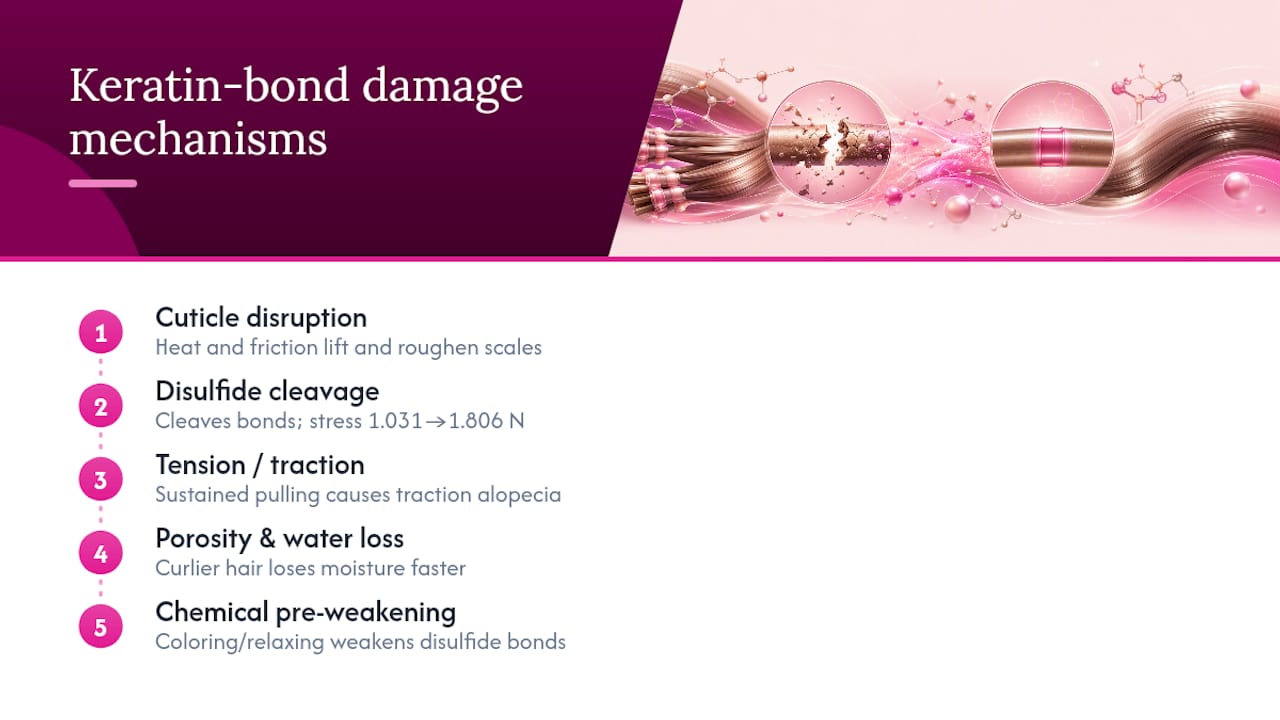
Cuticle disruption is the first domino. The cuticle is the shingle-like outer layer that protects the hair’s inner cortex. Heat from the bonding iron, plus the friction of bonds rubbing against each other or against a pillow at night, can lift and roughen those cuticle scales. Once cuticle scales lift, hair loses its smooth, protective surface and becomes more porous, which sets up the next problem: water loss. Reviews of hair structure link thermal, chemical, and mechanical stress directly to this kind of surface breakdown, and each stressor compounds the others rather than acting alone, according to a structural review of hair damage mechanisms.
Disulfide bonds hold the real structural strength, and they’re the second mechanism worth understanding. These are the sulfur-sulfur crosslinks inside the hair’s cortex that give a strand its tensile strength and elasticity. Heat, chemical exposure, and mechanical stress can cleave these bonds, and once they’re broken, hair loses measurable strength. Lab testing on damaged hair samples found that solutions built to reverse this kind of harm made a real difference: hydrolyzed wool keratin combined with serine and transglutaminase reduced alkali solubility by roughly 50.53% and pushed fracture stress from 1.031 N to 1.806 N, according to a 2023 keratin repair study in Polymers.
By the numbers: In that same lab trial, fracture strain, essentially how far damaged hair could stretch before snapping, approximately doubled after treatment. That’s more than double the flexibility recovered in samples that had lost significant structural integrity.
Tension and traction come third, and they’re the mechanism most people actually notice first. A bond that’s too heavy, placed too close to the scalp, or crowded with too many neighboring bonds pulls on the follicle every time you brush, sleep, or tie your hair back. Sustained pulling force is the textbook cause of traction alopecia, a form of hair loss that starts as thinning at the hairline or part and can become permanent if the follicle is damaged long enough.
Porosity and water loss deserve their own mention, especially for curly and wavy hair types. Curlier hair already has a more open cuticle structure and loses moisture faster than straight hair. Add heat-set bonds and repeated wet-to-dry cycles, and you get a hair type that’s structurally more vulnerable to the same bond stress a straight-haired client might tolerate without issue.
Finally, bonds rarely act in isolation. Chemical services like coloring or relaxing weaken disulfide bonds before extensions ever touch the hair, and repeated heat styling on top of bonded extensions stacks additional stress onto strands that already have less structural reserve to spare. This is why the same bond size and placement can be perfectly safe on virgin, unprocessed hair and genuinely risky on hair that’s been colored, lightened, or heat-styled for years.
Who’s Most at Risk and What Early Damage Looks Like
Not everyone faces the same odds with keratin bonds, and the difference usually comes down to a combination of hair condition and how the service was performed.
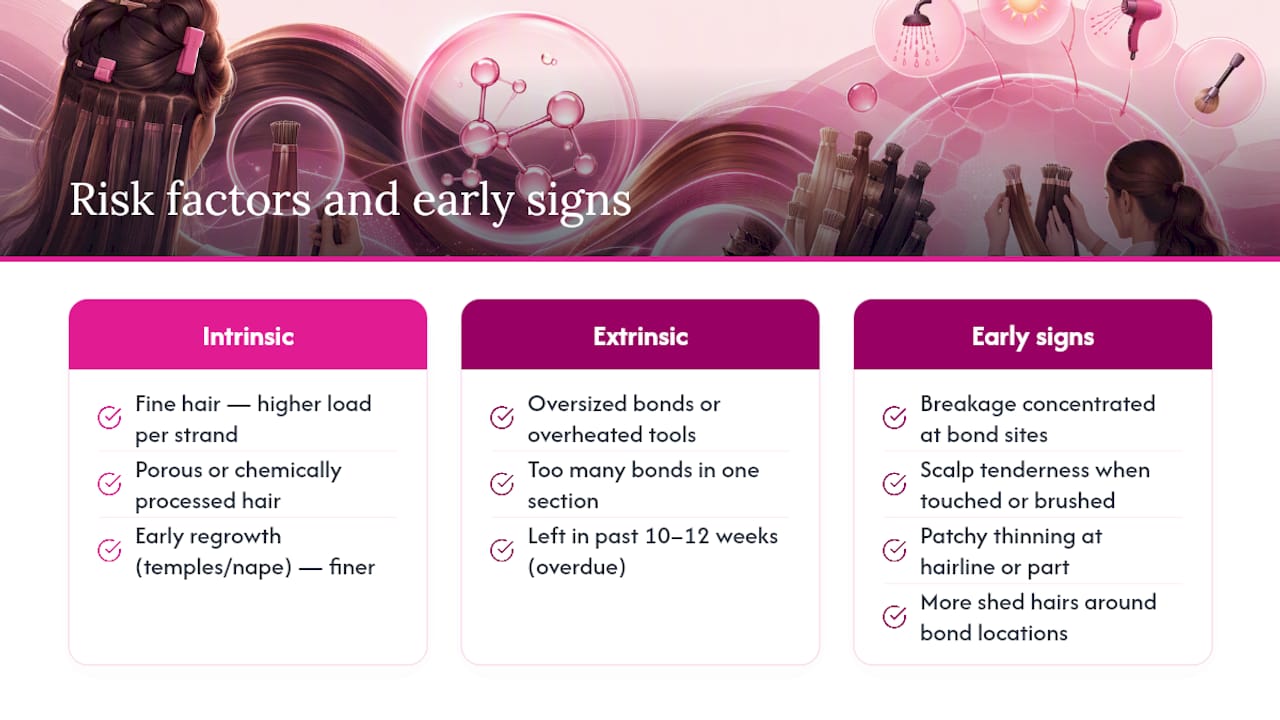
1. Intrinsic risk factors sit with your hair itself. Fine hair has fewer strands to distribute bond weight across, so each strand carries more load. Already-porous or chemically processed hair has less structural reserve. Hair in its early regrowth phase, especially near the temples and nape, is naturally finer and more fragile than mature strands elsewhere on the scalp.
2. Extrinsic risk factors sit with the service itself. An inexperienced stylist using oversized bonds or overheated tools introduces avoidable stress. Too many bonds crammed into one section multiplies tension. Leaving extensions in well past the point where natural regrowth has pushed the bond down the shaft, often past the 10 to 12 week mark, adds weight and leverage the follicle wasn’t built to handle.
3. Watch for specific, localized signs, not vague worry. Breakage concentrated right at bond sites, rather than scattered through your ends, points to mechanical stress from the extension itself. Scalp tenderness or pain when bonds are touched or brushed is an early warning, not something to push through. Patchy thinning near the hairline or part, and noticeably more shed hairs collecting around bond locations specifically, both suggest the follicle is under more strain than it can sustain.
4. Timeline matters as much as symptoms. Most damage from poor installation or overdue maintenance shows up gradually, over four to eight weeks, rather than overnight. If you notice tenderness or visible thinning within the first month of wear, treat that as a signal to get bonds checked or removed, not a wait-and-see situation. Waiting past three months with visible symptoms raises the risk that follicle damage becomes harder to reverse.
How to Prevent Bond Damage Before It Starts
Prevention starts before you ever sit in the chair, not after you notice a problem.
Before your appointment, get honest with yourself about your hair’s current condition. Freshly bleached, relaxed, or heavily colored hair is a poor candidate for bonded extensions until it’s had time to rebuild strength. Booking bonds immediately after a chemical service stacks two stresses on hair that hasn’t recovered from the first one.
Ask your stylist specific, technical questions, not just “will this damage my hair.” Useful ones include:
- What bond size do you use, and can you show me a sample?
- What temperature does your bonding iron run at, and is it adjustable for fine hair?
- How many bonds do you typically place per section, and how do you decide?
- What’s your removal protocol, and do you use a proper solvent soak?
- How often should I come in for maintenance checks?
A stylist who answers these clearly and specifically, rather than deflecting, is generally the safer bet.
In-salon standards worth expecting: bonds sized small enough to sit comfortably on a few dozen strands rather than a thick chunk of hair, placement at least a quarter inch from the scalp to leave room for natural growth, and an iron temperature that fuses keratin without scorching it. Weight should be spread evenly across the head rather than concentrated at the crown or nape, where tension is easiest to miss.
At home, aftercare is mostly about friction and moisture control. Brush gently starting at the ends and working up, always using a loop brush designed for extensions. Dry attachment sites fully before bed, since damp bonds sitting against a pillow all night invite both mildew and unnecessary swelling and softening. Skip heavy oils directly on bonds, since oil can loosen the keratin bond prematurely, and stick to sulfate-free cleansers that won’t strip or destabilize the bond material. A lightweight smoothing serum applied through the mid-lengths and ends, avoiding the bonds themselves, helps manage frizz and dryness without compromising bond integrity. Braiding hair loosely before sleep reduces overnight friction significantly.
Pro Tip: If you have an event coming up and your bonds are due for a maintenance check, don’t rush a fresh install just to make the date. A set of clip-in extensions gives you the length and volume for one night without adding load to hair that needs a break.
Most stylists recommend a maintenance check every six to eight weeks, when regrowth has shifted the bond enough to warrant repositioning. If you notice tenderness, visible gaps, or bonds that feel unusually tight before that window, don’t wait for the scheduled appointment. Earlier removal is always safer than a delayed one.
Safe Removal and Repair: What Actually Works
Most permanent keratin-bond damage doesn’t come from the installation. It comes from a rushed or incomplete removal, according to practitioner guidance on safe extension removal. A properly softened bond releases cleanly. A partially softened one, yanked or cracked apart before the solvent has fully done its job, tears at the cuticle layers still attached to your natural strand.
The correct removal protocol follows a specific order:
- Saturate the bond thoroughly with a keratin-specific solvent and let it sit long enough to fully soften, not just surface-wet.
- Gently mechanically crack the softened bond using fingers or a specialized tool, without applying pulling tension.
- Reapply solvent to any remaining residue and repeat softening rather than forcing a stubborn bond loose.
- Extract the loosened bond with minimal tension, checking that the strand slides free rather than resists.
Skipping the soak, using too little solvent, or trying to speed through a stubborn bond are the most common errors, and they’re the ones most likely to strip cuticle layers that were already weakened by months of wear.
Once bonds are out, repair chemistry has genuinely improved in recent years. Older bond-building treatments, similar in concept to the bis-aminopropyl diglycol dimaleate chemistry used in professional restoration treatments, work by temporarily reforming broken disulfide bonds during the treatment process. Newer research has pushed further into enzymatic repair. Thiol-reactive crosslinking agents form new disulfide bridges directly with cysteine residues in damaged keratin, and lab testing confirmed measurable adduct formation alongside real gains in tensile strength, according to research on thiol cross-linking compounds.
Enzymatic keratin, serine, and TGase repair formulas showed durable results in lab testing, maintaining improved strength and moisture retention even after five separate wash cycles, per research published in Polymers.
Realistic expectations matter here. These treatments rebuild measurable strength and elasticity, but they work incrementally. Most salon-based repair protocols call for multiple sessions spaced over weeks or months, not a single fix. Hair that’s lost significant structural integrity needs sustained treatment, plus a break from further bonded extension wear, to see its strength and elasticity genuinely recover.
If you’re dealing with persistent scalp pain, visible bald patches, or thinning that doesn’t improve once bonds are removed and hair is given time to rest, that’s a signal to see a dermatologist or trichologist. Traction alopecia caught early is often reversible; caught late, after the follicle has scarred, it usually isn’t.
HairLocks’ Approach to Safer Bond Application and Repair
Michele, HairLocks’ founder, has spent 30 years fitting and maintaining hair extensions, and that experience shapes how the salon approaches bonded installs: smaller sections, calibrated iron temperatures, and a removal process built around patience rather than speed. If you’re weighing whether bonds are right for your hair, or you’re already dealing with damage, the safe bond removal steps HairLocks recommends walk through the same solvent-first protocol described above, adapted for at-home reference between salon visits.
For daily maintenance, HairLocks’ Frizz-Control serum 50ml is designed to smooth strands and manage dryness along the mid-lengths and ends without destabilizing bonds when applied correctly, away from the attachment points themselves. For anyone who wants length or volume without committing to a semi-permanent bonded install, particularly hair that’s mid-recovery, the Clip In Extensions | Hair Piece | 18" Length | 185 grams | Pearl & Oak offers a no-commitment alternative that comes out at the end of the day. Both are products HairLocks sells directly, offered here as practical options rather than a substitute for a professional consultation.
The Truth About Keratin Bonds That Most Guides Skip
The conventional wisdom on keratin bonds splits into two unhelpful camps: one insists they’re inherently damaging, the other insists they’re completely safe as long as you “go to a good stylist.” Neither holds up against the actual evidence. Bonds themselves are chemically mild compared to older adhesive methods, and the biology of damage traces almost entirely to specific, correctable variables: bond size, iron temperature, section count, and above all, removal technique.
What gets underestimated is how much removal matters relative to installation. Most people fixate on choosing the right salon for the initial fitting, then attempt DIY removal months later with drugstore oil and a fine-tooth comb. That mismatch, careful installation followed by careless removal, is where most avoidable damage actually happens.
If you’re evaluating whether bonds are right for you, prioritize the stylist’s removal protocol as heavily as their application technique. A stylist who can’t clearly describe how they take bonds out safely isn’t someone who should be putting them in.
— HairLocks
Why HairLocks Is the Safer Path to Bonded Extensions
Choosing where to get bonded extensions installed matters more than almost any other decision in this process, and Every install should involve appropriate section sizing, iron calibration, and removal planning that research shows helps prevent damage. Where a rushed salon visit or a DIY kit leaves you guessing about bond size or removal solvent, consultations should be built around individual hair condition with experienced guidance informing recommendations.
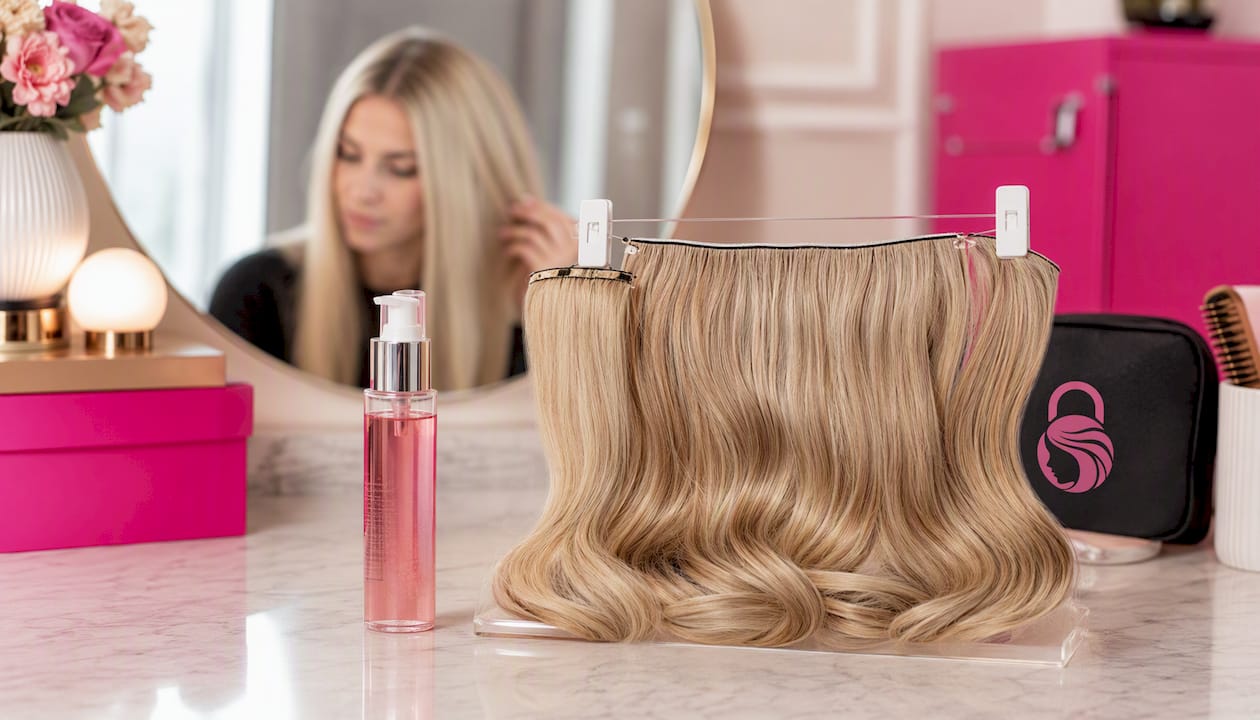
If your hair is fine, porous, or recovering from color treatments, a consultation should include an honest conversation about whether bonds are the right call at all, or whether a topper or clip-in set serves you better right now. For readers whose hair needs a break from bonded wear but still want extra length or volume for special occasions, the Clip In Extensions | Hair Piece | 18" Length | 185 grams | Pearl & Oak is available with no commitment and no attachment stress. Booking a personalized consultation can help provide a clear answer on what your hair can safely handle before your next appointment.
Sources
- (2023) Polymers — keratin-serine + TGase repair study
- Novel compounds for hair repair: thiol cross-linking agents (PMC)
- NCBI review on hair structure and damage mechanisms (PMC6691938)
- Enzymatic crosslinking improves keratin repair (MDPI Polymers, 2023)
FAQ
Do keratin bonds ruin hair?
Keratin bonds don’t ruin hair on their own. Damage occurs when bonds are oversized, placed too close to the scalp, left in too long, or removed without a proper solvent soak.
How do I fix hair damage from keratin bond extensions?
Remove bonds using a full solvent soak and gentle mechanical release, then follow up with enzymatic keratin repair treatments, which lab testing shows can restore measurable tensile strength over multiple sessions.
What breaks keratin bonds down prematurely?
Excess heat, direct oil application on bond sites, humidity-driven expansion and contraction cycles, and friction from sleeping without protection all weaken bonds faster than normal wear.
What are the downsides of keratin bond extensions?
The main downsides are the risk of traction on fine or fragile hair, the need for skilled application and removal, and a maintenance schedule around six to eight weeks that some wearers find more demanding than tape-ins or clip-ins.